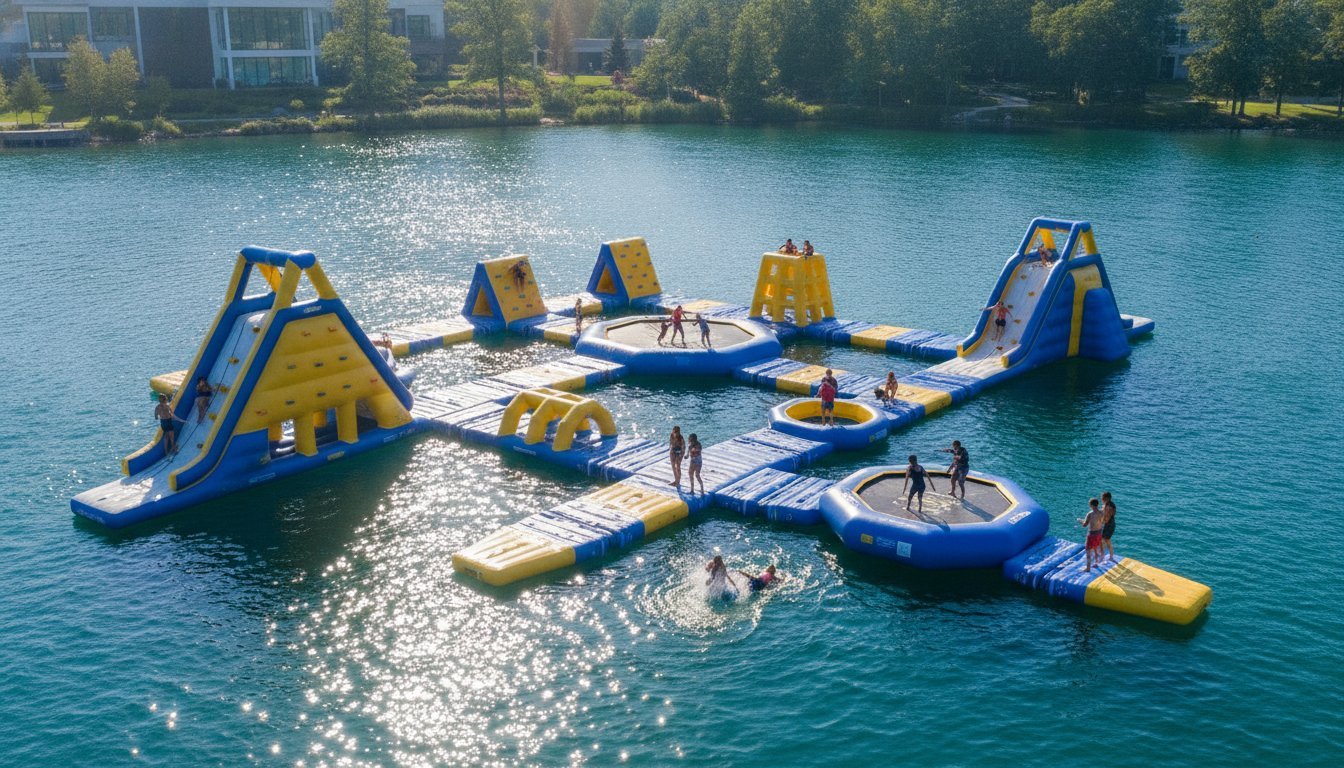
A $500 backyard toy and a $50,000 waterfront installation might look similar in a grainy catalogue photo, but that’s where the comparison ends. If you’re trying to build a business on a foundation of residential-grade PVC, you’re not investing; you’re gambling with your guests’ safety and your bottom line. Understanding the massive gap in a commercial vs residential inflatable water park is the difference between a thriving destination and a liability nightmare. You need a high-performance engine that generates revenue, not a puncture-prone headache that drains your maintenance budget before the first long weekend in July.
You want a waterfront that pays for itself quickly without the constant fear of equipment failure or insurance red flags. You realize that “cheap” usually means expensive downtime and a damaged reputation. This article breaks down the critical material science and professional training protocols that ensure your 2026 season is defined by growth rather than repairs. We’ll explore why 0.55mm PVC tarpaulin is the industry standard and how on-site technician training protects your investment from the 35% of lawsuits caused by improper anchoring.
Key Takeaways
- Master the material science of 1100D PVC and heat-welded seams to ensure your installation survives the punishing UV rays and wave action of a Canadian summer.
- Realize the true ROI of a commercial vs residential inflatable water park by comparing the multi-year lifespan of B2B assets against the single-season failure of backyard toys.
- Protect your investment with on-site technician training that slashes operational downtime and provides a robust defence against insurance and liability concerns.
- Elevate your brand with true custom designs that turn your specific lakefront topography into a high-capacity, money-earning destination.
- Eliminate the “price confusion” by understanding why industrial-grade vinyl and reinforced stress points are the only way to secure a professional insurance policy.
Beyond the Backyard: Why Your Waterfront Needs a Commercial-Grade Asset
Stop thinking about inflatables as toys. Start thinking about them as high-performance business engines. When you weigh the options of a commercial vs residential inflatable water park, the biggest mistake is looking at the price tag before you look at the spec sheet. A residential unit is a consumer expense designed for a handful of children in a static backyard pool. A B2B commercial resort quality installation is a revenue-generating asset built to survive the chaos of open water. The shift from “toy” to “asset” is a fundamental change in how you organize your business operations and realize your profit potential.
The environment of a lake is fundamentally hostile to cheap materials. The sun is a silent killer for thin PVC. While a backyard product might survive a weekend in a suburban pool, it will disintegrate under the relentless UV exposure and constant wave action of a commercial lakefront. Commercial-grade assets are engineered for the rigours of high-traffic environments. When you examine inflatable castle construction and safety, it’s clear that the standards for public-use structures are vastly more stringent than those for backyard playthings. You need material that doesn’t just hold air but holds its value under pressure.
Guest expectations have evolved. A family visiting a premium resort isn’t looking for a plastic slide they could buy at a big-box store. They want an experience. They want the scale and adrenaline of our Money Earning Monster Slides. These aren’t just attractions; they’re landmarks that define your waterfront and justify your ticket prices. If your equipment looks like a toy, your guests will treat it like one. If it looks like a professional-grade destination, they’ll pay for the privilege of being there.
The Capacity Challenge: Supporting Hundreds of Guests
Peak hour at a busy campground is the ultimate stress test. At 2 PM on a Saturday, your equipment faces a relentless barrage of weight and movement. Residential units often fail because their structural integrity isn’t designed for “peak hour” stress; they buckle, lose pressure, or tear at the seams. Our commercial designs use modularity to manage guest flow and prevent bottlenecks. By distributing weight across reinforced connection points, you ensure the park remains stable even when at full capacity.
Aesthetics and Brand Reputation
First impressions dictate your ROI. Professional-grade equipment like the Campers Starter Park elevates your resort’s visual appeal instantly. High-intensity colours and massive scale create a psychological “wow” factor that drives spontaneous ticket sales and social media shares. You aren’t just selling a swim; you’re selling a photo-worthy adventure. A commercial aqua park is a custom-engineered revenue destination.
The Material Science of Commercial Floating Water Parks
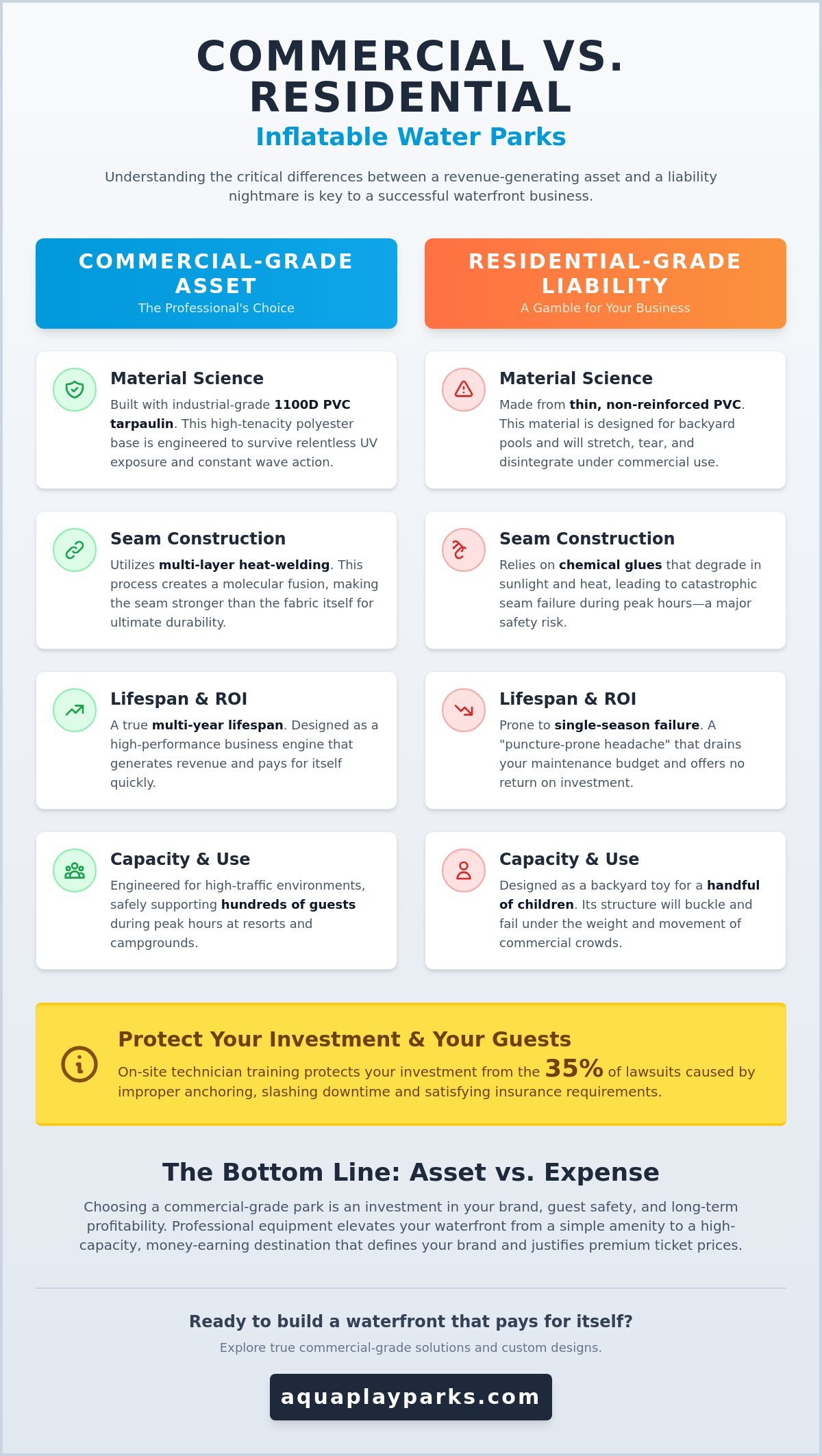
Engineering a revenue-generating waterfront requires more than just air. It requires chemistry. When you’re evaluating a commercial vs residential inflatable water park, the secret is in the “D” — Denier. Residential toys often use thin, non-reinforced PVC that stretches and tears. In contrast, B2B commercial resort quality installations demand 1000D or 1100D PVC vinyl. This material is a high-tenacity polyester base fabric coated on both sides with heavy-duty PVC. It’s built to withstand the constant flexing of lake waves without material fatigue. You want an asset that stays inflated and holds its value, not a sagging liability.
Seam construction is where most budget units meet their end. Residential products typically rely on chemical glues that degrade in the sun. Over time, heat and moisture weaken these bonds, leading to catastrophic failure during peak hours. We utilize multi-layer heat-welding. This process creates a molecular fusion between the panels, making the seam stronger than the fabric itself. It’s a non-negotiable standard for anyone serious about following IAAPA water park safety guidelines and ensuring long-term durability.
Stability on the water depends entirely on your anchor points. We utilize heavy-duty, reinforced stainless steel D-rings. These aren’t just glued to the surface; they’re integrated into the structural layers of the obstacle. This allows modular obstacle pieces in 3m, 5m, and 10m lengths to stay locked in place, even during high winds or heavy guest traffic. Proper anchoring is the backbone of a safe, professional operation.
UV Resistance and Anti-Microbial Coatings
The intense sun across the United States can be brutal on plastics. Without specific UV-protective coatings, bright colours fade into a dull, aged grey in a single season. Our materials include anti-fungal and anti-microbial treatments. This prevents the growth of “pink mould” and algae that can ruin your park’s professional appearance. It also significantly reduces the manual labour required for mid-season cleaning, keeping your staff focused on guest management rather than scrubbing vinyl.
Modular Connections: The Interactive Running Track
Think of your park as a modular puzzle. We engineer 3m, 5m, and 10m pieces to form a seamless running track that guests can navigate with speed. While residential units use flimsy velcro or ropes, those are safety hazards that cause gaps and trips. Our connection systems ensure a flush, stable surface. This modularity allows you to reconfigure your layout every year, giving returning guests a fresh challenge and keeping your ticket sales high. You can realize a completely new guest experience without buying an entirely new park.
Longevity, Liability, and ROI: The True Cost of Going Cheap
Price is what you pay; value is what you keep. When you’re debating the merits of a commercial vs residential inflatable water park, the upfront sticker shock of B2B quality often scares off the uninitiated. Look closer at the math. A residential unit is built for a 90 day lifecycle. It’s a seasonal disposable. In contrast, B2B commercial resort quality is an investment designed to endure years of pounding waves and thousands of jumping feet. By choosing custom inflatable water park design, you aren’t just buying vinyl. You’re engineering a high-yield destination that maximizes every square metre of your water and ensures your capital isn’t sinking to the bottom of the lake.
The “cheap” trap is a revolving door of expenses. If you buy a residential grade product for a commercial venue, you’ll likely replace it every season. Over three years, you’ll have spent more on replacements and shipping than you would have on a single, high-grade installation. Verified data shows that domestic commercial inflatables retain 60 to 70% of their resale value after three years. Budget imports and residential toys often retain less than 30%. You’re not just buying equipment; you’re building equity in a tangible business asset.
Calculating the Payback Period
Imagine a Saturday morning in July. Your park is at capacity. Suddenly, a seam on a budget slide splits. The hidden cost of downtime isn’t just the repair; it’s the lost ticket sales, the refunds, and the angry social media reviews. High-capacity assets like the Pyramid Bag Jump are built to be workhorses. They drive massive throughput and pay for themselves through sheer volume. Commercial gear is designed for 10 plus hours of daily use, not 10 hours a month. A durable setup minimizes operational downtime, allowing you to realize your profit goals faster than you ever thought possible. For operators looking to maximize throughput and guest excitement, an inflatable monster water slide serves as a high-visibility landmark that eliminates bottlenecks and drives ticket sales at scale.
Insurance and Safety Standards
Safety is the bedrock of your brand. For resort owners in the US, liability insurance is a non-negotiable hurdle. Most domestic providers require proof of ASTM F2374-22 compliance to offer coverage. If you deploy residential-grade equipment in a commercial setting, you’re likely voiding your liability coverage entirely. One accident could end your business. B2B builds incorporate critical safety features like “no-gap” connections and significantly higher side-walls to prevent falls. These aren’t just luxury additions. They’re the prerequisites for professional insurance and guest peace of mind. Investing in the right gear protects your guests and your bank account simultaneously.
Operational Excellence: Why Inflatable Water Park Training is Non-Negotiable
Buying the world’s best equipment is only half the battle. If you’re weighing the differences in a commercial vs residential inflatable water park, remember this: a residential toy comes with a manual; a commercial asset comes with a mission. You wouldn’t hand the keys to a high-speed ferry to someone who has only paddled a canoe. Why treat your waterfront any differently? The most advanced B2B commercial resort quality vinyl won’t save your bottom line if the anchoring is botched or the air pressure is ignored. Understanding how to operate an inflatable water park with professional precision is the critical skill that separates thriving businesses from costly liability nightmares. The best equipment is only as safe as the team operating it.
Professional on-site water park technician training is your ultimate business safeguard. It’s the shield that protects your investment from common operational failures. Trained eyes see what others miss. They recognize the subtle signs of material fatigue or a loosening tether before it becomes a headline. This proactive approach doesn’t just reduce liability; it significantly extends the life of your equipment. By empowering your team with expert protocols, you transform a group of seasonal workers into a professional crew focused on operational excellence.
On-Site Technician Training Protocols
We don’t just ship crates; we build experts. Our On-Site Technician Training is a deep dive into the physics of floating attractions. Your staff will master the precision of inflation levels, which vary based on daily temperature shifts across the US. They’ll run emergency response drills specific to open water environments. This training fosters a culture of ownership. When your team understands the engineering behind the park, they take pride in maintaining its peak performance. It’s about moving from “just a job” to professional asset management.
Setup and Seasonal Maintenance
Anchoring a massive modular course is a complex engineering feat. You have to account for varying water depths, shifting lake beds, and unpredictable wind loads. Professional guidance is essential for the initial launch of systems like the Campers Starter Park. We ensure your configuration is optimized for your specific topography to prevent bottlenecks and maximize guest flow. Maintaining that commercial calibre also requires a strict off-season strategy. Proper winterization and storage techniques are the only way to realize the full multi-year lifespan of your investment. Don’t leave your ROI to chance.
Ready to turn your staff into a high-performance operations team? Book your On-Site Technician Training today and secure your 2026 season.
Customizing Your Success: The Aqua Play Parks Advantage
Imagine your lakefront transformed into a high-capacity revenue engine. Stop settling for “off-the-shelf” solutions that don’t respect your shoreline’s unique topography. When you evaluate the commercial vs residential inflatable water park market, it becomes clear that generic catalogues are designed for the masses, not for your specific business goals. We’re the straight-shooters who value efficiency and high-impact outcomes. We don’t just sell equipment; we partner with you to engineer a visionary destination that guests will travel for. You need a strategy that turns water into a high-yield asset, and we provide the direct path to get there.
A direct partnership with a designer beats a generic reseller every single time. Resellers want to move whatever inventory is sitting in their warehouse. We want to design what you need to win. We bring a bold, results-oriented perspective to every project, ensuring your installation is as pragmatic as it is exciting. This isn’t a distant corporate transaction. It’s a hands-on collaboration with experts who are deeply invested in the craft and the long-term success of your waterfront.
From Concept to Money-Earning Reality
True Custom Designing is the core of our approach. We take a vision-first stance. We invite you to imagine the most successful scenario for your resort before we provide the logistical solution. This allows us to integrate our Money Earning Monster Slides into venues of all sizes. Smaller campgrounds often think they can’t handle “Monster” scale, but our custom engineering proves otherwise. With 35 years of industry experience, our Canadian design team understands how to maximize every square metre of water. If you’re new to the industry, our water park starter package for campgrounds provides a clear, direct path to realization without the complexity of starting from scratch.
The Direct Partnership Model
The direct partnership model is about transparency and quality. We eliminate the intermediaries. This ensures your investment is focused on B2B commercial resort quality materials rather than a reseller’s markup. Our commitment to your growth extends far beyond the initial transaction. We’re hands-on experts who stay involved, providing the on-site water park technician training and seasonal maintenance guidance that keep your park running at peak performance. You aren’t just a client; you’re a partner in pushing the boundaries of outdoor recreation. We realize that your success is our reputation, and we build every park to be a landmark destination.
Envision your waterfront transformation with a custom Aqua Play Parks design.
Dominate Your Waterfront with a High-Performance Asset
Your waterfront is a canvas for commercial growth. Don’t paint it with disposable toys. We’ve explored how the massive gap in a commercial vs residential inflatable water park comes down to the molecular level of the PVC and the professional calibre of your crew. You need 1100D heat-welded vinyl and comprehensive on-site technician training to ensure your park is a revenue engine rather than a liability. By choosing custom-engineered designs over generic catalogues, you maximize every square metre of water and every dollar of your budget.
We bring 35 years of industry-leading design experience to the table, helping you launch the world’s largest money-earning Monster Slides. We don’t just ship equipment; we build destinations and train your team to operate them with surgical precision. It’s time to stop gambling on backyard gear and start investing in a legacy. Build your high-ROI waterfront with a custom Aqua Play Parks quote today. Let’s turn your lake into the most talked-about destination of the 2026 season. Your vision is ready for realization.
Frequently Asked Questions
Can I use a residential inflatable water slide for my campground to save money?
No, attempting to use a residential toy for a commercial campground is a gamble that usually ends in financial loss. Residential units are designed for light, private use and lack the structural integrity required for the constant traffic of a resort. You’ll likely face rapid material failure and significant liability risks that could jeopardize your entire business operation.
How long does a commercial-grade floating aqua park typically last?
A B2B commercial resort quality installation typically lasts between three and five years with proper maintenance. This is a massive leap over residential gear, which often fails before its first season ends. High-grade 1100D PVC assets also retain 60 to 70% of their resale value after three years, whereas budget imports and toys retain almost nothing.
Is on-site technician training really necessary for my staff?
Yes, professional training is your most robust defence against operational downtime and insurance claims. It empowers your seasonal staff to perform daily safety checks and manage anchoring systems with expert precision. When you understand the engineering behind a commercial vs residential inflatable water park, you realize that the safest equipment is only as good as the team operating it.
What is the main difference in material between residential and commercial inflatables?
The primary difference is the use of 1000D or 1100D reinforced PVC vinyl in commercial units. Residential products use thin, non-reinforced PVC that is glued together, which quickly degrades under UV exposure. Commercial assets utilize multi-layer heat-welding to create molecularly fused seams that are significantly stronger than the base fabric itself.
Do commercial water parks require special insurance in Canada?
Yes, Canadian insurance providers require liability coverage that typically demands a $1,000,000 per occurrence minimum. To secure this, your equipment must meet specific safety standards like ASTM F2374-22. Using residential-grade equipment in a commercial setting will often void your liability policy entirely, leaving your business exposed to massive legal risks.
How much maintenance does a modular floating water park require daily?
Daily maintenance is a brief but critical 30-minute routine for your trained technicians. Every morning, your team must inspect the air pressure levels and anchor tension to account for temperature shifts and water movement. This proactive approach prevents the structural fatigue that leads to punctures and ensures your park remains a safe, professional destination for every guest.
Can I add more pieces to my aqua park as my business grows?
Yes, our modular design is engineered for scalability. You can start with a focused installation like the Campers Starter Park and add new obstacles or Monster Slides as your ticket revenue grows. This flexibility allows you to refresh your layout every season, giving returning guests a new reason to visit and spend money at your waterfront.
What happens if a piece of the modular course gets a puncture?
Punctures don’t have to be a disaster because our parks are built with modularity in mind. If one section is damaged, it doesn’t shut down the entire attraction; you simply remove that specific piece for repair while the rest of the park continues to earn money. Most commercial-grade punctures can be repaired on-site using professional heat-welding techniques, keeping your operational downtime to an absolute minimum.
Leave a Reply