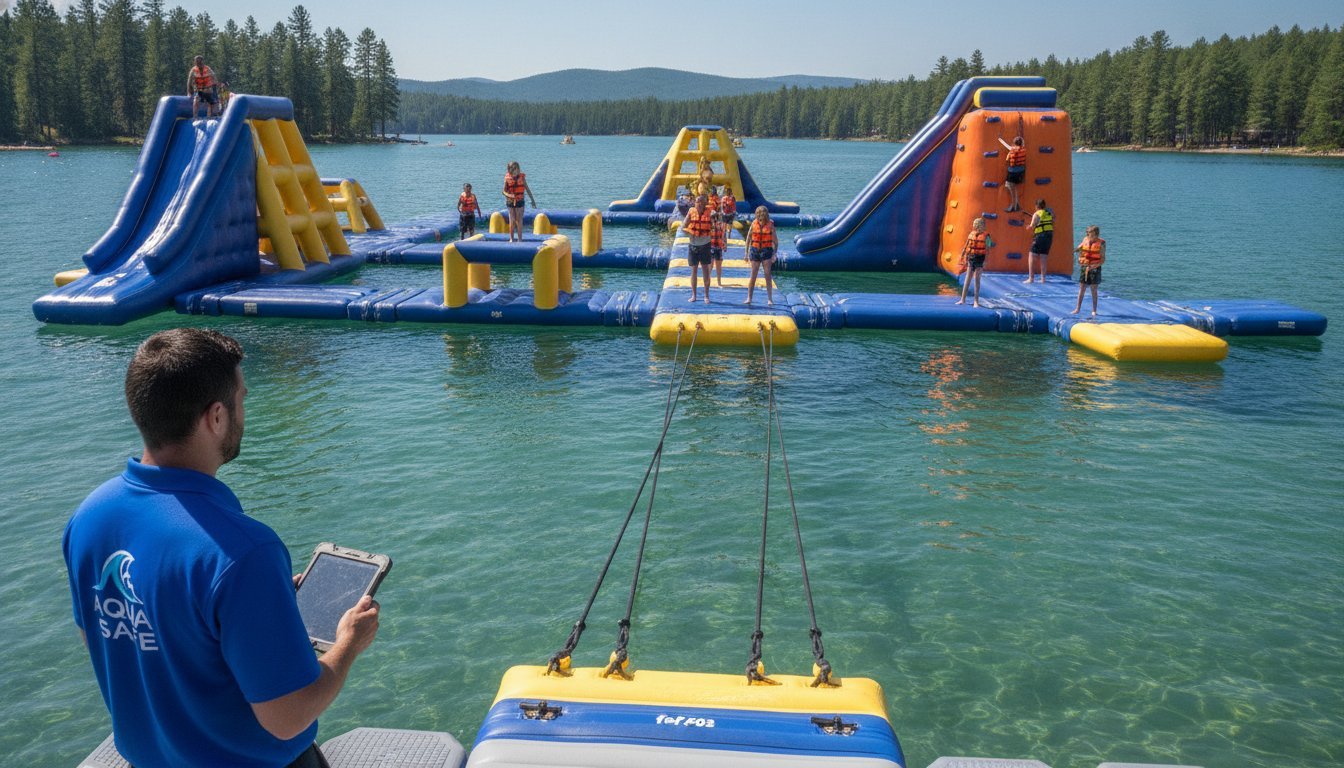
Did you know that improper anchoring is responsible for 35% of all inflatable rental lawsuits? For a visionary operator, that isn’t just a statistic; it’s a wake-up call that your technical setup is the only thing standing between a thriving resort and a legal disaster. Mastering commercial inflatable water park regulations is no longer a bureaucratic chore. It’s your most powerful competitive advantage in a global market projected to hit $3.13 billion by 2033. High-impact growth requires a foundation of absolute safety.
You likely feel the weight of confusion over whether your floating park falls under maritime law or amusement ride standards, especially with a surprise inspection looming. It’s a stressful way to run a business. We realize that you want a park that passes every check with flying colours while keeping your insurance premiums low through documented excellence. This 2026 checklist provides a clear roadmap for permitting and safety compliance. We will break down the new EN ISO 25649-6:2026 requirements and the latest ASTM standards so you can stop worrying and start growing your empire with confidence.
Key Takeaways
- Learn the vital differences between backyard toys and B2B resort-quality installations to ensure your park aligns with the most rigorous international safety standards.
- Master the dual nature of commercial inflatable water park regulations by navigating the intersection of amusement ride safety protocols and maritime navigation rules.
- Secure your investment by understanding how current ASTM F2374 and ISO 25649 standards influence your insurance premiums and long-term liability.
- Identify the specific environmental permits and lake-bottom rights required to organize a successful, high-impact floating destination without legal interruptions.
- Discover how custom engineering and professional on-site technician training serve as the ultimate foundation for passing every surprise inspection with flying colours.
Understanding the Regulatory Framework for Floating Aqua Parks
The distinction between a backyard toy and a commercial resort-quality installation isn’t just about size; it’s about legal survival. If you’re operating a business, you aren’t just buying PVC. You’re investing in a complex asset that must satisfy a multi-layered web of commercial inflatable water park regulations. Unlike residential inflatables, modular floating parks are engineered for high-frequency B2B use. They must withstand environmental stressors that would shred a retail-grade product in days. You must realize that the AHJ (Authority Having Jurisdiction) holds the keys to your waterfront. They don’t care about your marketing; they care about your structural load-bearing capacity.
The regulatory landscape is unique because it’s dual-natured. Your park exists at the intersection of amusement ride safety and maritime navigation rules. Depending on how your anchors are set, local authorities might view your park as a fixed structure similar to a pier or a floating vessel similar to a raft. This classification determines whether you answer to the harbour master or the state labour board. The water park industry has evolved to meet these challenges by developing modular systems that satisfy both jurisdictions through superior engineering. Successful operators organize their compliance files long before the first anchor hits the lake bed.
Amusement Ride vs. Floating Vessel
Is your park a fixed attraction or a floating craft? This question defines your permitting path. If your park is tethered in a way that the AHJ deems it “permanently moored,” you may face building codes usually reserved for boardwalks. Conversely, if it’s classified as a floating craft, you must adhere to maritime safety standards regarding buoyancy and navigation lighting. B2B commercial resort quality is a non-negotiable prerequisite here. Without it, you simply won’t secure the operational permits needed to open your doors to the public.
The Impact of 2026 Safety Trends
The 2026 safety consensus for modular floating parks dictates that operational success is built on a foundation of documented structural load testing and precise anchoring calculations rather than superficial material specs. Regulators have moved beyond checking seams. They now focus on capacity management and “interactive running track” safety to prevent bottlenecks during peak hours. Standalone high-impact pieces require specific clearance zones to prevent collisions. For example, a Pyramid Bag Jump demands a calculated fall-radius that accounts for both water depth and the trajectory of the guest. Adhering to these commercial inflatable water park regulations ensures your park remains a premium, safe destination for years to come.
Engineering Standards: ASTM F2374 and ISO 25649 Compliance
Compliance isn’t just a paper trail; it’s a physical reality built into the seams of your equipment. To dominate the waterfront, you must understand that commercial inflatable water park regulations are anchored in two primary engineering pillars: ASTM F2374 and ISO 25649. These aren’t suggestions. They are the blueprints for guest safety and investment protection. While retail toys ignore these benchmarks, a B2B commercial resort quality installation embraces them to eliminate liability from the design phase onward. You’re not just buying an inflatable; you’re buying an engineered system designed to withstand thousands of hours of high-intensity use.
The ASTM F2374-22 standard is the current gold standard for inflatable amusement device design. It dictates everything from seam strength to the precision of air pressure monitoring systems. In the world of modular floating parks, these standards are even more critical. You need to realize that every connection point between modules is a potential risk zone. We test these “pinch-points” ruthlessly to ensure no fingers or hair can get caught during play. This level of scrutiny is exactly why understanding the difference between a commercial vs residential inflatable water park is vital for your long-term ROI.
ASTM F2374: Design and Manufacture
Your park must be a fortress of durability. ASTM standards require commercial-grade, UV-resistant PVC that meets strict fire and tear resistance protocols. We don’t just build; we stress-test. Every custom design undergoes rigorous pressure testing to verify that seams won’t fail under the weight of a crowd. This engineering excellence ensures that your park stays inflated and operational, even in the harshest sun or choppy lake conditions. If you’re looking for a partner who understands these complexities, you can explore our custom design process to see how we build for longevity and compliance.
Entrapment and Drowning Prevention
Safety is about more than just staying afloat; it’s about preventing the unthinkable. ISO 25649-1:2024 and the specific requirements found in EN ISO 25649-6:2026 place a massive emphasis on entrapment prevention for Class D devices. For our Worlds largest Floating Monster Slides, specific landing zone regulations are mandatory. You must maintain minimum water depths that correlate directly to the height of the slide to prevent impact injuries. Even our Campers Starter Park is engineered with easy entry and exit points, ensuring that guests of all ages can navigate the water safely without the risk of getting trapped beneath a module. These standards are the foundation of a park that passes every inspection with flying colours.
Navigating Jurisdiction: Environmental and Maritime Safety
Stop thinking like a bounce house operator and start thinking like a marina owner. When you move your business onto the water, the legal ground shifts beneath your feet. Land-based commercial inflatable water park regulations are often useless once you cross the shoreline. You must realize that your park now occupies public or private water space, which brings the Coast Guard or local marine patrol into your daily operations. Securing lake-bottom rights is your first hurdle. You need specific permits to place concrete blocks or screw anchors into the bed, ensuring your park doesn’t drift or infringe on navigation channels. This isn’t just red tape; it’s the foundation of your legal right to exist on the water.
Environmental impact assessments are your next priority. Regulators want to ensure your installation doesn’t disrupt local ecosystems or scouring the lake floor. Standard business insurance policies are a recipe for bankruptcy in this niche. They rarely cover the unique risks of floating attractions, where maritime law might apply in the event of an incident. With industry research showing that improper anchoring causes 35% of all inflatable rental lawsuits, your insurance provider will demand proof of professional installation and compliance. To protect your investment, you can partner with experts who understand these jurisdictional minefields from day one.
Anchoring and Mooring Permits
Your anchor grid is the spine of your park. You must standardize your mooring system to meet local wind-load requirements, which vary wildly depending on your specific fetch and exposure. Improper anchoring is the primary cause of regulatory shutdowns because it poses a direct threat to both guests and nearby vessels. Decide early if you need temporary seasonal permits or a permanent installation. Seasonal permits often allow for faster approval but require you to completely remove the system annually, whereas permanent moorings involve more intense environmental scrutiny but offer long-term operational stability.
Guest Safety and Lifeguard Ratios
Safety on the water is high-energy and high-stakes. Mandatory PFD (Personal Flotation Device) standards are non-negotiable; every guest, regardless of age or swimming ability, must wear a certified life jacket. You must also calculate your maximum capacity for the fire marshal or local water authority based on the total surface area of your modular pieces. It’s a numbers game that requires precision. Finally, ensure your park features signage that meets national safety symbol standards. Clear, high-intensity visual cues help organize the flow of traffic and ensure that commercial inflatable water park regulations are followed by every guest on your “interactive running track.”
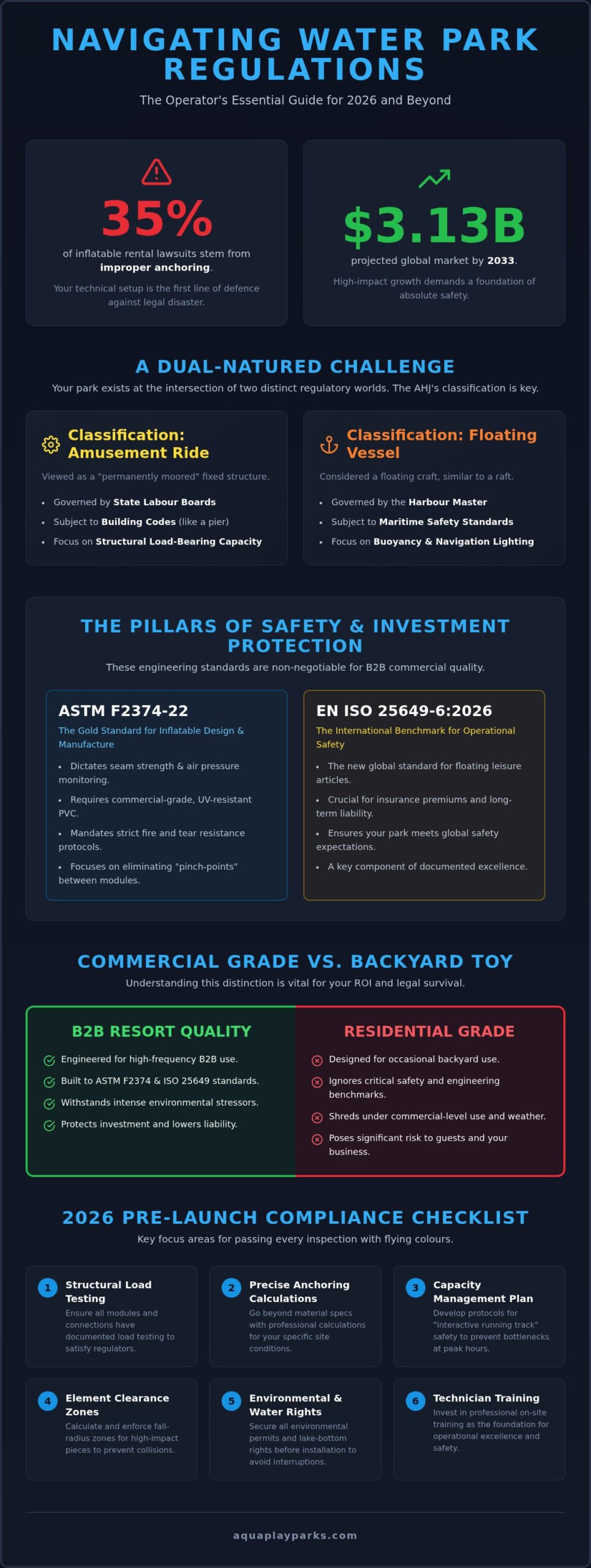
The Ultimate Pre-Launch Compliance Checklist for 2026
A visionary business owner doesn’t leave success to chance. Launching a world-class waterfront destination requires more than just high-energy enthusiasm; it demands a clinical approach to commercial inflatable water park regulations. You need to realize that your pre-launch phase is the most critical window for eliminating liability. By following a structured roadmap, you can organize your operation to pass every inspection with flying colours. This isn’t just about ticking boxes. It’s about building a foundation for a high-impact, high-ROI business that dominates the local market from day one.
- Phase 1: Design Approval – Your journey starts with a custom inflatable water park design that meets ASTM standards before a single piece of PVC is welded.
- Phase 2: Local Permitting – Secure your land-use and water-surface rights early to avoid costly delays with the harbour master or local council.
- Phase 3: Installation & Anchor Testing – Perform and document pull-tests for all moorings to ensure they meet the specific wind-load requirements of your location.
- Phase 4: Staff Certification – Invest in professional training and conduct rigorous lifeguard drills to prepare for the reality of a busy season.
- Phase 5: Final Inspection – Obtain a third-party engineering sign-off to satisfy your insurance provider and finalize your operational permit.
Daily Operational Compliance
Consistency is the heartbeat of a safe park. You must implement a mandatory 15-minute morning pressure and anchor check before the first guest arrives. This is especially vital for maintaining “Monster Slide” integrity during high-heat or wind events, where air expansion or anchor tension can shift rapidly. A meticulously maintained daily logbook is your ultimate shield against liability, providing a concrete paper trail that proves your commitment to safety standards. Don’t let a single day pass without documenting these critical checks.
Staff Training and Liability Reduction
Your team is your first line of defense. Professional on-site water park technician training is the best legal defense you can buy, as it ensures your staff can identify and fix potential issues before they become hazards. Every guest briefing must be documented, and emergency response protocols for “man-overboard” scenarios should be practiced until they become second nature. This level of preparation transforms a good park into a premium, secure destination. To ensure your team is ready for the 2026 season, you can book your on-site training session today and secure your park’s professional future.
Beyond the Red Tape: Scaling Your Waterfront with Aqua Play Parks
Scaling a waterfront empire shouldn’t feel like drowning in paperwork. While others see commercial inflatable water park regulations as a barrier to entry, mastering them is your ticket to rapid growth. True custom designing allows you to bypass the “compliance guesswork” that plagues off-the-shelf products. When every module is engineered to fit your specific shoreline, you eliminate the friction that stops most operators before they even start. You aren’t just building a park; you’re creating a premium, regulated destination that commands higher ticket prices and attracts repeat guests who value safety as much as excitement.
You must realize that positioning your resort as the safest park on the lake is your most potent marketing tool. In a market projected to reach $3.13 billion by 2033, professional credibility is the currency of success. Lower insurance premiums and a reputation for excellence are the direct results of documented compliance. You need a partner who understands the 2026 regulatory landscape from the first sketch to the final on-site training session. Dealing directly with a designer who manages the entire process ensures that nothing is lost in translation and every safety standard is met with precision.
Custom Design as a Regulatory Solution
Every lake has its own rules. Some authorities demand specific distance-from-shore offsets, while others have strict depth requirements for high-impact attractions. Our custom engineering allows us to tailor modular pieces to these exact local constraints without sacrificing the “wow” factor. We specialize in integrating high-capacity inflatable monster water slides that serve as the compliant centrepiece of your park. These slides are designed to meet all safety throughput standards, ensuring that your most popular attraction is also your most secure and profitable asset.
The Aqua Play Parks Advantage
With 35 years of industry design experience, we’ve seen every regulatory shift and environmental challenge. We don’t use intermediaries; we offer direct accountability for every seam and anchor point we produce. This “straight-shooter” approach fosters trust and ensures that your B2B commercial resort quality standards are never compromised. We provide the on-site technician training that transforms your staff into compliance experts, effectively reducing your liability while maximizing your operational efficiency. Stop worrying about red tape and start building your legacy with a partner who is as invested in your success as you are.
Dominate the 2026 Season with Compliance Excellence
You’ve seen the roadmap. Navigating commercial inflatable water park regulations isn’t just about avoiding a fine; it’s about building a bulletproof foundation for your waterfront legacy. By prioritizing ASTM-engineered designs and mastering the dual nature of maritime and amusement ride jurisdiction, you’re positioning your resort as the gold standard in safety. This commitment doesn’t just protect your guests; it reduces insurance premiums and builds the professional credibility that drives long-term ROI. Safety is your most profitable asset.
We bring 35 years of industry-leading design expertise to every project, ensuring our commercial-grade modular systems meet the highest standards. With our included on-site technician training, your team will have the skills to maintain operational excellence every single day. Stop letting red tape hold back your vision. The future of recreation is floating, and it belongs to the operators who lead with authority and safety.
Let’s build something extraordinary together.
Frequently Asked Questions
Do I need a special permit to put an inflatable water park on a public lake?
Yes, you absolutely need specific permits to operate on public water. These typically include land-use agreements, water-surface rights, and environmental impact assessments from the Authority Having Jurisdiction. You must secure lake-bottom rights for your anchoring system to ensure you don’t interfere with navigation channels. It’s vital to organize these approvals early to avoid costly delays or shutdowns during your peak operational season.
What are the specific insurance requirements for a commercial floating aqua park?
You need a specialized commercial general liability policy that specifically covers floating attractions. Most standard business insurance won’t touch open-water parks because they fall under different risk categories, including maritime law. Industry standards usually dictate a minimum of $1,000,000 per occurrence. Documenting your adherence to commercial inflatable water park regulations is the most effective way to lower these premiums and secure comprehensive coverage.
How does ASTM F2374 differ from standard pool toy regulations?
ASTM F2374 is a rigorous engineering standard for commercial amusement devices, while pool toy regulations focus on low-impact residential use. ASTM F2374-22 mandates specific seam strength, air pressure monitoring, and structural load testing to handle thousands of guests. Standard toys lack the UV-resistant, commercial-grade PVC required to survive the environmental stressors of a resort setting. Choosing B2B quality ensures your park satisfies these high-level safety benchmarks.
Can I operate a modular water park without a certified lifeguard on duty?
No, operating without certified lifeguards is a massive legal risk and usually violates your insurance terms. While commercial inflatable water park regulations vary by state, the industry consensus requires professional supervision to manage guest flow and emergency response. Beyond lifeguards, you must realize that mandatory PFD usage for every guest is a non-negotiable safety layer. Your staff training should include drills for man-overboard scenarios to ensure total waterfront control.
What wind speeds are considered dangerous for a floating monster slide?
Sustained wind speeds exceeding 15 to 20 mph often require park closure or deflation of high-profile pieces like a Monster Slide. Every installation has unique wind-load limits based on its specific anchoring grid and fetch. You must implement a 15-minute morning check to monitor these conditions. Keeping a meticulous daily logbook of weather and pressure readings serves as your ultimate defense in the event of a liability claim.
How often do commercial inflatable water parks need to be professionally inspected?
Annual professional inspections are generally required to renew your operating permits. However, your own on-site technicians should perform rigorous daily and weekly inspections to catch wear before it becomes a hazard. These internal checks focus on modular connection points and anchor tension. Aqua Play Parks provides on-site technician training to ensure your team can identify potential issues, keeping your park in inspection-ready condition throughout the entire summer.
Are there specific safety signage requirements for resorts?
Yes, signage must meet national safety standards and should be bilingual where required by state law. Use clear, high-intensity visual symbols to communicate rules regarding diving, PFD usage, and age restrictions. Well-placed signage helps organize the guest experience and ensures that your safety protocols are understood by everyone. It is a simple but effective way to demonstrate your commitment to a professional and regulated waterfront environment.
Does the ‘Campers Starter Park’ require the same permitting as a full-scale resort?
Yes, even a smaller installation like the Campers Starter Park must comply with the same core safety and permitting rules as a massive resort. While the footprint is smaller, the anchoring requirements and guest safety standards remain identical in the eyes of the law. You still need to satisfy the local authorities regarding water-surface rights and environmental impact. Starting small doesn’t mean skipping the red tape; it means building a compliant foundation for future growth.
Leave a Reply