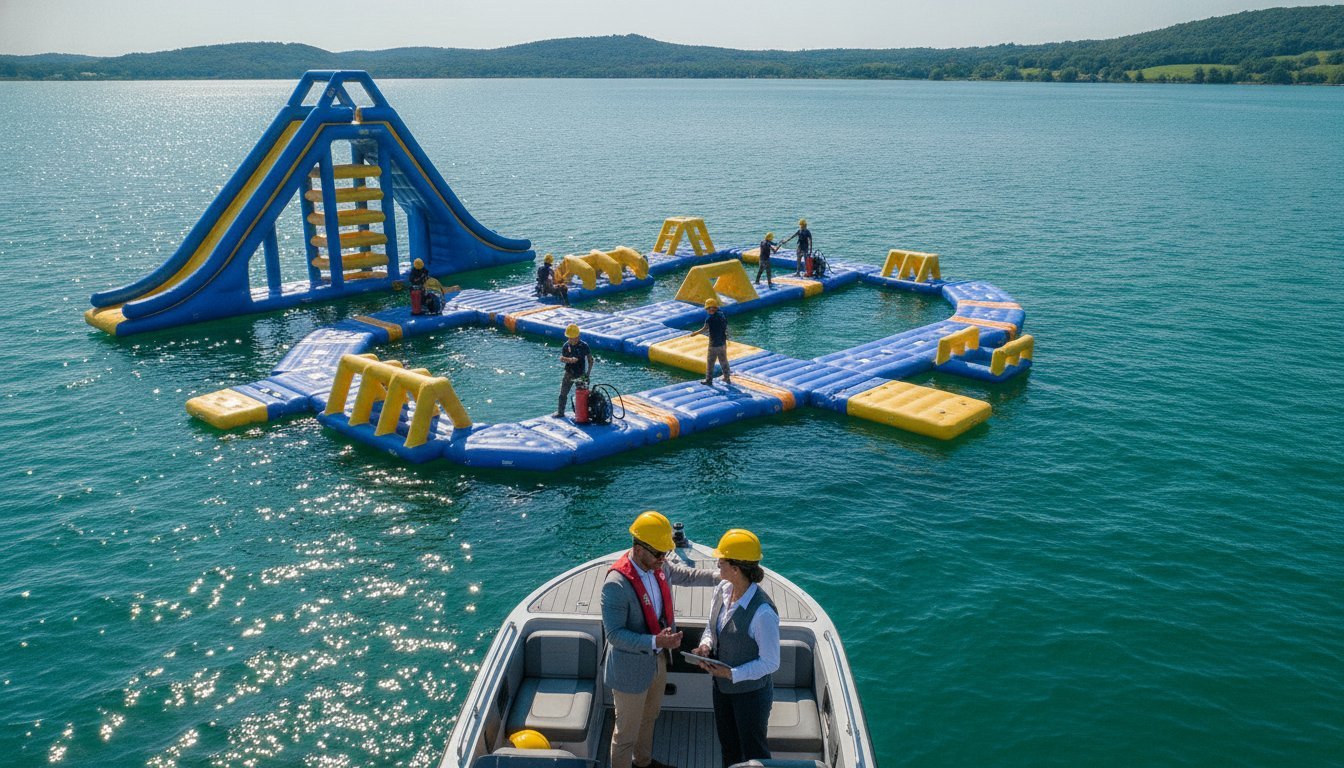
The difference between a high-ROI destination and a logistical nightmare isn’t just the quality of the inflatables; it’s the direct line of sight between your vision and the final anchor. Most developers get bogged down by layers of intermediaries who don’t understand the engineering behind a 10-metre Monster Slide. You’re likely feeling the pressure of 2026 regulatory changes and the complexity of lakebed permits. We understand that anxiety. It’s a massive undertaking that demands a precise, professional floating water park project management framework to ensure your investment doesn’t just float, but thrives.
You’ll realize a clear, step-by-step roadmap from the initial custom design phase to the moment your first guest hits the water. We’re going to dive into the essential strategies for navigating ASTM F2374-22 safety standards and organizing efficient modular connections. This article previews the entire lifecycle of a commercial aqua park, giving you the confidence to execute a launch that maximizes revenue while minimizing operational friction. Get ready to transform your waterfront into a world-class attraction with a plan built for speed and results.
Key Takeaways
- Learn how True Custom Design creates bespoke interactive tracks that move far beyond cookie-cutter layouts to define your brand.
- Master a professional floating water park project management framework to navigate 2026 regulations and site-specific geographic challenges.
- Discover how “Monster Slides” serve as massive revenue anchors that drive social media buzz and maximize ticket sales.
- Understand why on-site technician training is the most critical phase for ensuring long-term operational excellence and guest safety.
- Realize the ROI benefits of the “Campers Starter Park” strategy for new operators looking for a high-impact, low-complexity launch.
Mastering Floating Water Park Project Management: The 2026 Framework
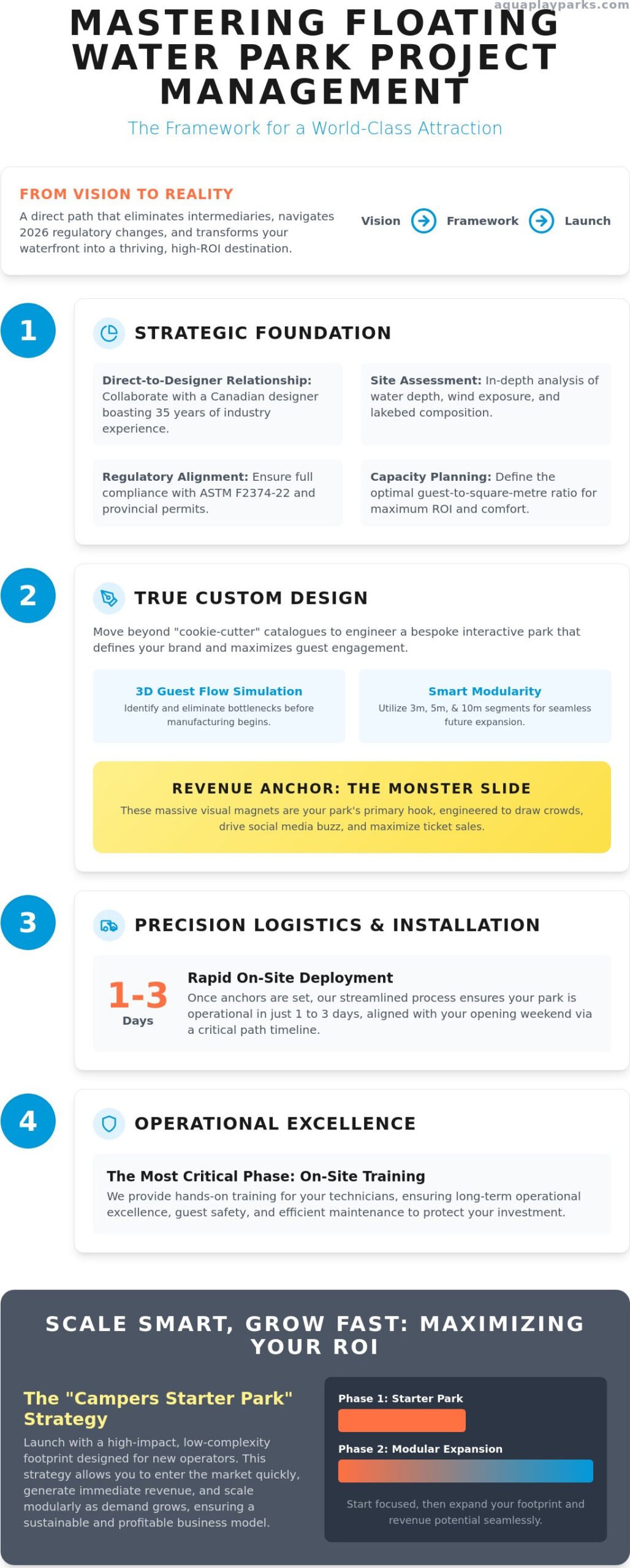
Launching a water park in 2026 requires more than just buying inflatables. It demands a vision that balances high-intensity thrills with a rock-solid business model. You need to define your scope before the first anchor drops to avoid the budget creep that plagues generic builds. Our approach to floating water park project management prioritizes a direct-to-designer relationship. By working directly with a Canadian designer who has 35 years of industry experience, you eliminate the communication lag and markup of corporate vendors. This isn’t just about efficiency; it’s about ensuring your specific site requirements are baked into the blueprint from day one.
Site Assessment and Regulatory Alignment
Your site’s geography dictates your engineering needs. We look at everything from water depth to wind exposure. A thorough lakebed survey is non-negotiable for anchor stability and guest safety. In 2026, navigating Canadian regulatory bodies and provincial permits for floating structures is more complex than ever. You must ensure compliance with standards like ASTM F2374-22 to protect your guests and your liability. Key factors include:
- Compliance with updated safety standards to protect your liability and guest welfare.
- Evaluation of water quality and flow patterns to maintain a premium guest experience.
- Ensuring anchor points are optimized for the specific lakebed composition to prevent drift.
Don’t leave these details to chance. A site that hasn’t been properly vetted can lead to installation delays or, worse, safety compromises that shut you down during peak season.
Defining Your Commercial Capacity
How many guests can you safely handle? Determining the ideal guest-to-square-metre ratio is the key to comfort and maximum ROI. You want a layout that balances high-adrenaline Monster Slides with family-friendly modular obstacle tracks. Place your highest-impact pieces at the centre of the park to draw the eye and drive ticket sales. We utilize modular 3m, 5m, and 10m segments to allow for seamless future expansion. Start with a focused footprint like the Campers Starter Park, then scale as your revenue grows. This modularity ensures your park evolves with market demand without requiring a total redesign of your existing layout.
Effective floating water park project management means aligning your manufacturing and shipping dates with your resort’s opening weekend. Establish a critical path timeline immediately. Installation usually takes only 1 to 3 days once anchors are set, but the lead-up requires precision. Focus on the direct path to realization. We don’t do “cookie-cutter” solutions. We deliver B2B commercial resort quality that stands up to heavy traffic and high expectations. Your success depends on a framework that values transparency and results-oriented engineering.
The True Custom Design Phase: Engineering Your Waterfront Vision
Stop settling for catalog layouts that ignore your site’s unique potential. True Custom Design is the heartbeat of elite floating water park project management. It moves your project beyond “cookie-cutter” kits toward bespoke interactive tracks that reflect your brand’s identity. We utilize advanced 3D rendering to simulate guest flow and identify potential bottlenecks before a single seam is welded. This proactive engineering ensures that your park isn’t just a collection of inflatables but a high-performance machine designed for movement and excitement. Just as a comprehensive waterfront revitalization program demands precise mapping, your aqua park needs a bespoke blueprint to succeed in a competitive market.
Imagine a guest standing on your shore. They shouldn’t see a random assortment of shapes; they should see a challenge. By designing “interactive running tracks,” you keep guests engaged for longer sessions, directly increasing your revenue per visitor. Modularity allows us to craft these paths with intention, ensuring that every 3m, 5m, and 10m segment serves a specific purpose in the overall guest experience. If you’re ready to move past generic designs, you can realize your vision through our custom design process and build something truly iconic.
Anchor Revenue with Monster Slides
Monster Slides are the primary “hook” for resort guests, acting as massive visual magnets that draw crowds from kilometres away. These aren’t just slides; they are engineered revenue anchors built with commercial-grade durability to withstand thousands of sliders every season. We strategically place these standalone giants alongside iceberg climbers and pyramid bag jumps to create high-impact zones. These pieces drive ticket sales and generate the social media buzz essential for modern destination marketing—often enhanced by high-impact on-shore branding from Zodiac Event Displays to ensure a professional look. When you prioritize these high-adrenaline anchors, you create a landmark that defines the entire waterfront.
Modular Obstacle Course Logic
The secret to replayability lies in the connection logic of your modular pieces. By connecting various 3m, 5m, and 10m waterproof segments, we create infinite course variations that cater to different skill levels. This variety ensures that a guest’s tenth lap is just as thrilling as their first. Every custom design we produce meets rigorous international safety standards for commercial use, balancing heart-pounding fun with professional-grade security. Effective floating water park project management integrates this logic early, allowing you to scale from a “Campers Starter Park” to a massive destination hub without losing the cohesive flow of your interactive running track.
Logistics and Installation: Navigating the Build Journey
Logistics is where the blueprint meets the water. It’s the high-stakes phase where professional floating water park project management proves its worth. You don’t want a chaotic shoreline; you want a choreographed deployment. Coordinating the arrival of your commercial-grade inflatables is critical to avoid site congestion. If your Monster Slides arrive while the anchor team is still surveying the lakebed, you’ve got a bottleneck. Professional site coordination reduces confusion and ensures every component is exactly where it needs to be when the build begins.
We utilize a “Staging Area” strategy to streamline the process. Organize every modular piece on-shore before the big splash. This eliminates those frustrating “where is it?” moments that eat into your opening timeline. By inspecting and pre-inflating on land, you catch potential issues before the equipment is floating 50 metres out. Managing specialized tools and high-volume inflation equipment is part of this pragmatic plan. We don’t use consumer-grade pumps; we use high-pressure systems designed for a rapid, safe setup that respects your seasonal opening dates.
The Step-by-Step Installation Process
A successful launch follows a logical, high-impact sequence. We move quickly from curiosity to conviction by following these four critical phases:
- Step 1: On-shore inspection and pre-inflation of modular obstacle pieces to verify integrity.
- Step 2: Deployment of the primary anchoring system based on the lakebed data gathered during your initial site assessment.
- Step 3: Sequential connection of tracks, starting from the centre outwards to maintain balance and alignment.
- Step 4: Final safety tensioning and buoyancy checks to ensure every connection is rock-solid before guest access.
Managing Site Readiness and Access
Your site must be physically ready for the scale of this equipment. This means planning for crane access or boat ramps required for those massive, money-earning slides. They are heavy, professional-grade structures that require more than just a few sets of hands to move. You also need a reliable power supply for the high-volume pumps during the initial inflation phase. This is the difference between a professional resort setup and a temporary attraction. Understanding the Commercial vs Residential Inflatable Water Park distinction is vital. The weight and engineering of resort-grade PVC require serious logistical planning and authoritative floating water park project management to realize a successful opening day.
Operational Excellence: On-Site Training and Safety Protocols
The build is complete. The water is calm. Now the real work of generating ROI begins. Many operators treat the handover as a simple key exchange, but elite floating water park project management demands a deeper commitment to operational excellence. On-site technician training is the most critical phase of this transition. It’s the moment your local team transforms from observers into experts who understand the engineering of every seam and anchor point. This isn’t just about safety; it’s about protecting the massive investment you’ve just launched onto the water.
You need “operator-ready” documentation that does more than just sit in a drawer. This paperwork is your primary tool for insurance negotiations and liability reduction. It should include a daily maintenance checklist designed to catch minor wear before it becomes a season-ending failure. High-capacity parks require clear lifeguard zones and strict guest-to-staff ratios to maintain order. When your team follows a professional project management framework, they operate with the authoritative confidence needed to manage hundreds of guests per hour while keeping the environment controlled and exciting.
Professional Technician Training
We don’t just ship equipment; we build experts. Our training covers the entire “inflation-deflation” cycle, which is essential for proper seasonal storage in the Canadian climate. Your team will learn specific repair protocols to keep the park at 100% uptime during the frantic peak season. On-site training reduces long-term operational costs by empowering your staff to identify and resolve minor issues before they escalate into expensive downtime. You can secure your park’s future by booking our on-site technician training as part of your custom build package.
Safety and Risk Management
Safety is the foundation of your brand’s reputation. Implementing Transport Canada-aligned safety signage and guest briefing zones is a non-negotiable requirement for 2026. These zones act as the “onboarding” area where guests learn the rules of the track before they ever touch the PVC. High-adrenaline features like the Pyramid Bag Jump require dedicated staff who are trained specifically on the physics of those pieces. You can explore more about Inflatable Water Park Training to understand how these protocols protect your business. By establishing these zones early, you ensure that the high-energy joy of the park is always balanced by professional-grade risk management.
Maximizing ROI: Scaling Your Commercial Waterfront
ROI is the ultimate metric for any waterfront development. You aren’t just building a playground; you’re engineering a profit centre. Calculating the payback period for a floating aqua park involves more than just counting ticket sales. It requires a pragmatic look at how an attraction increases resort-stay value or campground occupancy. Our floating water park project management framework focuses on eliminating the middleman. By working directly with our designer, you save on corporate markups, allowing you to reinvest those funds into high-capacity attractions that drive growth.
The “Campers Starter Park” strategy is your low-risk entry into the market. Start with a high-impact, low-complexity layout that establishes your site as a destination. Because our system is modular, you aren’t locked into your first design forever. You can add one “Monster” piece per season to keep your guests returning for something new. This incremental scaling keeps your capital expenditure manageable while ensuring your park never feels stale. It’s a visionary approach to growth that balances immediate joy with long-term commercial reality.
Revenue Generation Framework
How you charge dictates your speed of return. Some operators prefer ticket-based models, charging by the hour to maximize throughput. Others use the park as a premium value-add to justify higher nightly resort rates. Both models benefit from the “Money Earning” potential of standalone Inflatable Monster Water Slides. These giants aren’t just for show. They are the primary reason guests choose your waterfront over a competitor’s. They create the visual gravity needed to pull in local traffic and keep your park at maximum capacity all summer long.
The Scaling Roadmap: Starter to Monster
Growth should be a choreographed evolution. We’ve designed a roadmap that allows you to scale with confidence as your revenue hits specific milestones. This prevents the “over-extending” trap that many new business owners fall into. By planning your expansion in phases, you ensure that every new piece is paid for by the success of the previous season.
- Phase 1: The Starter Park. Focus on modular 3m and 5m tracks that provide family-friendly fun and quick, efficient installation.
- Phase 2: The Expansion. Introduce high-impact standalone pieces like the Iceberg Climber or a Pyramid Bag Jump to increase the difficulty and the “wow” factor.
- Phase 3: The Destination. Install the world’s largest monster slides to cement your status as a regional landmark and maximize your peak-season throughput.
Effective floating water park project management ensures that Phase 1 is designed with Phase 3 in mind. Your anchor points and guest flow patterns should anticipate future growth. This prevents costly re-engineering when you’re ready to expand. You’re building for today, but you’re planning for a legacy of growth that will dominate your local market for years to come.
Launch Your Waterfront Legacy in 2026
Your vision for a world-class destination is within reach. We’ve mapped out the framework for success, from the initial True Custom Design phase to the final safety tensioning. You now realize that effective floating water park project management isn’t just about logistics; it’s about engineering an experience that keeps guests coming back. By prioritizing on-site technician training and integrating high-revenue anchors like the world’s largest money-earning monster slides, you ensure your park remains a regional landmark.
We eliminate the corporate middleman by providing a direct-to-client process backed by 35 years of industry expertise. This transparency allows you to reinvest savings into high-capacity attractions. Every commercial park we build includes on-site training to empower your team from day one. It’s time to stop imagining and start building a high-ROI asset that defines your waterfront. Speak directly with our Lead Designer to start your project today and turn your blueprint into a 2026 reality. Let’s make a splash that your competitors can’t ignore.
Frequently Asked Questions
What are the first steps in floating water park project management?
The first step is defining your commercial capacity and conducting a thorough lakebed survey to ensure site stability. These initial assessments are the foundation of effective floating water park project management. You must identify geographic challenges like water depth and wind exposure early to avoid budget creep and ensure your layout fits the environment perfectly.
How long does the custom design and installation process usually take?
Most commercial parks require several months for custom design and manufacturing, but the physical installation typically takes only 1 to 3 days. This speed depends on having your anchoring system and staging area ready before the inflatables arrive. A direct-to-designer relationship accelerates this timeline by removing the communication lag typical of corporate vendors.
Do I need a professional engineer for the anchoring system?
Consulting a professional engineer for your anchoring system is vital for ensuring guest safety and regulatory compliance. Proper engineering accounts for lakebed composition and local environmental loads, protecting your investment from drifting or damage. This step is a critical part of meeting the ASTM F2374-22 standards required for modern commercial operations.
What kind of on-site training is required for my staff?
Your team needs comprehensive on-site technician training covering the inflation-deflation cycle and minor repair protocols. This ensures your staff can maintain 100% uptime during the peak season while adhering to strict safety and risk management standards. We include this training to transform your local staff into hands-on experts who understand the engineering of your park.
How do I manage the seasonal setup and teardown of the park?
Manage seasonal transitions by following a documented project management framework that includes specific storage procedures. Proper cleaning, drying, and folding before winter storage are essential for maintaining the commercial-grade quality of your PVC modules. Our technician training provides your team with the skills to handle these cycles efficiently each year.
Can I add modular pieces to my existing aqua park later?
Absolutely, our modular 3m, 5m, and 10m obstacle pieces allow you to scale your park’s layout season after season. You can launch with a “Campers Starter Park” and gradually add high-impact “Monster” pieces to keep the experience fresh for returning guests. This modularity ensures your park evolves with your revenue without requiring a total redesign.
What are the Canadian regulatory requirements for floating water parks?
You must navigate Transport Canada regulations and specific provincial permits for floating structures in 2026. Adherence to the ASTM F2374-22 safety standard is also critical for meeting insurance requirements and ensuring legal compliance in the Canadian market. Always verify local bylaws to ensure your anchoring and signage meet regional safety expectations.
How does project management impact the ROI of my waterfront attraction?
Professional floating water park project management maximizes ROI by eliminating the markups of corporate middlemen and focusing on high-capacity revenue anchors. A direct-to-designer relationship ensures every dollar is spent on engineering that drives guest throughput and ticket sales. Efficient execution reduces your payback period and allows for faster seasonal scaling.
Leave a Reply