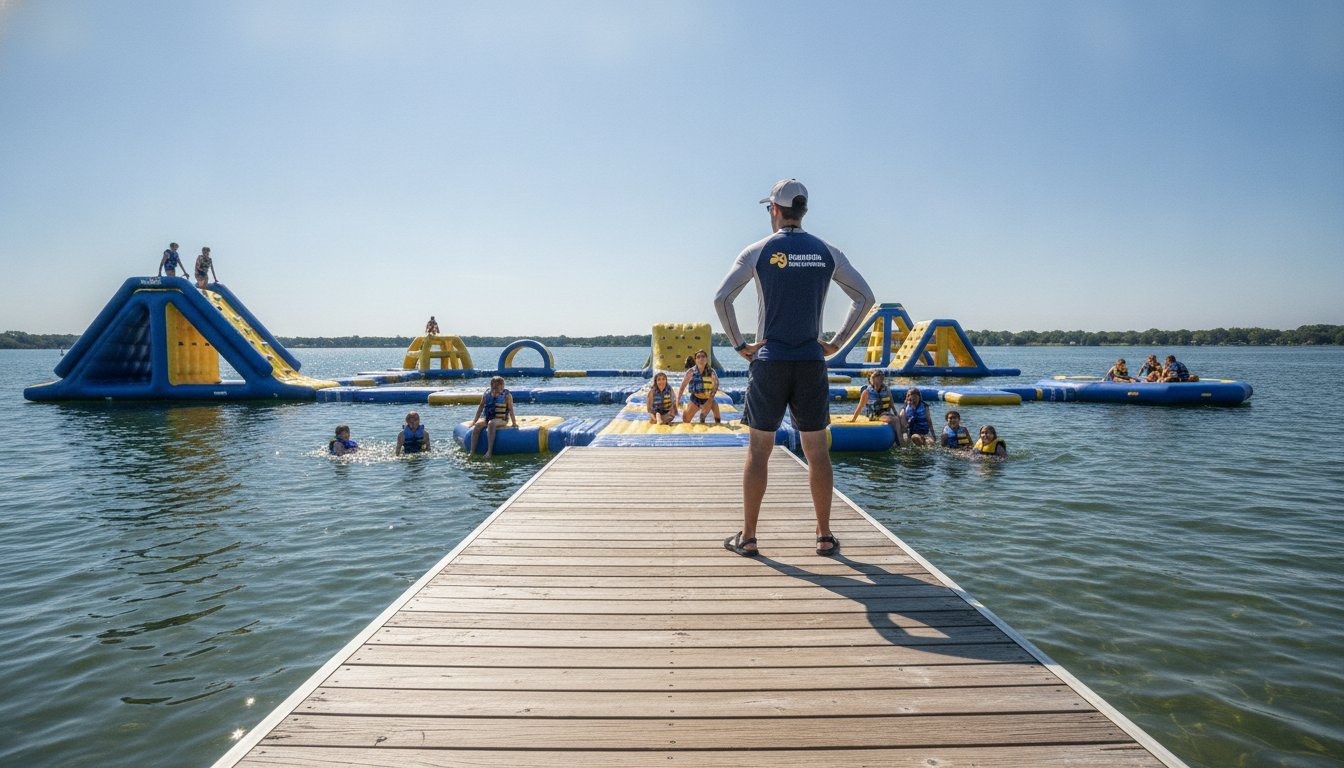
Your floating water park isn’t a backyard bounce house, and if your insurer treats it like one, your entire investment is at risk. You’ve likely felt the sting of skyrocketing premiums or the frustration of underwriters who simply don’t understand the difference between a professional resort-grade installation and a cheap beach toy. It’s exhausting to prove your park is safe when the regulatory landscape feels like a moving target. We know the struggle; securing the right inflatable water park liability insurance shouldn’t feel like an uphill battle against bureaucracy.
This guide provides the definitive 2026 checklist to help you secure robust coverage while actively driving down your annual costs through smarter risk management. You’ll gain total clarity on exactly what underwriters require to see in your documentation to realize lower premiums. We will break down the latest global safety standards, including the nsBAS EN ISO 25649-6:2026 update, and show you how to organize your operations to satisfy even the toughest lenders. It’s time to stop overpaying for “good enough” coverage and start building an insurable, high-impact destination that’s built to last.
Key Takeaways
- Realize that standard business policies often exclude floating attractions, making specialized coverage the only way to protect your commercial investment.
- Identify the essential coverage types, including Participant Legal Liability, required to satisfy lenders and local regulations in 2026.
- Learn why underwriters prioritize B2B commercial resort quality over “beach toy” grade equipment when assessing your park’s risk profile.
- Use our professional checklist to organize your layout and manufacturer certifications, ensuring you secure the best rates for inflatable water park liability insurance.
- Discover how on-site technician training serves as a powerful liability-reduction tool by preventing common anchoring failures and operational errors.
What is Inflatable Water Park Liability Insurance?
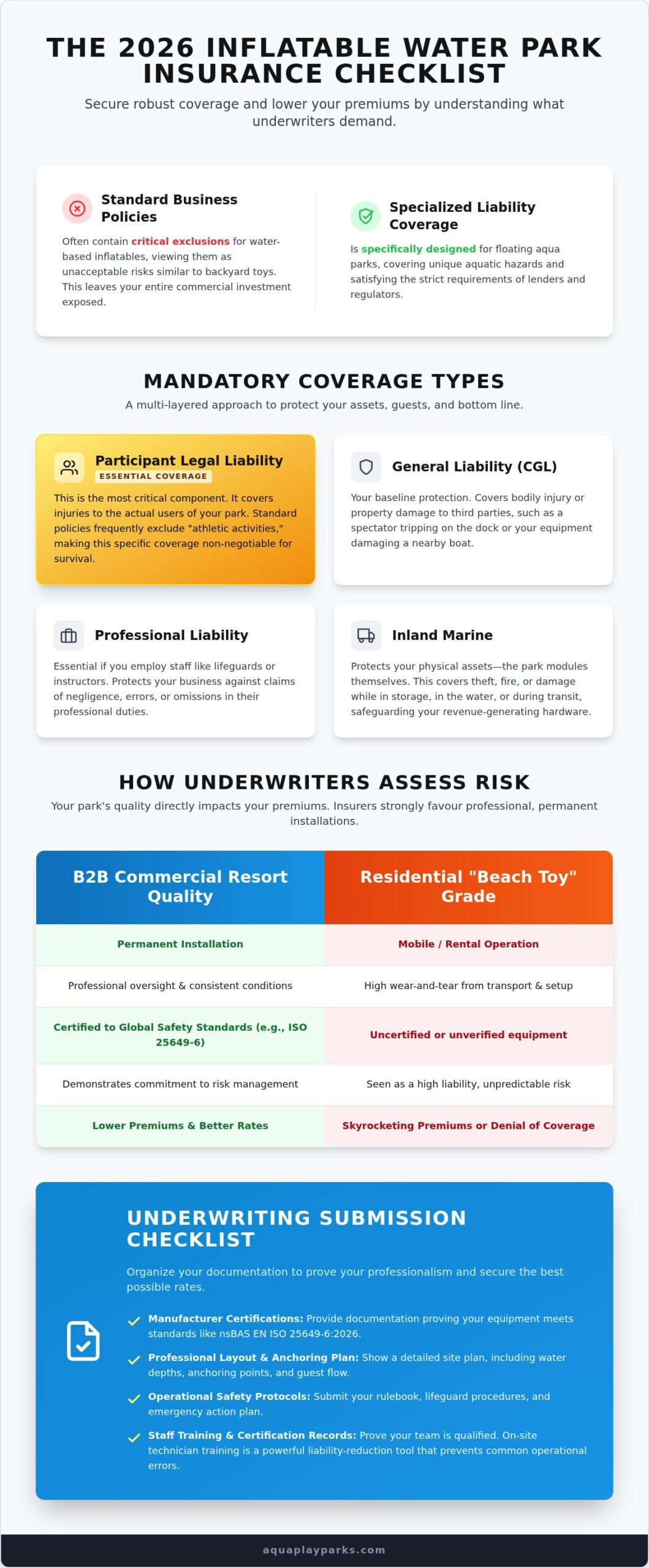
Imagine your waterfront transformed into a high-energy obstacle course where guests push their limits and create lifelong memories. That vision requires a foundation of absolute security. Inflatable water park liability insurance isn’t just another line item on your balance sheet; it’s a specialized commercial general liability (CGL) policy built for the unique physics of water-based play. Standard business insurance typically views floating attractions as an unacceptable risk. They see “inflatable” and think “backyard party,” but your commercial resort deserves better. Most general policies explicitly exclude water-based inflatables because they lack the specific underwriting expertise to assess aquatic hazards.
This specialized coverage protects your business against the “big three” catastrophic risks. First, it covers bodily injury, which is critical when guests are running, jumping, and climbing in a wet environment. Second, it handles property damage. If a storm causes an anchor to fail and your massive slide drifts into a neighbouring marina, you’re covered. Third, and perhaps most importantly, it covers legal defence costs. Even if you’ve done everything right, the cost of proving your innocence in court can bankrupt an unprotected business. Adhering to Inflatable amusement safety standards like ASTM F2374-22 is the first step in proving your park is a professional operation, not a collection of uncertified beach toys.
To further insulate your bottom line, many operators add participant accident insurance. This acts as a first-line defence by covering immediate medical expenses for guests regardless of fault. It’s a pragmatic tool that often prevents minor scrapes from escalating into expensive liability claims.
The Difference Between Rental and Permanent Installation Insurance
Land-based “bounce house” insurance is a completely different beast. Land-based risks focus on impact with the ground, whereas floating aqua parks deal with drowning risks, current management, and complex anchoring systems. Interestingly, permanent commercial installations often realize better rates than mobile rental companies. Insurers prefer the stability of a fixed location where water depth profiles are consistent and equipment isn’t subjected to the daily wear and tear of being packed into a truck. A permanent resort-grade setup suggests a higher level of professional oversight.
Who Needs a Specialized Policy?
If you’re generating revenue from the water, you need this coverage. This includes campgrounds and RV parks looking to modernize their waterfront, as well as high-end commercial resorts and hotels adding floating obstacle courses to their amenities. Even municipalities and private lakefront owners must secure these policies to satisfy local regulations and protect public funds. Don’t settle for “close enough” coverage. Demand a policy that recognizes the B2B commercial resort quality of your installation.
Mandatory Coverage Types for Floating Aqua Parks
Secure your commercial vision with a fortress of protection. When you invest in a world-class floating park, you can’t rely on a “one size fits all” policy. You need a suite of coverages that recognize the unique risks of the waterfront. General Liability is your baseline. It protects you if a passerby trips on the dock or if your equipment causes damage to a neighbouring boat. But the real heavy lifter is Participant Legal Liability. This is what covers the actual users of your park. Without it, you’re flying blind. Standard policies often hide exclusions for “athletic activities,” so ensuring your inflatable water park liability insurance specifically includes participant coverage is vital for survival.
If you employ lifeguards or instructors, Professional Liability is non-negotiable. It protects against claims of negligence in supervision or instruction. Meanwhile, Inland Marine insurance protects your physical assets. Whether your modular obstacle pieces are in the water or stored for the winter, this covers theft, fire, or damage during transit. It’s about protecting the hardware that generates your revenue. Implementing strict Operational safety protocols isn’t just about guest safety; it’s a strategic move to make your park attractive to underwriters who want to see proactive risk management. If you’re looking to elevate your park’s profile, choosing B2B commercial resort quality equipment naturally reduces these risks from the start.
Setting Your Coverage Limits
Setting the right limits is a strategic business decision. Most commercial venues now require $1 million per occurrence and a $2 million aggregate limit at a bare minimum. If you’re running a larger park, an Umbrella or Excess Liability policy provides that extra layer of comfort. It’s often required by municipal or state bodies before they’ll even grant a permit. Don’t guess on these numbers. Check your local regulations to ensure your inflatable water park liability insurance satisfies every legal requirement for your specific state.
Critical Endorsements to Request
Don’t overlook the fine print in your policy documents. You need specific endorsements to make your coverage truly functional. An “Additional Insured” endorsement protects the municipality or landlord whose water you’re using. A “Waiver of Subrogation” prevents your insurer from seeking recovery from your partners after a claim. Most importantly, check for “Watercraft” or “Drowning” exclusions. If these aren’t removed, your policy is effectively worthless the moment a guest hits the water. A professional operator knows that a cheaper policy with these exclusions is no bargain at all.
Commercial Quality vs. Residential Risks: What Underwriters Look For
Underwriters aren’t fooled by bright colours and impressive shapes. They look at the structural integrity and the engineering behind the fun. When you apply for inflatable water park liability insurance, the first thing an insurer evaluates is whether your equipment is a professional-grade asset or a glorified beach toy. “Beach toy” grade products, often made from thin PVC with single-stitch seams, are a red flag for any serious underwriter. These residential-style units lack the durability to withstand the relentless sun, salt, and high-volume traffic of a commercial resort. Choosing the right equipment isn’t just a design choice; it’s a financial one that dictates your insurability. Understanding the commercial vs residential inflatable water park standards is essential to realizing a lower risk profile and protecting your bottom line.
Material thickness and seam reinforcement are the twin pillars of risk assessment. Commercial-grade inflatables use heavy-duty, UV-resistant materials designed for years of interactive play. More importantly, your anchoring system must be professionally engineered. Statistics show that improper anchoring causes 35% of all inflatable rental lawsuits. Under the ASTM F2374-22 update, any unit over 400 square feet requires stakes of at least 24 inches or an equivalent weighted anchoring system. If your anchors fail, your liability becomes catastrophic. Underwriters reward operators who can prove their park is secured by professional-grade systems rather than improvised weights.
The “Monster Slide” Factor
High-adrenaline attractions are your biggest revenue drivers, but they also carry the highest perceived risk. Insurance companies pay close attention to inflatable monster water slides because of their sheer scale and capacity. To manage this risk, you must implement strict safety protocols for high-capacity pieces. This includes specific water depth requirements, such as the 3.5 to 4.5 metres needed for slides over 4 metres high. When you demonstrate that your monster attractions meet or exceed EN ISO 25649-1:2024 standards, you move from being a “high-risk” operator to a “preferred” client.
Standardizing Your Safety Equipment
Consistency is the friend of the underwriter. A mandatory life jacket (PFD) policy is often a non-negotiable requirement for securing inflatable water park liability insurance. Beyond PFDs, your park must feature clear signage and enforced rules that serve as defensive evidence in the event of a claim. Certified commercial equipment is simply easier to organize for an underwriter. It comes with manufacturer specifications and safety certifications that provide a clear paper trail of professional intent. By standardizing your safety gear, you prove that your park is a controlled, professional environment rather than a chaotic playground.
Your Underwriting Submission Checklist: Securing the Best Rates
Don’t leave your premium to chance. A disorganized insurance application signals a disorganized operation to an underwriter. To secure the most competitive rates for inflatable water park liability insurance, you must present your business as a low-risk, high-precision machine. Underwriters are risk-averse by nature. Give them every reason to say yes by providing a comprehensive data package that proves your commitment to safety. This isn’t just paperwork; it’s your primary tool for driving down the cost of doing business.
- Step 1: Document your park layout and water depth profiles. Provide a professional site map showing exactly where each modular piece sits and the corresponding water depths. Clear boundaries between high-energy zones and rest areas show you understand crowd flow and safety zones.
- Step 2: Provide manufacturer specifications and commercial certifications. Include technical data sheets that prove your equipment meets B2B commercial resort quality standards. This separates your park from uncertified “beach toy” operations in the eyes of the insurer.
- Step 3: Submit your operational safety manual and lifeguard ratios. Detail your supervision plan clearly. Underwriters want to see that your staff-to-guest ratios meet or exceed state-mandated requirements.
- Step 4: Detail your daily inspection and maintenance logs. Show them your history. A documented trail of daily pressure checks and seam inspections proves you’re proactive, not reactive, which lowers your perceived risk.
- Step 5: Present your staff training and emergency response protocols. Prove your team is ready for anything. Include certifications and training schedules to demonstrate professional readiness for all aquatic scenarios.
Proving Operational Competence
Your legal fortress is only as strong as your smallest waiver. Organize your release forms for a thorough legal review to ensure they’re airtight according to the laws of your specific state. If you’re an entry-level operator, documenting your use of The Campers Starter Park can actually work in your favour. It shows you’ve chosen a manageable, high-quality system designed for safety. A clean safety record is your most valuable asset. Protect it fiercely by implementing rigorous standards from day one. If you’re ready to build a park that underwriters will love, start your custom design journey today.
Negotiating Your Premium
Everything is negotiable if you have the data to back it up. Ask your broker for “Seasonality Credits” if your park only operates during the peak summer months. There’s no reason to pay full-year rates for a four-month season in regions with distinct seasonal operations. You can also bundle your inflatable water park liability insurance with other resort amenities to find hidden savings. Choosing a water park starter package for campgrounds simplifies the entire application process. These packages are often pre-vetted by insurers who recognize the specific safety configurations and commercial durability of the components.
How Aqua Play Parks Training Minimizes Operational Liability
Professional training isn’t a luxury. It’s your most potent defensive weapon. When you invest in on-site technician training, you’re buying more than knowledge. You’re buying credibility with your insurer. Underwriters look for reasons to trust your operation. Proving that your team has been trained by the manufacturers themselves transforms your park from an “uncontrolled hazard” into a “managed risk.” This distinction is the secret to securing inflatable water park liability insurance at rates that actually make sense for your business.
Anchoring failures are the leading cause of industry lawsuits. They don’t happen because of bad luck; they happen because of bad setup. Our technician training ensures your anchoring systems are tensioned correctly and monitored daily. We teach your staff to recognize subtle signs of wear and tear before they escalate into a liability claim. By empowering your team to spot a fraying strap or a pressure drop early, you stop accidents before they occur. This proactive stance is exactly what an insurance company wants to see in your daily logs.
Certified Installation vs. DIY Setups
Underwriters realize that human error is the biggest variable in any aquatic attraction. DIY setups are an invitation for high premiums and frequent exclusions. In contrast, professionally installed modular floating parks signal a level of expert oversight that insurers prefer. When you can prove your team is expert-trained, you eliminate the “guesswork” that leads to accidents. It’s about building a culture of safety that starts the moment the equipment hits the water and continues through every daily inspection.
Designing for Safety and Profit
Safety starts on the drawing board. A custom inflatable water park design doesn’t just maximize fun; it eliminates “blind spots” for your lifeguards. We engineer sightlines into the layout, ensuring that every corner of the park is visible to your safety team. This balance of high-intensity excitement and manageable risk is what defines a world-class destination. Finalizing your park plan with insurability in mind ensures that your inflatable water park liability insurance application is a formality rather than a fight. You’re not just building a park; you’re building a sustainable, protected business.
Secure Your Waterfront Legacy and Command Better Rates
You’ve seen how the right equipment and a rigorous safety culture transform an unpredictable venture into a high-performance asset. Insurability is a choice you make during the design phase. By prioritizing B2B commercial-grade durability and professional on-site technician training, you send a clear signal to underwriters that your operation is elite. Don’t let your investment be sidelined by a lack of specialized inflatable water park liability insurance or a disorganized submission. Our 35 years of industry-leading design experience ensures your layout isn’t just exciting; it’s engineered for maximum safety and minimal liability.
It’s time to turn your vision into a protected, profitable reality where the only things soaring are your guest numbers and your ROI. We are here to help you every step of the way to ensure your park meets the most stringent 2026 standards. Build something that lasts and gives you the peace of mind you deserve as an operator.
Talk to our designers about building an insurable, high-ROI park
Frequently Asked Questions
How much does inflatable water park liability insurance cost in 2026?
Annual premiums for small commercial operators typically range between $1,800 and $3,000. Growing businesses with up to 15 units should budget between $3,000 and $9,000. These rates depend on your fleet size, revenue, and claims history. Investing in B2B commercial resort quality equipment often helps you secure the lower end of these ranges by proving a commitment to durability.
Do I need a separate policy for my lifeguards?
You don’t necessarily need a separate policy, but you must ensure your general liability includes a professional liability endorsement. This specific coverage protects your business against claims of negligent supervision or improper instruction. Without it, your inflatable water park liability insurance might leave you exposed if a lifeguard fails to act during an incident. It’s a critical layer for any professional operation.
Will my existing campground insurance cover a floating aqua park?
Most standard campground policies explicitly exclude water-based attractions because they lack the specific underwriting expertise for aquatic hazards. You’ll likely need a specialized rider or a standalone policy designed for floating aqua parks. It’s vital to check your current exclusions to ensure your new commercial investment isn’t completely unprotected from day one. Don’t assume your general policy covers the waterfront.
What is the most common reason for an insurance claim at a water park?
Improper anchoring is the culprit behind 35% of all inflatable rental lawsuits. When a unit isn’t secured to ASTM F2374-22 standards, wind or guest movement can cause catastrophic failures. This is why we emphasize on-site technician training. Professional setup is your best defence against the industry’s most frequent and expensive legal battles. A well-anchored park is an insurable park.
Can I get insurance for a park on a private lake?
Yes, you can secure coverage for private lakefront installations as long as you meet specific safety requirements. Underwriters will examine your water depth profiles and public access controls. Private lake operators often enjoy more stable rates because they have greater control over the environment compared to public beaches or high-traffic marinas. It’s an ideal setting for a controlled, high-ROI attraction.
Are waivers enough to protect me from lawsuits?
Waivers are a critical defensive tool, but they don’t provide absolute immunity from lawsuits. Courts often set aside waivers if they find evidence of gross negligence or equipment failure. Your inflatable water park liability insurance serves as the ultimate safety net when a waiver isn’t enough to stop a determined legal challenge. Think of waivers as your first line of defence, not your only one.
Does the size of my monster slide affect my premium?
The scale of your attractions directly influences your risk profile and premium costs. Larger monster slides require deeper water, typically 3.5 to 4.5 metres, and more rigorous anchoring. While these pieces drive massive revenue, insurers view them as higher-risk units. Providing proof of commercial-grade durability and strict adherence to ISO standards helps mitigate these potential rate increases and proves your operational competence.
How do I find an insurance broker who understands floating water parks?
Look for brokers who specialize in the amusement or aquatic recreation industries rather than general commercial agents. Ask them about their specific experience with floating parks and their access to specialized underwriters. A broker who understands the difference between a “beach toy” and a resort-quality installation will be much more effective at negotiating your rates. They should speak the language of ASTM and ISO standards.
Leave a Reply