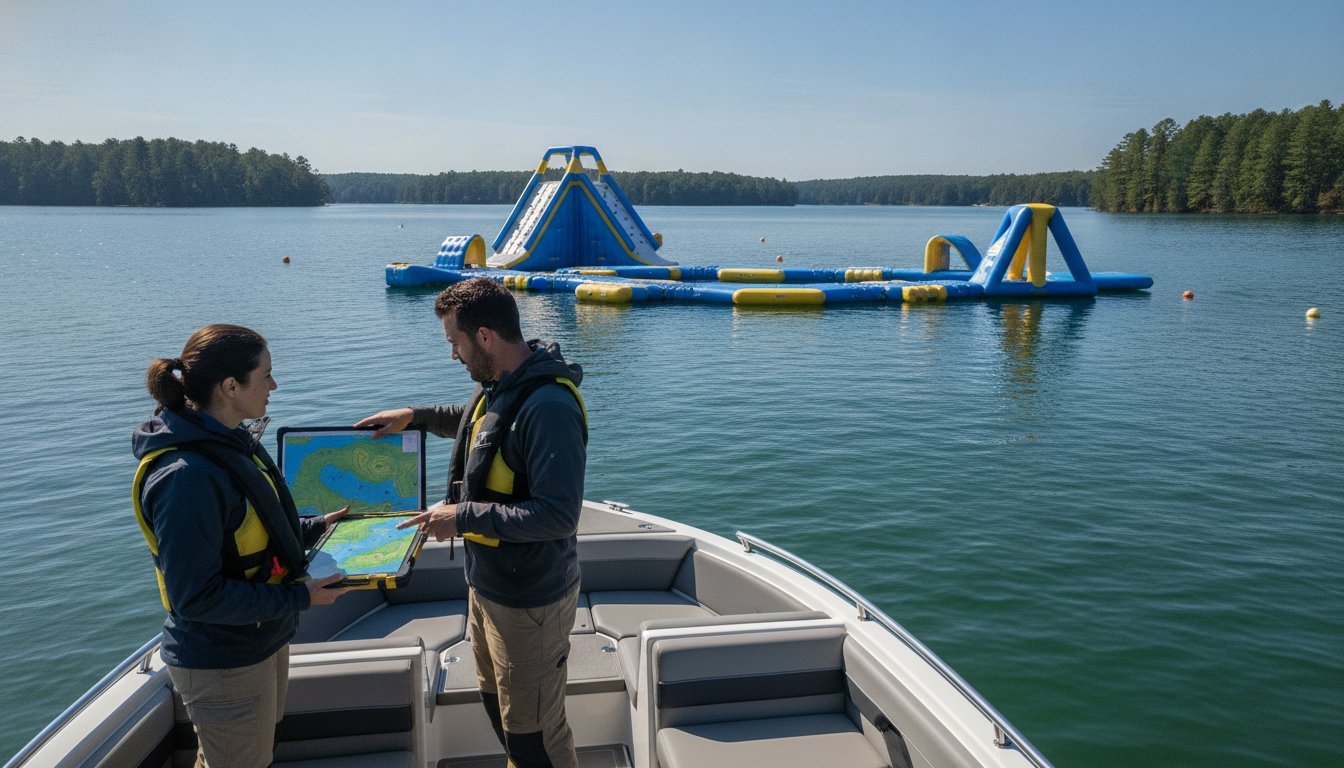
Did you know that improper anchoring accounts for 35% of all inflatable rental lawsuits? It’s a staggering reality that keeps many ambitious resort owners awake at night as they realize the potential risks. You want to build a destination that draws massive crowds, but the fear of equipment drifting away or facing a liability claim is real. You’re right to be cautious. A single mistake in evaluating water depth or lakebed composition while conducting a site assessment for floating water park installations can turn a visionary project into a costly recovery mission.
It’s time to replace that uncertainty with absolute confidence. Master the technical protocols and environmental standards required for a high-stakes waterfront setup so your park becomes the centre of attraction. This 2026 commercial guide provides the roadmap you need to protect your investment. Protect your guests. We’ll outline the essential assessment timeline, explain how to verify anchoring integrity, and help you organize a training plan so your staff can manage the park with expert precision. Let’s build something massive, safe, and incredibly profitable.
Key Takeaways
- Learn how to execute a precise site assessment for floating water park installations, focusing on critical water depth and lakebed composition to ensure your monster slides stay secure.
- Compare advanced anchoring solutions, from concrete blocks to screw-in earth anchors, to build a foundation that withstands wave tension and high-capacity use.
- Master the professional installation protocol for commercial-quality PVC, including high-volume inflation techniques that preserve the lifespan of your equipment.
- Discover why on-site technician training is the ultimate liability shield, empowering your team to perform daily maintenance checks with total confidence.
- Leverage 35 years of Canadian design expertise to transition from a “Campers Starter Park” to a massive, custom-engineered revenue generator.
Pre-Installation: Site Assessment and Environmental Engineering
Stop treating your waterfront like a backyard pool. A rigorous site assessment for floating water park development is the line between a thriving resort and a logistical nightmare. You need to map every centimetre of that lakebed before the first anchor drops. This isn’t just about aesthetics; it’s about environmental engineering and high-stakes safety. You’re building a destination, and that requires a foundation that can withstand the unpredictable energy of open water. This isn’t a hobby; it’s a high-performance business model that demands precision from day one.
Start by calculating your swing radius with total accuracy. Every modular piece moves with the wind and current. If you don’t account for the total arc of your anchoring chains, your equipment could drift into shallow water or collide with submerged hazards. This calculation must include the length of your heavy-duty chains plus the width of the modules themselves. Precision here prevents equipment loss and keeps your liability risks low. You want your park to stay exactly where you put it, regardless of the weather.
Water Depth and Safety Clearance
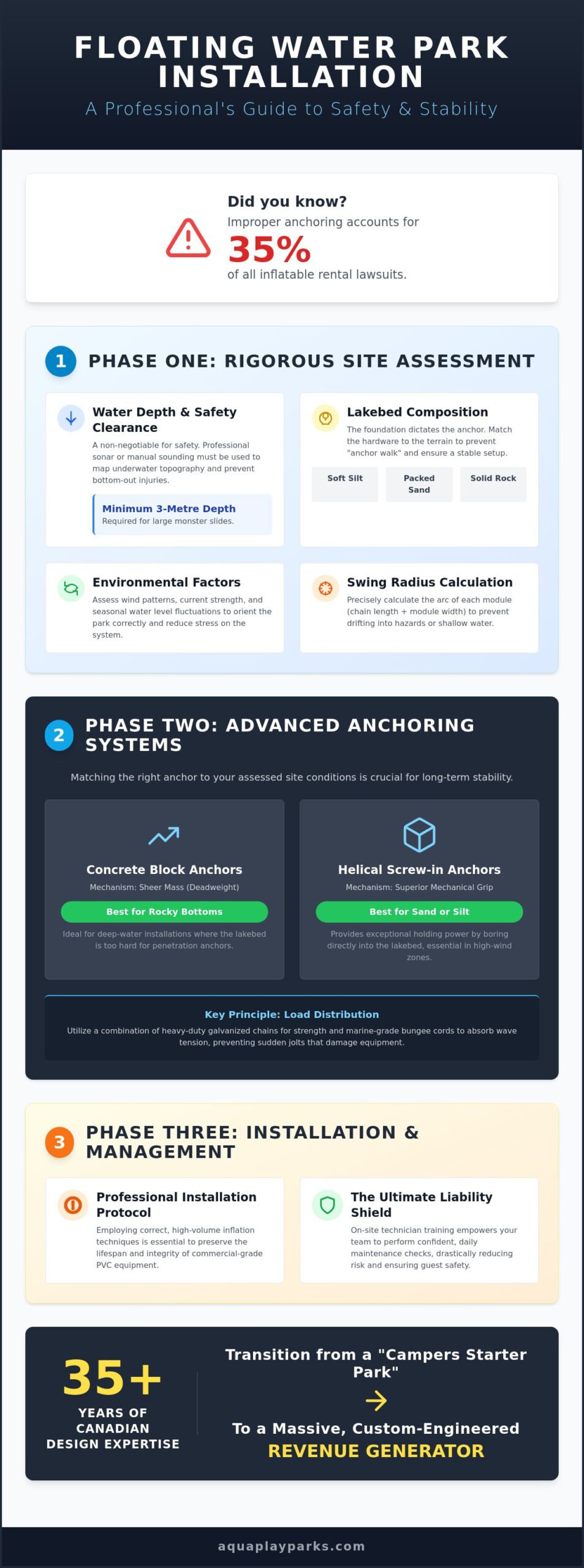
Impact zones are non-negotiable. For the world’s largest monster slides, you must establish a minimum 3-metre safety zone to prevent bottom-out injuries. Mapping the underwater topography is vital to your success. You need to identify sudden drop-offs or hidden boulders that could pose a risk during high-velocity entries. Most modern inflatable water slides are designed for deep-water deployment, so ensuring your site meets these technical requirements is the first step toward a profitable season. Don’t guess the depth; use professional sonar or manual sounding to verify the entire footprint of the park.
Environmental Impact and Permit Navigation
Your lakebed composition dictates your entire foundation. Whether you’re dealing with soft silt, packed sand, or solid rock, your anchor type must match the terrain to prevent “anchor walk.” In many US jurisdictions, you’ll need to prove your site assessment for floating water park installation won’t disturb local ecosystems or cause shoreline erosion. You must also account for seasonal water level fluctuations. A site that looks perfect in June might be dangerously shallow by August. By assessing wind patterns and current strength early, you can organise your park’s orientation to face the elements head-on. This reduces stress on the commercial-grade PVC and the anchoring system, showing regulators you’re a seasoned, hands-on expert who values both safety and sustainability.
Engineering the Foundation: Advanced Anchoring Systems
If your foundation fails, your entire investment drifts. It’s that simple. While the previous phase focused on mapping the terrain, this stage is about engineering the hold. You aren’t just tossing weights overboard; you’re deploying Advanced Anchoring Systems designed to fight back against the relentless pull of the tide. Your site assessment for floating water park success hinges on matching your hardware to the specific density of your lakebed. A professional site assessment for floating water park stability must account for both vertical and lateral forces long before the first guest climbs aboard.
Concrete block anchors, or deadweight anchors, are the workhorses for deep-water installations where the bottom is too rocky for penetration. They rely on sheer mass. Conversely, helical screw-in earth anchors provide superior grip in sandy or silty environments by literally boring into the ground. If you’re operating in a high-wind zone, these screws are your best friend. They offer a mechanical advantage that concrete simply can’t match. Standalone pieces like massive iceberg climbers require their own dedicated weight calculations to prevent tipping during peak capacity. You can’t afford to guess here. Every kilogram of ballast must be accounted for in your engineering plan.
Anchor Types and Load Distribution
Load distribution is where the math meets the water. You must organize your tension lines to ensure that no single module bears the brunt of a storm. Utilizing a combination of heavy-duty galvanized chains and marine-grade bungee cords allows your park to breathe. The chains provide the strength; the bungees manage the wave tension. This setup prevents the sudden jolts that can tear D-rings or separate modular segments. If you want a layout that stays tight during a Saturday rush, consider Floating Aqua Park Designs that prioritize these commercial engineering realities.
Connecting the Modular Grid
Creating a grid-based anchoring map is essential for complex interactive running tracks. You need to visualize the entire installation as a single, cohesive unit rather than a collection of separate toys. This means ensuring seamless transitions between your 3m, 5m, and 10m segments. Every connection point must be tested for commercial-grade durability. We use technical protocols that secure the waterproof obstacle pieces with redundant fasteners. This isn’t just about keeping the park together. It’s about guest safety. When a hundred people are sprinting across your track, those connections are the only thing standing between a perfect day and a liability claim. Realize that your grid is only as strong as its weakest link.
The Professional Installation Protocol: A Step-by-Step Guide
Execution is everything. You’ve mapped the water and engineered the anchors; now it’s time to bring the vision to life. A professional installation follows a rigid sequence: unpack, inspect, inflate, and position. Skipping even one of these steps compromises the integrity of your B2B commercial resort quality equipment. This phase is where your thorough site assessment for floating water park success finally pays off. You aren’t just blowing up toys. You’re deploying a massive, money-earning infrastructure that must perform under pressure from day one.
Start with a meticulous surface inspection of your commercial-grade PVC on a clean, protective tarp. Look for any shipping abrasions before the modules ever touch the water. Once verified, utilize high-volume professional air pumps to reach the optimal PSI. Timing is critical here. You must account for thermal expansion. On a scorching July afternoon, the air inside your modules will expand; if you over-inflate in the cool morning, you risk stressing the seams by midday. Conversely, a drop in temperature can leave your park looking soft. Constant monitoring during the first 48 hours is mandatory to maintain the structural rigidity your guests expect. Aligning your layout with the USACE Master Plan Guidelines ensures your final positioning respects regional recreational standards and safety buffers.
Safe Deployment and Handling
Preventing friction is your top priority during the land-to-water transition. Dragging heavy PVC across sand or gravel can cause micro-abrasions that shorten the lifespan of your park. Use a team-based carry or rollers to move inflated modules into the water. Every team member must wear proper PPE, including high-visibility vests and water-safe footwear. Efficiency comes from organization. Assign specific roles for valving, tethering, and guiding so the assembly moves with the speed of a professional pit crew. This isn’t just about saving time; it’s about protecting the material that generates your ROI. Before deployment begins, ensure you’ve sourced the right equipment by reviewing the ultimate checklist to buy commercial inflatable water park for sale so every module meets the durability standards your installation demands.
Final Safety Inspections
Before the first guest climbs the ladder, you must verify the integrity of your on-site water park technician training protocols. This is the final fail-safe. Conduct a rigorous walkthrough of the how to operate inflatable water park manual to ensure every valve is double-sealed and every connection point is flush. Look for snag hazards or loose bungee tension that could have shifted during the positioning phase. Your site assessment for floating water park durability concludes only when every module is locked into the grid and the anchoring lines are taut. A final pressure check across the entire park confirms you are ready for high-capacity crowds and maximum impact.
Bridging the Gap: On-Site Technician Training and Liability
A professional site assessment for floating water park installations isn’t a one-and-done event. It’s a continuous operational skill. You can’t just drop the anchors and walk away. If your team doesn’t understand the specific engineering of your park, your ROI is in jeopardy. Staff competency is the vital link between a high-stakes installation and a decade of profitable seasons. It’s about transforming your staff into technical experts who recognize a shifting anchor or a pressure drop before it impacts your bottom line.
Documented technician certification is your most powerful tool for negotiating lower insurance premiums. Underwriters value precision and accountability. They want to see a rigorous, day-by-day maintenance log that proves you’re actively managing risk through every shift. By training staff to mitigate operational hazards in real-time, you protect your guests and your reputation simultaneously. This is how you maintain B2B commercial resort quality for the long haul. It’s about being a visionary leader who understands that safety and profitability are two sides of the same coin.
The Role of the On-Site Technician
Your on-site technician must master the daily inflation adjustment with surgical precision. Temperature swings on the water are relentless. A cool morning requires a different pressure profile than a blistering afternoon. Your team needs to understand the anchoring grid’s mechanics to make mid-season adjustments as water levels fluctuate or currents shift. They must be ready for emergency deflation or weather-related closures with a staccato-fast response time. No hesitation. Just professional execution that keeps your equipment in top-tier condition.
Liability and Guest Safety Protocols
Liability protection requires clear physical boundaries. Your ongoing site assessment for floating water park safety should include a strict “no-go” zone during the setup and testing phase to keep unauthorized personnel away from active work areas. Proper signage and boundary marking are mandatory for Canadian and US waterfronts to meet safety codes. You must also ensure your staff can articulate the commercial vs residential inflatable water park safety differences. High-traffic commercial environments demand a level of material integrity and training that residential products simply can’t provide. Enforce these zones with authority.
Empower your team and shield your business from unnecessary risk. Schedule your On-Site Technician Training now to ensure your park operates at peak performance.
Custom Solutions: The Aqua Play Parks Installation Advantage
Stop settling for generic, off-the-shelf packages that ignore the unique characteristics of your shoreline. You need a partner who understands that every high-ROI waterfront requires a bespoke engineering approach. Our site assessment for floating water park development isn’t just a checklist; it’s the culmination of 35 years of Canadian design and engineering expertise. We eliminate intermediaries. You deal directly with the visionaries who design, build, and train. This straight-talking, high-efficiency partnership ensures that your capital is invested in performance, not middleman markups. We’re here to build a legacy, not just sell a product.
For entrepreneurs launching their first venture, “The Campers Starter Park” provides a seamless, entry-level path to success. It’s the perfect balance of B2B commercial resort quality and manageable scale. We don’t just ship boxes and hope for the best. We provide world-class on-site training that transforms your local team into technical experts. You get the world’s largest money-earning monster slides and the confidence that they are secured by a foundation that can withstand the elements. This is about vision. This is about growth. This is about realizing the full potential of your waterfront destination.
Tailored Designs for Your Waterfront
We don’t believe in one-size-fits-all solutions. We realize your vision through custom inflatable water park design that respects the natural contours of your site. Whether you’re integrating massive pyramid bag jumps or high-impact obstacle courses, our engineering team ensures every piece fits perfectly within your specific safety buffers. You can start with a focused footprint and scale your park with additional modular segments over multiple seasons. This modularity allows you to grow your revenue alongside your guest capacity, ensuring your park remains the premier destination in your region year after year.
The ROI of Professional Setup
Professional installation is an investment in the lifespan of your commercial asset. Expert-led setup reduces early-season downtime and prevents the micro-abrasions that lead to costly repairs. By conducting a rigorous site assessment for floating water park longevity, we identify potential issues before they become operational failures. This proactive approach maximizes your seasonal revenue and ensures your guests enjoy a safe, high-energy experience every single day. We aren’t just a supplier. We are your long-term partner in growth, committed to pushing the boundaries of what’s possible in outdoor recreation. Let’s build something massive together.
Secure Your Vision: The Path to Waterfront Dominance
A successful season starts long before the first guest hits the water. It begins with a meticulous site assessment for floating water park that accounts for every centimetre of depth and every shift in the lakebed. By mastering advanced anchoring systems and following a rigid professional protocol, you eliminate the guesswork that plagues amateurs. You aren’t just buying equipment; you’re building a high-performance commercial engine backed by 35 years of industry-leading design experience. This is about more than fun. It’s about engineering a legacy.
Direct-to-client Canadian expertise ensures your park is built for durability and maximum impact. From the world’s largest money-earning monster slides to modular obstacle tracks, your growth potential is limitless when the foundation is solid. Don’t leave your liability to chance. Empower your team with the technical skills required to protect your investment and your reputation. Ready to transform your waterfront? Book your on-site technician training and installation consultation today.
The future of outdoor recreation is waiting. Let’s build something massive together.
Frequently Asked Questions
How long does a floating water park setup and installation usually take?
A standard commercial installation typically takes between one and three full days to complete. This timeline depends heavily on the scale of your layout and the complexity of the anchoring system chosen during your site assessment for floating water park development. Larger parks featuring monster slides require more time for precise positioning and inflation. We focus on efficiency to ensure your waterfront is revenue-ready as quickly as possible.
What is the minimum water depth required for a commercial aqua park?
Safe operational water depth is generally considered to be between 2.5 and 5 metres. You must maintain a 3-metre safety clearance for high-impact jumping pieces to prevent bottom-out injuries. During your site assessment for floating water park safety, we map the underwater topography to ensure every module sits in a zone that meets these technical requirements. Never compromise on depth; it is the foundation of guest safety.
Do I need a professional diver for the anchoring process?
Professional divers are highly recommended for any installation involving complex screw-in earth anchors or heavy deadweight blocks in low-visibility water. They ensure that your anchoring grid is secured exactly according to the engineering map. While shallow, clear-water setups might be manageable by a trained surface team, a diver provides the level of precision required for high-stakes commercial installations. It’s about getting the hold right the first time.
Can I install a floating water park in a location with high currents?
Yes, you can operate in high-current environments provided your anchoring system is custom-engineered for those specific lateral forces. We utilize heavy-duty galvanized chains and marine-grade bungee cords to manage tension and prevent modular separation. Success in these locations depends entirely on the data gathered during your initial environmental analysis. If the current is too extreme, we adjust the park’s orientation to minimize drag and stress on the PVC.
What kind of maintenance is required after the initial installation?
How many staff members are needed to manage the installation process?
Managing a professional installation usually requires an organized team of four to eight capable individuals. You need enough hands to safely carry inflated modules from land to water without causing abrasions. Assigning specific roles for valving, tethering, and positioning ensures the process moves with speed and precision. Efficiency here protects your investment and prepares your team for the operational demands of the season.
Is it possible to move the park to a different location after it is installed?
Absolutely. The modular design of our floating aqua parks allows for complete relocation if your business needs change. You can dismantle the segments, retrieve the anchors, and re-install the entire park at a new site. This flexibility is a core advantage of inflatable infrastructure over permanent concrete structures. It allows you to adapt to new commercial opportunities or seasonal changes with minimal disruption to your revenue stream.
What happens to the installation during a severe storm or high winds?
Your operational manual includes specific protocols for emergency deflation or park closure during severe weather. If high winds are forecasted, you must secure all loose components and, in extreme cases, deflate the largest pieces to reduce wind fetch. Your anchoring system is designed to handle significant tension, but protecting the PVC from flying debris or extreme surges is vital. Preparation and quick action are the only ways to mitigate storm-related risks.
Leave a Reply