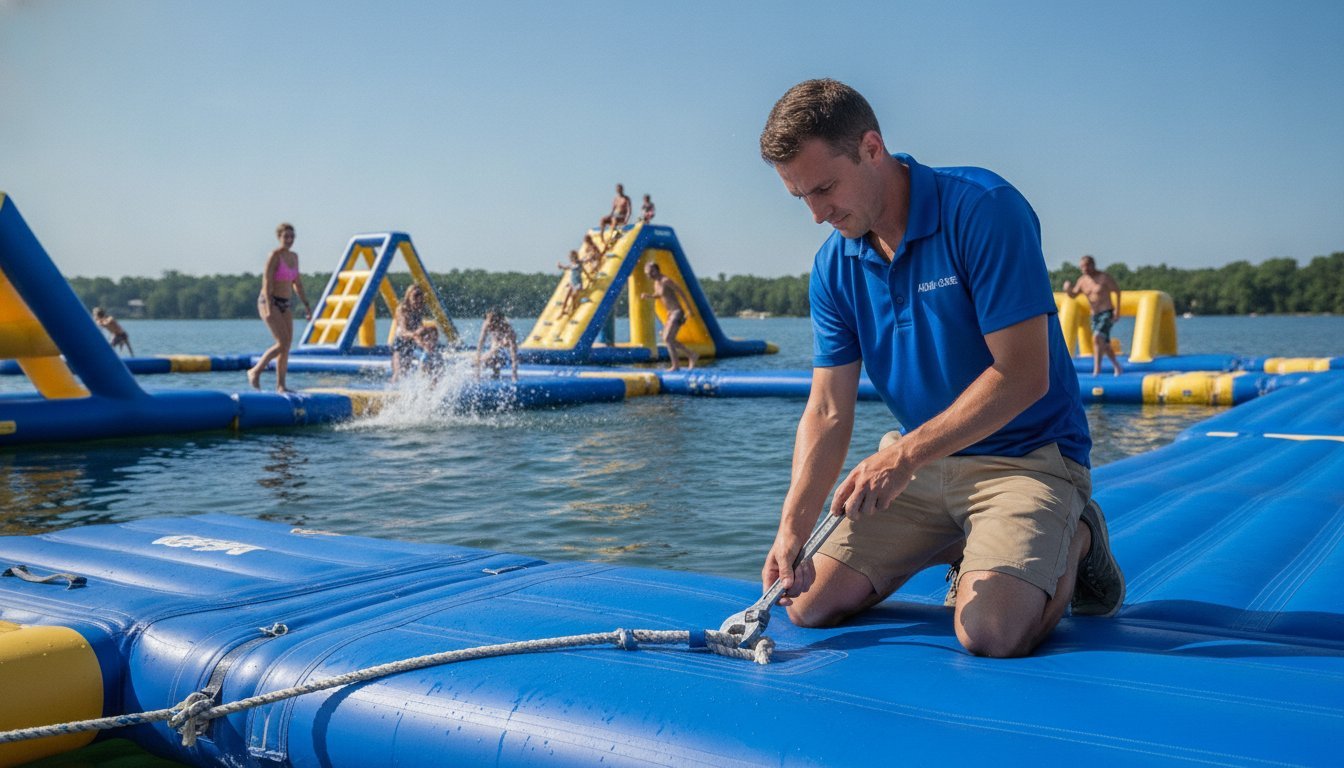
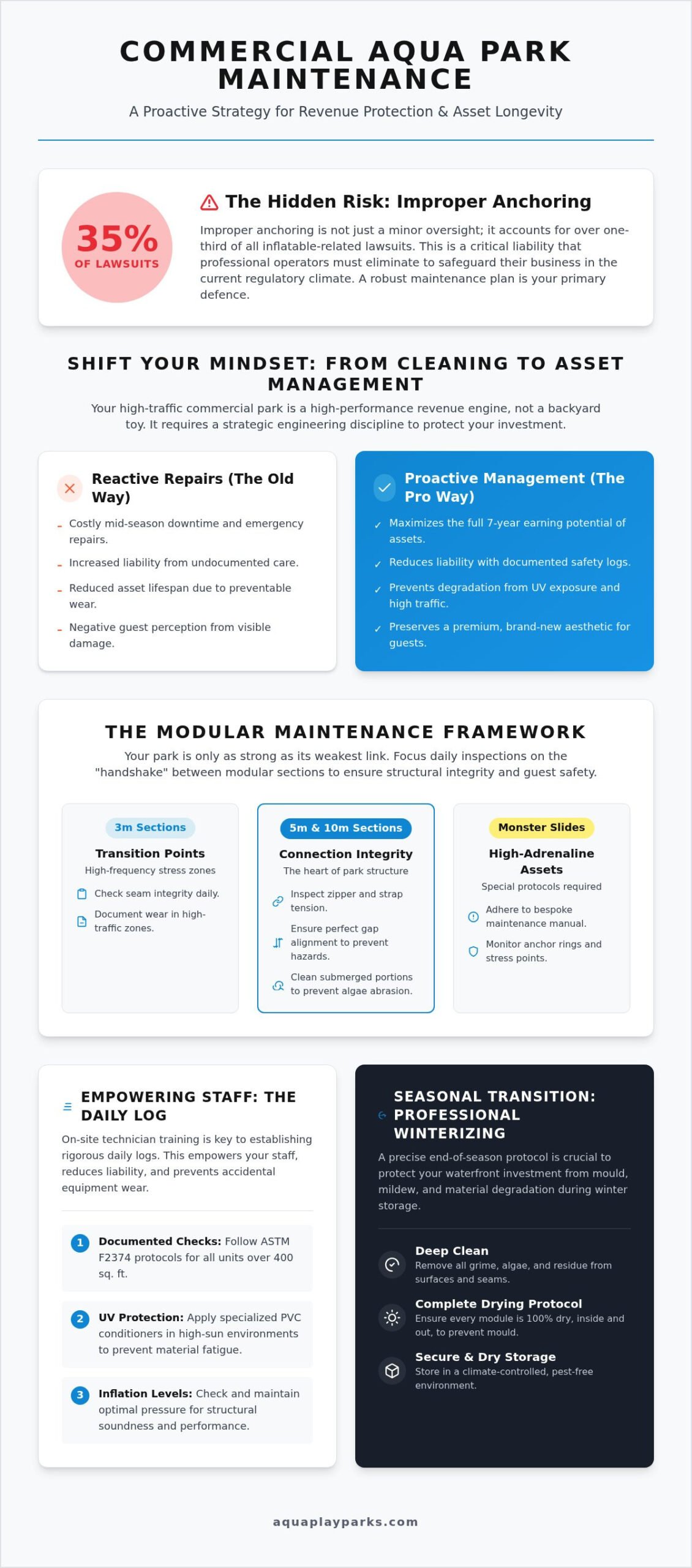
Improper anchoring accounts for 35% of all inflatable-related lawsuits, a risk no serious operator can afford in the 2026 regulatory climate. Your waterfront is a high-performance revenue engine, not a backyard toy. It requires a professional approach to stay profitable. You likely worry about UV rays baking your investment or an inexperienced staff member causing a costly mid-season tear. We realize that protecting your ROI means eliminating these variables before they impact your guests. By mastering commercial inflatable water park maintenance, you shift from reactive repairs to proactive asset management.
This article promises to show you exactly how professional protocols and on-site technician training extend the life of your modular aqua park and safeguard your seasonal revenue. We’ll provide a clear maintenance schedule that maximizes your ROI and reduces liability through documented safety checks. You’re about to discover the path to an attraction that looks brand new and stays safe for every guest, every single season.
Key Takeaways
- Shift your mindset from basic cleaning to a strategic revenue protection system built for high-traffic, commercial-grade resort environments.
- Identify and master the critical inspection points for 3m, 5m, and 10m modular sections to ensure structural integrity and seamless guest transitions.
- Implement a professional commercial inflatable water park maintenance plan tailored for high-adrenaline assets like Monster Slides to maximize their 7-year earning potential.
- Leverage on-site technician training to establish rigorous daily logs that empower your staff, reduce liability, and prevent accidental equipment wear.
- Execute a precise end-of-season deep clean and drying protocol to protect your waterfront investment from mould and mildew during winter storage.
Beyond the Scrub Brush: Maintenance as a Revenue Protection Strategy
Stop viewing a bucket of soapy water as your primary maintenance tool. In the high-stakes world of resort recreation, commercial inflatable water park maintenance is a sophisticated engineering discipline designed to protect your most valuable waterfront asset. You aren’t just cleaning PVC; you’re executing a proactive system to ensure your park reaches its full seven-year lifespan. While a residential toy might survive a few weekends of light use, your B2B commercial resort quality installation faces hundreds of guests daily. Treating these two categories the same is a recipe for financial disaster. Consistent upkeep is the only way to realize the massive revenue potential of attractions like our world-leading Monster Slides.
Safety isn’t a suggestion; it’s your biggest liability shield. The history of inflatable safety regulations proves that documented, rigorous care is what separates successful operators from those facing ruinous legal claims. A well-maintained park does more than just stay safe. It preserves the high-end aesthetic your premium resort guests expect. When a visitor sees a vibrant, structurally sound aqua park, they see a premium experience worth the entry fee. When they see faded colours or sagging modules, they see a risk. Your maintenance log is your most effective marketing tool.
The ROI of Rigorous Upkeep
Downtime is a silent killer of seasonal profits. Every hour a module is out of the water for mid-season repairs is an hour of lost revenue that you can never recover. We’ve found that a disciplined daily maintenance schedule costs a fraction of a single emergency repair. Proper care also fights the relentless degradation caused by UV exposure. In high-intensity sun environments, specialized PVC conditioners prevent material fatigue and keep your park looking brand new. Understanding the commercial vs residential inflatable water park distinction is the foundation of this logic. You’ve invested in professional-grade gear; protect it with professional-grade protocols.
Engineering for Longevity
Commercial inflatables are complex structures with specific stress points at seams and anchor rings. These aren’t random. They are calculated zones of tension designed to handle the kinetic energy of a thousand jumping kids. Because every Aqua Play Park is a custom design, a generic checklist won’t suffice. You need a bespoke maintenance manual that addresses your specific layout. With 35 years of industry experience, we design our parks to be “maintainable” from day one. We identify the high-traffic zones in your 3m, 5m, or 10m modules and show you exactly how to monitor them. This direct approach eliminates complexity and ensures your staff focuses on what actually matters for the park’s structural health.
The Modular Maintenance Framework: Caring for 3m, 5m, and 10m Sections
Your modular aqua park is only as strong as its weakest link. In a high-traffic resort, those links are the connection points between your 3m, 5m, and 10m sections. Precision is everything. When you organize your daily commercial inflatable water park maintenance, the focus must be on the “handshake” between modules. Misaligned pieces aren’t just an eyesore; they’re a trip hazard and a point of mechanical stress that can lead to premature failure of the waterproof zippers and connection sleeves. We realize that a seamless running track is what keeps guests coming back, and that starts with a rigorous inspection of every modular interface.
Inspecting Connection Integrity
Check the gaps. Tighten the straps. Protect the revenue. You must perform daily checks for gap alignment between modular obstacle pieces to prevent guest entrapment. Following ASTM F2374 maintenance protocols ensures your anchoring and connection systems meet the latest 2026 safety requirements for units over 400 square feet. Don’t forget the underside. Cleaning the submerged portions of your 5m and 10m modules prevents algae-induced friction. Algae isn’t just slippery; it acts as an abrasive against the PVC, slowly grinding away at the structural integrity of your connection points. If you want to optimize your layout for easier daily inspections, consult with our design experts to refine your park’s configuration.
Pressure Management in the Canadian and American Sun
The sun is both your best friend and your worst enemy. Thermal expansion can turn a perfectly inflated module into a ticking time bomb by mid-afternoon. You must realize when a module is over-inflated. A rock-hard surface isn’t “firm”; it’s a sign of dangerous internal pressure that can blow out seams. Use high-accuracy pressure gauges to maintain the perfect “bounce” for guest performance across the entire modular floating water park. Standardizing pressure across the 3m, 5m, and 10m interactive running track pieces ensures a smooth, predictable experience for guests. A soft module is a slow module, and a slow module kills the high-adrenaline energy of your park. Maintain the PSI, maintain the momentum.
Managing this modular system requires a dedicated approach to the waterproof zippers and connection sleeves. These aren’t just accessories; they’re the tendons of your park. Apply specialized lubricants to zippers weekly to prevent salt or mineral buildup from jamming the mechanism. Addressing minor wear on a connection sleeve today prevents a total module failure in August. High-impact outcomes require high-impact attention to detail.
Scaling Up: Maintenance Protocols for Monster Slides and Standalone Attractions
Scaling up to the giants requires a shift in intensity. Your inflatable monster water slide is the crown jewel of your park. It’s a high-maintenance, high-reward asset that demands more than a cursory glance. These massive structures generate the highest guest throughput, which means they also experience the most friction and mechanical stress. Effective commercial inflatable water park maintenance for these standalone attractions focuses on structural stability and surface speed. If the slide isn’t fast, the revenue slows down. If the supports aren’t rigid, the safety risk skyrockets. We realize that your biggest earners need the most specialized care to keep the cash flowing.
Maintaining the Monster Slide
The vertical support columns of a monster slide are its backbone. You must check their structural integrity daily. Any loss of pressure in these primary supports can lead to swaying or collapse under the weight of multiple climbers. Beyond the air, focus on the slide surface itself. Lubricate the PVC with specialized, eco-friendly solutions to ensure high guest throughput without the risk of friction burns. This isn’t just about guest comfort; it’s about volume. A fast slide clears the landing zone quicker, allowing more guests per hour. Following established operational safety and maintenance guidelines is critical when managing these high-capacity landmarks. Precision in these checks ensures your monster slide remains a safe, money-earning machine.
Climbers and Bag Jumps: High-Impact Zones
Standalone pieces like Iceberg Climbers and Pyramid Bag Jumps are designed for high-adrenaline action. This means they take a beating. For your climbers, inspect every handle and climbing grip. These are the most common failure points because of the repetitive pulling force from guests. A loose handle isn’t just a repair job; it’s a liability waiting to happen. The Pyramid Bag Jump requires even more technical precision. The landing zone must remain perfectly pressurized to absorb the impact of a jumper without bottoming out or bouncing them off-course. High-capacity attractions require more frequent surface inspections to catch micro-tears before they become mid-season disasters.
- Daily debris checks: Remove any sand or small objects that can act as sandpaper under the force of a jump.
- Biofilm management: High-traffic splash-down areas are breeding grounds for slippery biofilm. Scrub these zones daily to prevent accidental slips during the climb back up.
- Material health: Look for whitening on the PVC, which indicates stress from over-expansion or repetitive impact.
These high-impact zones define the guest experience. If they look worn or feel soft, your park’s perceived value drops. Stay aggressive with your inspections to keep the excitement and the ROI at their peak. You’ve invested in the world’s largest floating slides; don’t let a lack of maintenance dull their impact.
Operational Training: Empowering Technicians to Reduce Liability and Wear
Your equipment is world-class, but your staff is the front line of defence. Even the most robust B2B commercial resort quality PVC can be compromised by an untrained hand. We realize that the human element is often the biggest variable in your ROI equation. This is why on-site technician training is a non-negotiable part of our operational design. You aren’t just hiring summer students; you’re building a team of asset protectors. Effective commercial inflatable water park maintenance starts with a crew that knows how to listen to the air and look for the subtle signs of material stress before they turn into catastrophic failures.
The On-Site Technician Training Protocol
Train hard. Protect your assets. Our training protocol follows a three-step mastery system designed for high-impact results. First, we teach visual inspection. Technicians learn to spot “stress whitening” in the PVC, a precursor to a seam failure. Second, they master the inflation and deflation cycle. Improperly folding a 10m module can snap internal baffles, leading to unsightly bulges and structural instability. Finally, we provide minor repair training. Your team will know how to apply a professional-grade patch mid-season without pulling the module from the water. This keeps your park open and your revenue flowing.
Documenting Safety for Liability Reduction
A maintenance log is your best friend in a courtroom. If a liability claim arises, your documented daily, weekly, and monthly checks are your primary shield. We help you organize staff schedules to include dedicated “maintenance hours” before the park opens. During this time, technicians verify anchor tension and pressure levels according to North American commercial safety standards. This isn’t busy work; it’s a rigorous safety audit. If you want to ensure your crew is ready for the 2026 season, you can book your on-site technician training session today to lock in your operational excellence.
Empowering your technicians also means giving them the right tools for the job. Staff must be trained on the precise application of commercial-grade cleaning agents and UV protectants. Using the wrong chemicals can strip the protective coating off your PVC, leading to premature fading and “sticky” surfaces that attract algae. When your team understands the science behind the material, they treat the equipment with the respect it deserves. High-energy guest experiences are only possible when the behind-the-scenes engineering is handled with authoritative confidence. Don’t leave your investment to chance; leave it to trained experts who know how to maintain the standard.
Seasonal Transitions: Professional Winterizing for Long-Term Durability
The season doesn’t end when the last guest leaves the water. It ends when your park is safely stored and protected for the winter. Professional commercial inflatable water park maintenance requires a rigorous transition strategy to ensure your gear survives the off-season. We realize that many operators lose years of equipment life during storage, not during operation. Mould, mildew, and improper folding are silent killers of PVC. You’ve built a high-ROI destination; don’t let a sloppy winterization process eat into your next year’s profits. This is the time to be a straight-shooter with your staff. If it isn’t bone-dry, it doesn’t go in the bag.
Winterization: The 35-Year Expert Method
Dampness is your greatest enemy. Even a tiny amount of moisture trapped in a folded 10m module will breed mould that can permanently stain and weaken the PVC. You must dry every inch of the material completely before storage. Use high-volume air movers and specialized PVC conditioners to keep the material supple during the cold months. This prevents the “brittle effect” that leads to cracking when you unfold in the spring. Our 35 years of experience have taught us that folding patterns matter. Avoid sharp creases. Use soft, rolling folds to minimize stress on modular seams and connection points. Store your assets in a climate-controlled environment away from pests. Mice can turn a world-class monster slide into a pile of scrap in a single winter.
Preparing for a Record-Breaking Season
Winter is the perfect time for a hardware audit. Inspect every anchor, bungee, and stainless steel ring in your inventory. Review your previous year’s maintenance logs to identify which pieces showed the most wear. This data-driven approach allows you to order replacements before the spring rush. If you are managing a water park starter package for campgrounds, pay close attention to the smaller interactive pieces. These often see the highest relative traffic and need the most frequent hardware refreshes. A successful spring launch starts in December.
- Hardware Audit: Replace any rusted or frayed connection components immediately.
- Log Review: Analyze where the most frequent repairs occurred to adjust your 2026 layout.
- Inventory Check: Ensure you have a full stock of professional-grade patches and adhesives for the coming season.
Your waterfront investment deserves more than a “good enough” storage plan. It deserves a professional protocol that guarantees longevity. Protect your revenue and your reputation by making winterization a core part of your business strategy. If you want to ensure your team is executing these steps with total precision, contact Aqua Play Parks for a professional maintenance consultation or to book your on-site technician training. Let’s make sure your park looks brand new for every guest, every single season.
Own the Waterfront: The Path to Permanent Profitability
Stop playing small. Your waterfront is a high-performance revenue engine, not a temporary seasonal setup. By mastering commercial inflatable water park maintenance, you’ve moved from being a passive participant to an industry leader. You now realize that rigorous daily logs and professional winterization are the true drivers of seasonal growth. You’ve protected your investment with B2B commercial resort quality engineering and empowered your team to act as asset protectors. This is how you dominate your market and ensure every guest experience is flawless.
Leverage our 35 years of industry design experience to keep your attraction looking brand new. We don’t just sell parks; we provide the professional on-site technician training required to keep them profitable for years. The future of your resort depends on the standards you set today. Take control of your asset’s longevity and eliminate the fear of mid-season downtime. Secure Your Waterfront ROI with Aqua Play Parks. Your most successful season yet is just one protocol away.
Frequently Asked Questions
How often should I perform a full visual inspection of my commercial aqua park?
Perform a full visual inspection every single morning before the first guest enters the water. You must focus on anchor line tension, gap alignment between modular pieces, and the integrity of high-traffic seams. This daily discipline is the backbone of effective commercial inflatable water park maintenance, allowing your team to identify micro-wear before it evolves into a costly repair or a safety liability.
What is the best way to remove algae and biofilm from commercial PVC?
Use soft-bristled telescoping brushes and specialized, eco-friendly PVC cleaners to neutralize buildup without damaging the material. Avoid harsh industrial chemicals or bleach, as these strip the UV-protective coating and weaken the heat-welded seams. Daily scrubbing of submerged sections and splash-down zones prevents slippery biofilm from taking hold and maintains the premium aesthetic of your waterfront.
Can my regular maintenance staff handle repairs on a monster slide?
Your staff should only attempt repairs if they’ve completed professional on-site technician training. Monster slides feature massive vertical support columns and complex internal baffles that require specific patching techniques to ensure structural stability. A botched repair on a high-capacity asset doesn’t just look bad; it creates a significant safety risk that can compromise your entire operation.
How does water temperature affect the air pressure in modular inflatable sections?
Water temperature acts as a constant thermal regulator that can shrink or expand your air volume in minutes. Cooler water causes the air inside to contract, leading to soft modules that kill guest momentum, while the midday sun causes rapid expansion that stresses the seams. You must realize that PSI management is a dynamic task requiring adjustments throughout the day to maintain peak performance.
What are the most common maintenance mistakes that void commercial warranties?
Using high-pressure power washers and storing modules while even slightly damp are the two fastest ways to void your warranty. Power washers can delaminate the PVC layers, while damp storage breeds irreversible mould and mildew that eats through the fabric. Always follow the manufacturer’s drying protocols and use only approved cleaning agents to protect your investment’s legal and physical standing.
Is it necessary to remove the aqua park from the water during a storm?
Yes, you must evacuate the park and potentially remove or deflate sections if wind speeds are forecasted to exceed 25-30 km/h. High winds transform your modules into massive sails, putting extreme stress on your anchoring system and connection points. Prioritize asset protection during extreme weather to avoid the catastrophic equipment loss that often follows improper storm prep.
How long does a commercial-grade inflatable water park typically last with proper maintenance?
A B2B commercial resort quality park typically has a lifespan of 5 to 7 years when backed by a rigorous commercial inflatable water park maintenance program. This longevity is directly tied to how well you manage UV exposure and off-season storage. Parks that skip professional winterizing rarely see the same high-ROI lifespan as those managed with authoritative care.
What specialized equipment do I need for daily maintenance of a large-scale park?
Invest in high-accuracy digital pressure gauges, industrial air movers for rapid drying, and telescoping soft brushes for algae control. You also need a professional-grade repair kit featuring marine-grade adhesives and heat-welding tools. Having the right commercial-grade equipment ensures your technicians can work with the speed and confidence required to keep a massive park operational every day.
Leave a Reply