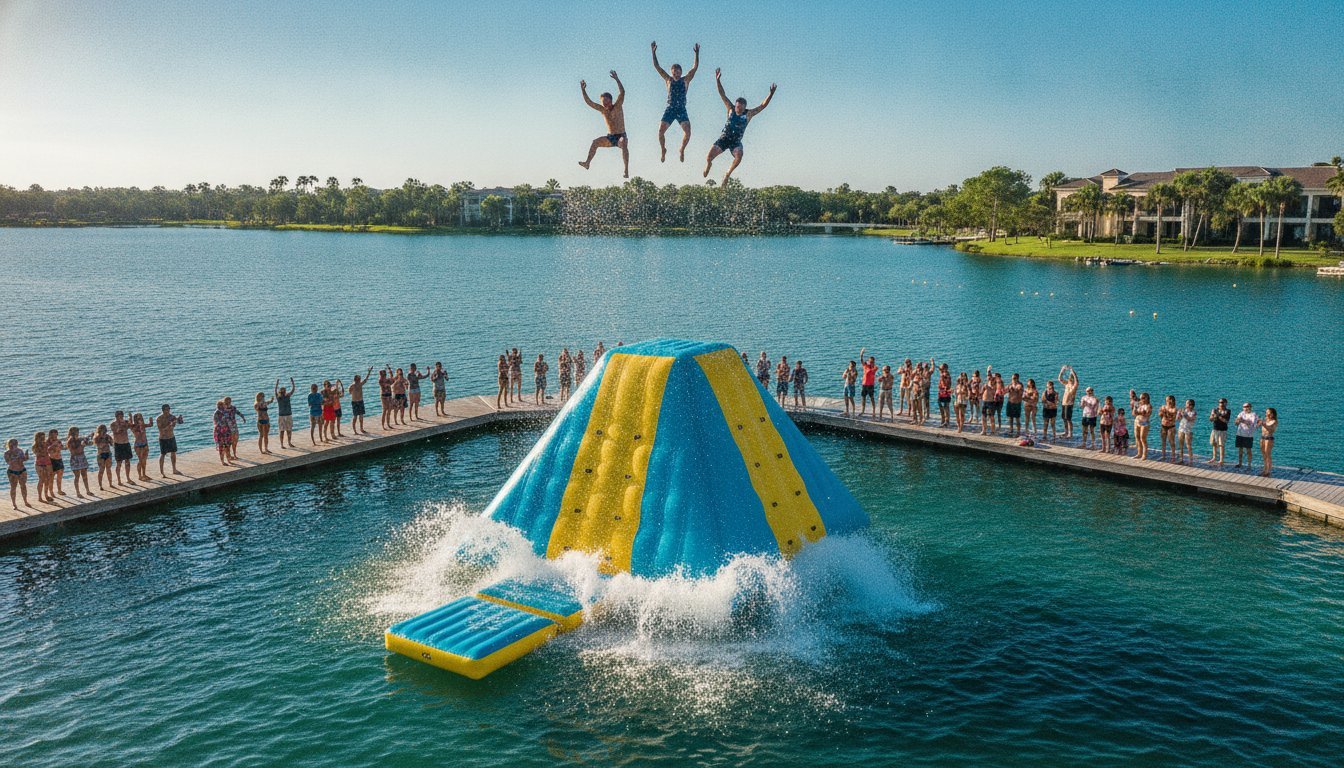
Your shoreline is either earning money or it isn’t. If guests are snapping photos of calm water instead of screaming off a towering floating pyramid bag jump commercial operators are raving about, you’re leaving serious revenue on the table every single season. That’s the hard truth, and most resort owners already feel it.
You’ve probably watched cheap inflatables deflate mid-season, fielded nervous questions from your insurance broker, and wondered why your waterfront still doesn’t have that magnetic, crowd-stopping moment that fills social feeds and drives repeat bookings. Those are real problems, and they compound every year you wait.
This guide is built specifically for commercial waterfront operators who are done settling for flat seasonal numbers and low-durability equipment that costs more to maintain than it earns. By the time you finish reading, you’ll understand exactly how a commercial-grade pyramid bag jump transforms your shoreline into a high-throughput, high-ROI attraction, what separates resort-quality construction from the beach toys your guests will ignore, and how professional on-site technician training turns liability concerns into a genuine operational advantage. We’re covering investment logic, guest throughput, safety protocols, and everything in between.
Key Takeaways
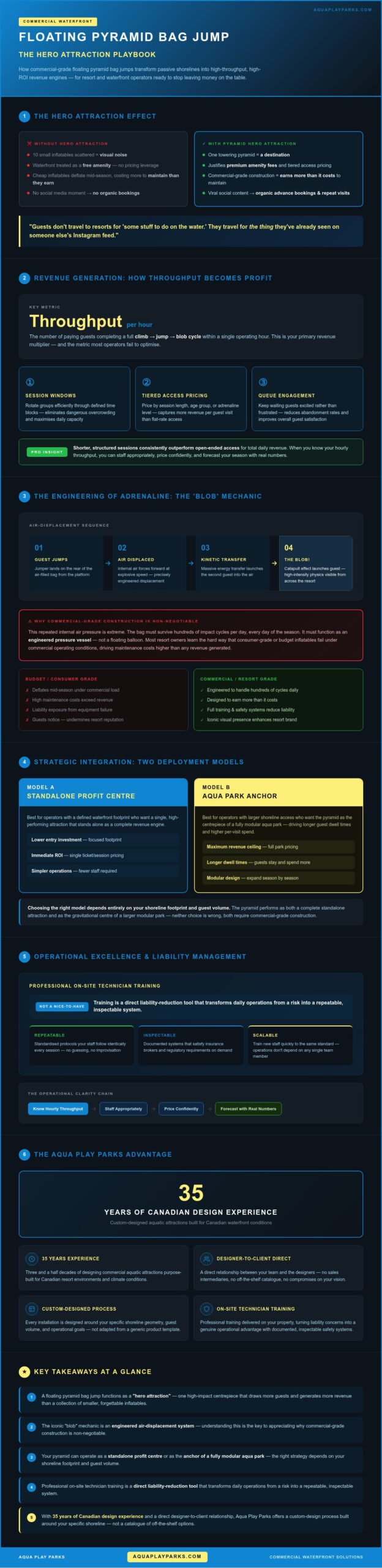
- A floating pyramid bag jump commercial installation functions as a “hero attraction” — one high-impact centrepiece that draws more guests and generates more revenue than a collection of smaller, forgettable inflatables.
- The iconic “blob” mechanic is an engineered air-displacement system, and understanding how it works is the key to appreciating why commercial-grade construction is non-negotiable for resort environments.
- Your pyramid can operate as a standalone profit centre or as the anchor of a fully modular aqua park — and the right strategy depends entirely on your shoreline footprint and guest volume.
- Professional on-site technician training isn’t just a nice-to-have; it’s a direct liability-reduction tool that transforms daily operations from a risk into a repeatable, inspectable system.
- With 35 years of Canadian design experience and a direct designer-to-client relationship, Aqua Play Parks offers a custom-design process built around your specific shoreline — not a catalogue of off-the-shelf options.
Transforming Passive Shorelines: Why Commercial Floating Pyramid Bag Jumps Are the Ultimate Hero Attraction
Picture your waterfront at peak season. Now ask yourself: what’s the one thing guests are pointing at, filming, and lining up for? If you can’t answer that instantly, you don’t have a hero attraction yet. A floating pyramid bag jump commercial installation changes that equation completely. It’s a multi-functional climbing, jumping, and blobbing station engineered for high-capacity commercial use, and it functions as the gravitational centre of your entire waterfront operation.
The psychology here is straightforward. Ten small inflatables scattered across a lake create visual noise. One towering pyramid creates a destination. Guests don’t travel to resorts for “some stuff to do on the water.” They travel for the thing they’ve already seen on someone else’s Instagram feed. A single, iconic hero piece does more marketing work than any ad campaign you’ll ever run, because the guests do it for you.
The Business Case for High-Adrenaline Waterfronts
The broader water park attractions industry has been shifting steadily away from passive, supervised swimming toward active, pay-to-play aquatic experiences. Resorts and campgrounds that have made this transition are justifying premium amenity fees and tiered access pricing that passive shorelines simply can’t support. A hero piece gives you the commercial leverage to charge more per guest, per session, per day. It transforms your waterfront from a free amenity into a revenue-generating attraction with a price point guests are genuinely happy to pay.
The viral dimension is real, too. High-impact visual moments, someone launching off a pyramid peak and crashing into a bag below, generate organic social content that circulates long after the season ends. That’s not a soft benefit; it’s a measurable driver of advance bookings and repeat visits.
Guest Throughput and Revenue Generation
Guest throughput on a 10-metre floating attraction refers to the number of paying participants who can complete a full climb-jump-blob cycle within a single operating hour. That number is your primary revenue multiplier, and it’s the metric most operators fail to optimize.
A well-managed pyramid session structure typically involves:
- Defined session windows that rotate groups efficiently without creating dangerous overcrowding on the structure
- Tiered access pricing by session length, age group, or adrenaline level, capturing more revenue per guest visit
- Queue engagement strategies that keep waiting guests excited rather than frustrated, reducing abandonment rates
Shorter, structured sessions consistently outperform open-ended access when it comes to total daily revenue. When you know exactly how many guests move through the pyramid per hour, you can staff appropriately, price confidently, and forecast your season with real numbers instead of guesswork. That’s the operational clarity a commercial-grade hero attraction delivers.
The Engineering of Adrenaline: Understanding the ‘Blob’ Mechanic and Commercial Durability
The legendary catapult effect that defines a floating pyramid bag jump commercial installation isn’t magic; it’s a precise calculation of air displacement. When one guest jumps from the platform onto the rear of the air-filled bag, the internal air is forced forward with explosive speed. This creates a massive kinetic transfer that launches the second guest into the air. It is high-intensity physics in action. To survive this repeated internal pressure, the equipment must be an engineered vessel, not just a floating balloon.
Most resort owners learn the hard way that “beach toys” are not commercial assets. A consumer-grade inflatable might look similar in a catalogue, but it will typically fail within 30 days of heavy resort use. Commercial durability requires 1000D UV-stabilized PVC and precision-engineered seams that can handle thousands of high-impact cycles without losing structural integrity. If your equipment isn’t built to these specifications, you aren’t investing in an attraction; you’re buying a mid-season headache.
Anatomy of a Commercial Pyramid Bag Jump
A true commercial pyramid isn’t a single-use piece. It is a multi-functional powerhouse that integrates climbing walls, steep slide faces, and a dedicated jump platform into one compact footprint. This density of activity is what drives your ROI. We utilize hot air welding to create permanent, airtight bonds that far outperform traditional glued seams. These welds are critical because they maintain the internal air pressure required for a consistent “blobbing” launch. Without that integrity, the launch effect feels sluggish and the guest experience suffers. Every unit is also fitted with heavy-duty stainless steel anchor points, designed to organize and stabilize the structure against wind, current, and the weight of multiple active users simultaneously.
Why B2B Quality Defines Your Long-Term ROI
Your total cost of ownership is determined by how many days your attraction stays in the water. Low-cost imports often lack the tear-resistant technology and professional-grade valves needed for a full season of sun and salt exposure. When you choose commercial vs residential inflatable water park equipment, you are paying for the elimination of downtime. A single week of repairs in July can cost more in lost revenue than the initial savings on a cheap unit.
Safety is the final, non-negotiable pillar of engineering. This involves calculating optimal splash zones and ensuring water depth requirements meet strict aquatic facility safety standards to protect your guests and your business. If you are ready to move beyond basic inflatables, you can explore customized B2B designs that are built to last for years, not just weeks.
Strategic Integration: Standalone Profit Centres vs. Modular Aqua Park Anchors
Not every waterfront starts the same way. Some operators are working with a compact lake frontage and a tight first-season budget. Others are managing a full-scale resort with the shoreline real estate to build something genuinely spectacular. The smart move isn’t to copy what someone else built; it’s to match your strategy to your footprint, your guest volume, and your growth timeline. That’s where the real planning begins.
A floating pyramid bag jump commercial installation can function in two fundamentally different roles, and understanding which one fits your operation right now is the decision that shapes your entire waterfront strategy.
The Standalone Strategy treats the pyramid as your complete hero attraction. For smaller campgrounds or operators entering the pay-to-play waterfront market for the first time, this is the highest-impact move you can make with a single purchase. One towering, multi-functional structure, with its climbing faces, steep slides, and blobbing platform, delivers enough visual drama and guest engagement to justify premium session pricing on its own. It earns from day one. It photographs beautifully. And it gives you a clear, manageable operation to refine before you scale.
The Modular Anchor Strategy is a different animal entirely. Here, the pyramid becomes the centrepiece of a connected interactive running track, with 3m, 5m, or 10m obstacle pieces radiating outward from the central hub. This is where your waterfront stops being an attraction and starts being a destination. Guests don’t just ride the pyramid; they run a full aquatic obstacle course, with the pyramid serving as the dramatic high point they build toward. Throughput increases. Session value increases. And the social content guests generate becomes genuinely remarkable.
Designing Your Waterfront Layout
Position the pyramid where it’s visible from your shore and resort centre. That sightline is free advertising every single day. From there, modular connectors let you create distinct route difficulty levels: an easier, lower-profile track for younger guests running parallel to a more aggressive, elevated sequence for thrill-seekers. This dual-routing approach keeps mixed-age groups moving simultaneously without creating dangerous congestion on a single structure. For a deeper look at how layout decisions drive revenue outcomes, the custom inflatable water park design process covers the engineering logic behind high-ROI configurations in detail.
The Campers Starter Park Approach
For campground operators, the pyramid is almost always the right first major investment. It’s compact enough to fit within the water depth and safety clearance constraints that most campground sites face, yet it generates the kind of visual impact that justifies a dedicated waterfront fee structure. You build your operational confidence, your staff training, and your guest expectations around one well-chosen piece, then expand deliberately from there. The water park starter package campground guide outlines exactly how successful operators have structured that first-season foundation before scaling into full modular configurations.
The bottom line: your growth path is modular by design. Start with the hero piece. Prove the revenue model. Then add pieces around it each season until your shoreline becomes the attraction guests plan their entire summer around.
Operational Excellence and Liability: Managing a High-Intensity Waterfront Attraction
A floating pyramid bag jump commercial installation earns its ROI only when it runs safely, consistently, and without incident. The physical structure is the starting point. What happens after it hits the water determines everything: your insurance position, your guest experience, your staff confidence, and ultimately, whether your attraction stays open or gets shut down mid-July by a preventable incident. Operations matter as much as equipment. Full stop.
Most operators who struggle with liability don’t have a product problem. They have a process problem. The gap between a well-run commercial waterfront and a chaotic one isn’t the size of the attraction; it’s the quality of the systems behind it.
On-Site Technician Training
Professional setup is the single highest-leverage factor in reducing long-term equipment damage. Improper anchoring, incorrect inflation pressure, and poor positioning create cumulative stress on seams and valves that compounds daily. Aqua Play Parks’ on-site technician training addresses this directly, putting expert knowledge on your site, with your specific installation, so your team learns the right habits from day one rather than figuring them out through costly trial and error.
Blob safety is its own discipline. Staff need to understand weight ratios between jumper and seated guest, jump timing windows, and landing zone clearance protocols. These aren’t abstract guidelines; they’re the operational details that prevent injuries and keep your insurance broker calm. With 35 years of Canadian design experience, this training is grounded in real-world commercial environments and calibrated to international safety standards, giving your team the confidence to enforce rules that guests will actually respect.
Seasonal Setup and Maintenance
Proper inflation technique isn’t a detail; it’s the foundation of structural rigidity. Under-inflating a pyramid reduces the kinetic transfer of the blob mechanic and accelerates wear on the PVC surface. Over-inflating creates dangerous internal pressure spikes. Your team needs to know the exact operating specifications for your unit and check them consistently throughout the day as temperature and sun exposure affect air pressure.
Protecting your investment through the off-season is equally non-negotiable. A disciplined end-of-season protocol includes:
- Thorough cleaning to remove algae, mineral deposits, and UV-degrading contaminants before storage
- Complete deflation and dry storage in a climate-controlled environment to prevent mould and PVC cracking
- Valve and seam inspection before folding, so minor repairs are caught before they become structural failures
- Anchor hardware check to identify any corrosion on stainless steel components before the next season
Follow these steps consistently and a commercial-grade unit will deliver a lifespan well beyond five seasons. Ignore them and you’ll be shopping for a replacement far sooner than your budget planned for.
2026 Pre-Opening Safety Inspection Checklist:
- Verify operating air pressure matches manufacturer specifications before every session
- Inspect all anchor lines and tension points for wear, fraying, or corrosion
- Check all hot-welded seams and valve housings for signs of separation or stress
- Confirm minimum water depth requirements are met at all jump and landing zones
- Test all climbing surfaces for grip integrity after winter storage
- Review and brief all supervising staff on blob weight ratio protocols and jump timing rules
- Confirm lifeguard positioning covers all active zones simultaneously with clear sightlines
- Document the inspection in a dated log for insurance and regulatory purposes
On the insurance front, underwriters for high-adrenaline commercial inflatables want documented evidence of training, daily inspection logs, and clear operational protocols. That paper trail isn’t bureaucracy; it’s your liability shield. Operators who can produce it are in a fundamentally stronger position when incidents are reviewed. Those who can’t often find their coverage challenged at exactly the wrong moment.
Don’t leave your operational foundation to chance. Connect with Aqua Play Parks to learn how on-site technician training protects your investment from day one.
The Aqua Play Parks Advantage: Realizing Your Vision with Custom Canadian Design
Thirty-five years. That’s not a marketing number; it’s the depth of engineering intuition behind every floating pyramid bag jump commercial installation Aqua Play Parks designs. When you’re making a capital investment that shapes your waterfront’s earning potential for the next decade, experience at that level isn’t a nice-to-have. It’s the difference between a structure that performs and one that disappoints from the moment it hits the water.
And here’s what that experience actually means in practice: you’re not talking to a sales rep who’ll pass your requirements down a chain. You’re talking directly to the designer. No intermediaries. No interpretation errors. No “that’s not what I ordered” moments when the truck arrives. Just a straight-shooter conversation about your shoreline, your guest volume, and what you need to earn.
Why Direct Designer Partnership Matters
Overseas marketplace “customization” typically means one thing: your logo printed on someone else’s standard mould. That’s not a custom design; it’s a sticker. What Aqua Play Parks delivers is bespoke engineering, a footprint sized and shaped specifically for your water depth, your anchor points, and your modular expansion plans. Every piece integrates cleanly with your existing or future interactive running track because it was designed to do exactly that from the start. If you’re also considering the scale of a full waterfront build, it’s worth exploring how inflatable monster water slides complement a pyramid installation as a second revenue-generating anchor on larger shorelines.
The “lost in translation” risk of ordering from overseas is real, and it compounds. Incorrect dimensions, incompatible anchor hardware, seam placements that don’t account for your prevailing current direction; these aren’t hypothetical problems. They’re the ones operators call about after a frustrating first season. A direct Canadian designer relationship eliminates that entire category of risk before a single measurement is taken.
Owning the Future of Your Waterfront
Commercial quality outlasts and out-earns the competition. That’s not a slogan; it’s the ROI logic that underpins every design decision. When Aqua Play Parks works through a custom site analysis with you, the conversation includes payback period calculations grounded in your specific session pricing, your operating hours, and your projected throughput. You leave that conversation knowing your numbers, not guessing at them.
Your waterfront isn’t static. It grows. The right first investment, a properly engineered hero piece, becomes the foundation every future addition is built around. That’s the Aqua Play Parks model: design it right once, then scale it deliberately.
Ready to stop leaving revenue on the table? Realize your waterfront’s potential with a custom Aqua Play Parks design and find out what a site-specific ROI projection looks like for your 2026 season.
Your 2026 Waterfront Season Starts with One Decision
Every concept covered in this guide points to the same conclusion: a floating pyramid bag jump commercial installation isn’t a purchase, it’s a strategic turning point. You’ve seen how the blob mechanic demands resort-grade engineering, why a hero attraction outperforms a scattered collection of cheap inflatables, and how on-site technician training converts liability concerns into operational confidence. These aren’t abstract ideas; they’re the building blocks of a waterfront that earns consistently, season after season.
The proof points matter here. 35 years of Canadian design experience, a direct designer-to-client relationship with zero intermediaries, and on-site technician training built into the process. That’s commercial resort-grade durability backed by the kind of partnership that eliminates guesswork before your first guest hits the water.
Your shoreline has untapped earning potential sitting idle right now. Don’t carry that into another season. Design your custom high-ROI waterfront attraction today and find out exactly what your 2026 numbers could look like.
Frequently Asked Questions About Commercial Floating Pyramid Bag Jumps
Is a floating pyramid bag jump safe for all ages at a resort?
A commercial pyramid bag jump is designed for a defined age and weight range, not universal open access. Most commercial operators set a minimum age and weight threshold for the blobbing mechanic specifically, because the kinetic transfer between jumper and seated guest requires a controlled weight ratio to be safe. Younger or smaller guests can typically enjoy the climbing and sliding elements with appropriate supervision, while the blob platform is reserved for participants who meet the operator’s specified criteria.
The key is having clear, posted eligibility rules and trained staff who enforce them consistently. Aqua Play Parks’ on-site technician training covers exactly this, giving your team the confidence to manage mixed-age groups without creating dangerous situations or turning away revenue unnecessarily.
What is the minimum water depth required for a commercial bag jump?
Minimum water depth requirements vary depending on the height of the jump platform and the specific unit configuration, but commercial installations generally require sufficient depth to ensure a safe landing clearance beneath the surface. This isn’t a number to guess at. Your designer needs to know your site’s bathymetric profile before finalising the installation plan, because a 10-metre pyramid has different depth requirements than a shorter entry-level configuration.
Aqua Play Parks conducts a site-specific analysis as part of the custom design process, so water depth is assessed against your actual shoreline conditions rather than a generic catalogue specification. If your site has variable depth across the potential installation zone, that’s a conversation to have early, not after the equipment arrives.
How many lifeguards are needed to operate a floating pyramid safely?
There’s no universal number, because staffing requirements depend on your structure’s size, your guest throughput per session, and your local regulatory requirements. The non-negotiable principle is that every active zone, the blob platform, the climbing faces, and the landing area, must have clear, unobstructed sightlines from a designated supervisor at all times. A single lifeguard covering a busy pyramid during peak session is almost always insufficient.
Most commercial operators running structured session windows find that a combination of one or two in-water safety staff and one platform supervisor provides adequate coverage. Your provincial or territorial aquatic safety authority will have specific staffing ratios that apply to your operation, and those requirements should be confirmed before you open for your first season.
How long does a commercial-grade inflatable pyramid typically last?
A properly maintained commercial pyramid built from 1000D UV-stabilised PVC with hot-welded seams will reliably deliver multiple seasons of heavy resort use. Five seasons is a reasonable baseline expectation for units that follow a disciplined maintenance and off-season storage protocol. Operators who skip end-of-season cleaning, store units improperly, or run at incorrect inflation pressure will see that lifespan shrink considerably.
The distinction between commercial-grade and consumer-grade construction is the deciding factor here. Cheap imports with glued seams and thinner PVC simply can’t survive the repeated internal pressure cycles of a full resort season. The investment in quality materials upfront is what makes a five-plus-season lifespan achievable rather than aspirational.
Can I add a pyramid bag jump to an existing modular water park?
Yes, and it’s one of the most effective upgrades an existing waterfront operation can make. A floating pyramid bag jump commercial installation is designed to function as a modular anchor, meaning it can connect cleanly with existing interactive running track pieces when the engineering is compatible. The critical question is whether your current equipment’s connector points, anchor hardware, and spatial layout can accommodate a new centrepiece without creating congestion or safety clearance issues.
Aqua Play Parks designs modular pieces specifically for integration, so if you’re adding a pyramid to an existing configuration, the custom design process accounts for your current footprint rather than treating it as a blank slate. Bring your site dimensions and your existing equipment specifications to that first conversation.
What is the typical ROI or payback period for a hero attraction like this?
Payback period depends on three variables you control: your session pricing, your daily throughput, and your operating season length. Operators running structured session windows with tiered pricing consistently outperform those offering open-ended access, because defined sessions let you maximise the number of paying participants per operating hour. A pyramid that runs full sessions across a peak summer season generates meaningfully more revenue than the same structure used casually.
Aqua Play Parks works through site-specific ROI projections as part of the custom design conversation, using your actual numbers rather than industry averages. That’s the only honest way to model payback, because a campground running eight weeks of season has a fundamentally different calculation than a full-scale resort operating from May through September.
Do you provide on-site training for our maintenance and safety teams?
On-site technician training is a core part of what Aqua Play Parks delivers, not an optional add-on. The training covers proper inflation technique, anchor tensioning, daily inspection protocols, blob weight ratio management, and end-of-season storage procedures. It’s conducted at your specific installation, with your actual equipment, so your team learns the right habits in the exact context they’ll be working in every day.
This matters beyond operational efficiency. Documented, structured training is what your insurance underwriter wants to see when they’re assessing your liability position. A team that can demonstrate trained, inspectable processes is in a fundamentally stronger position than one improvising daily. That’s the practical value of professional on-site training built directly into your setup process.
How do I secure a 10-metre pyramid against high winds or currents?
Commercial pyramid installations use heavy-duty stainless steel anchor points engineered to hold the structure stable against wind load, current, and the dynamic weight of multiple active users simultaneously. The anchoring system typically involves a combination of bottom anchors and shoreline tie-off points, with the specific configuration determined by your site’s prevailing current direction, wind exposure, and bottom substrate type.
Getting this right isn’t something to figure out after installation. Aqua Play Parks’ on-site technician training includes anchor setup and tensioning as a core component, because improper anchoring is one of the most common causes of cumulative seam stress and structural wear. Your site’s specific conditions shape the anchoring plan, which is another reason a direct designer relationship matters more than ordering from a catalogue.
Leave a Reply