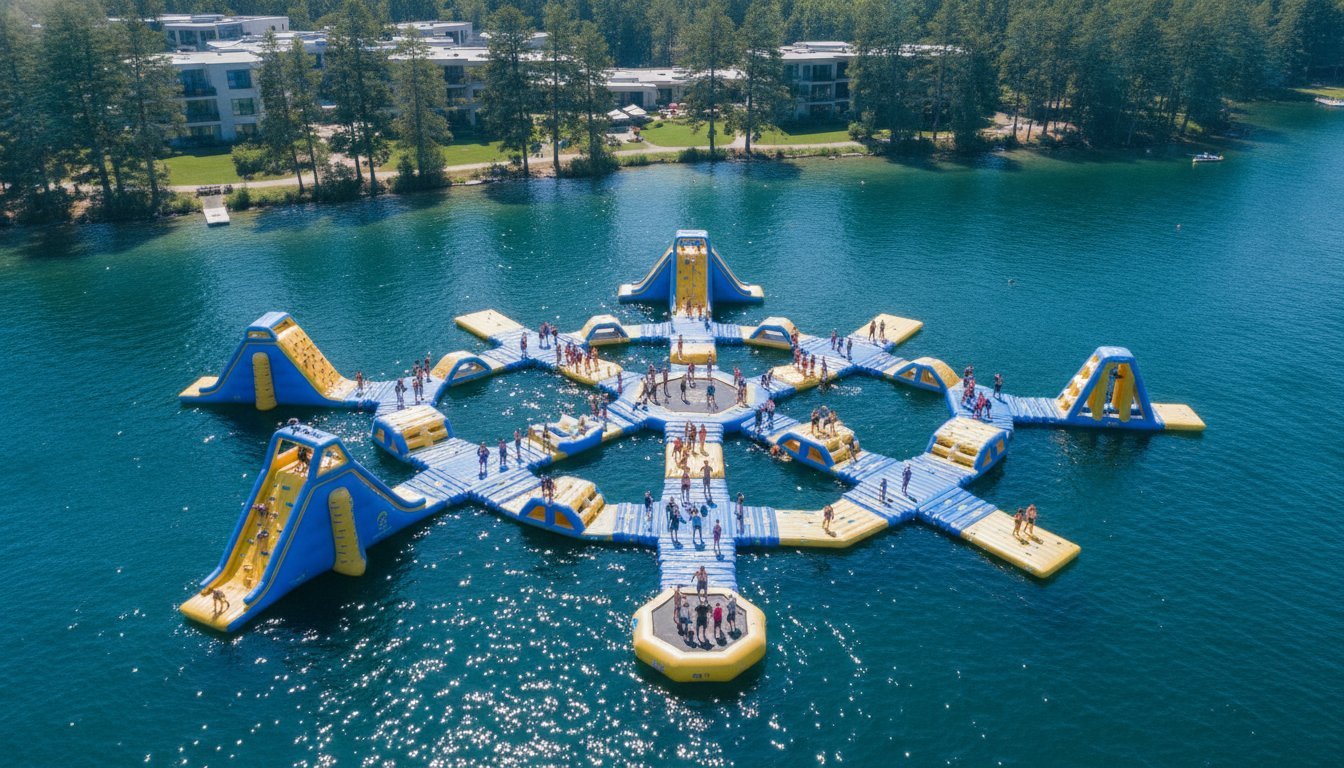
Imagine a floating destination that pays for itself before the peak summer heat even hits. If you believe the cost of a commercial water park is simply the price of the PVC, you’re missing the bigger picture of your resort’s growth. Understanding inflatable aqua park pricing means looking past the initial sticker price to see the true value of capacity, durability, and professional engineering. You’ve likely felt the frustration of confusing modular quotes or the fear of hidden shipping fees that suddenly balloon your budget. It’s a common hurdle, but it shouldn’t stop you from transforming your waterfront into a high-revenue asset.
We agree that every dollar must be justified to your stakeholders with clear, data-driven results that favour long-term growth. This comprehensive 2026 guide promises to reveal the critical factors that dictate commercial costs and how to evaluate your investment for maximum revenue. You’ll gain a clear understanding of cost tiers, learn to avoid the traps of low-quality equipment, and discover a framework to secure a durable solution that lasts for years. We’re diving into everything from installation logistics to the modular designs that allow your park to grow alongside your guest list.
Key Takeaways
- Master the three pillars of inflatable aqua park pricing to ensure your budget covers high-capacity “Monster” attractions and superior material quality.
- Compare the entry-level investment of The Campers Starter Park against the transformative potential of True Custom Designing for high-traffic resort installations.
- Discover why commercial-grade engineering is the only way to avoid mid-season closures and realize a consistent return on your investment.
- Account for the “hidden” essentials of a successful launch, including specialized anchor systems and required on-site technician training.
- Optimize your waterfront layout for maximum throughput to ensure your park functions as a high-velocity, money-earning destination.
Decoding Inflatable Aqua Park Pricing: Key Cost Drivers
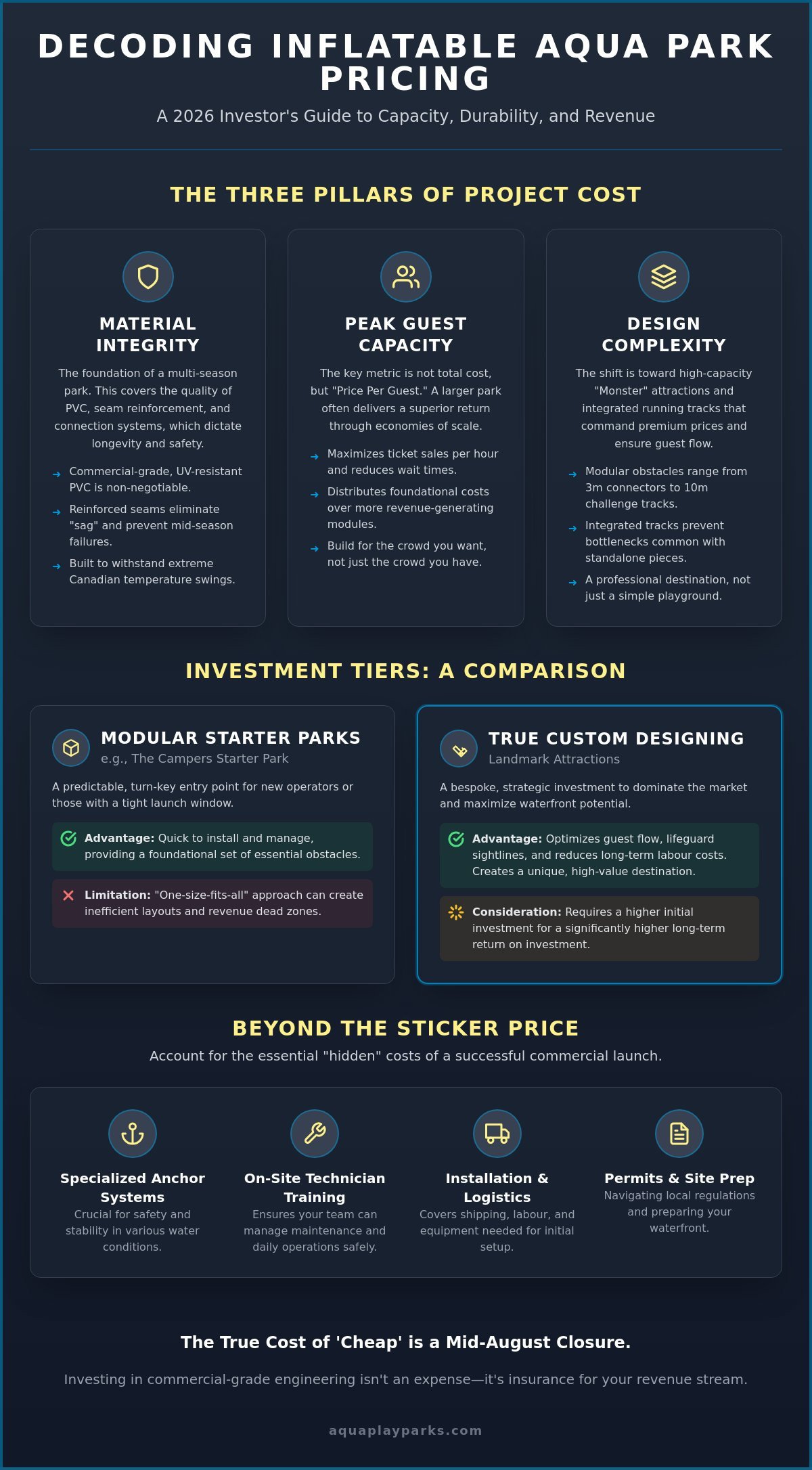
Stop thinking about your waterfront as a static view. Start seeing it as a high-velocity revenue engine. When you evaluate inflatable aqua park pricing, you aren’t just buying PVC and air; you’re investing in a calculated business model designed for rapid throughput. The total project quote is built on three non-negotiable pillars: material integrity, peak guest capacity, and design complexity. In 2026, the market has shifted decisively away from small, disconnected clusters toward high-capacity “Monster” attractions that dominate the horizon and command premium ticket prices. Understanding these costs is central to modern amusement park business models, where throughput determines the speed of your return.
The architecture of your park relies on modular obstacle lengths, typically ranging from 3m and 5m connectors to massive 10m challenge tracks. While standalone pieces might seem like a lower entry point, they often create bottlenecks. Integrated running tracks, though requiring a higher initial investment, allow for a continuous flow of guests. This reduces wait times and maximizes the number of tickets you can sell per hour. It’s the difference between a simple playground and a professional, money-earning destination.
Material Science and Price Variance
Commercial-grade, UV-resistant PVC is the backbone of any park that survives more than one season. Cheap retail alternatives fail because they can’t handle the relentless sun and physical friction of hundreds of guests. We prioritize reinforced seams and advanced connection systems because they eliminate the “sag” that plagues lower-quality builds. For resort owners in Canada, these specs are even more critical. Our extreme temperature swings mean your equipment must expand and contract without losing structural integrity or developing microscopic leaks. Investing in higher-quality material now prevents the nightmare of a mid-August closure for repairs.
Capacity Planning as a Pricing Metric
Smart operators don’t look at the total cost; they look at the “Price Per Guest.” A larger park often provides a superior economies-of-scale ratio, as the foundational costs of anchoring and site prep are distributed across more revenue-generating modules. You must balance your footprint with local lakefront regulations and anchor requirements, but don’t undersize your vision. If your park hits capacity by noon every Saturday, you’re leaving money on the table. Precise inflatable aqua park pricing accounts for this future growth, ensuring your layout can scale as your guest list expands. It’s about building for the crowd you want, not just the crowd you have today.
Modular Starter Parks vs. Custom Landmark Attractions
Choosing between a pre-configured bundle and a custom-engineered layout is the most significant decision affecting your inflatable aqua park pricing. You have to decide if you want to enter the market quickly or dominate it completely. While modular bundles offer a predictable entry point, they often ignore the unique contours of your shoreline or the specific flow of your guest traffic. A “one-size-fits-all” approach can lead to dead zones in your park where revenue stalls. True Custom Designing eliminates these inefficiencies. It allows you to build a landmark that competitors cannot simply replicate by clicking “buy” on a standard catalogue. This bespoke approach ensures every square metre of PVC is working to generate profit.
Beyond the visual impact, custom layouts are a pragmatic business tool. By designing your park with intentionality, you can optimize lifeguard sightlines and eliminate blind spots created by massive obstacles. This strategic placement can actually reduce long-term labour costs by allowing fewer staff members to monitor the same capacity safely. Every custom design we produce adheres to rigorous international safety standards, ensuring your high-adrenaline attractions meet the highest B2B commercial resort quality. If you are ready to see how a bespoke layout fits your specific shoreline, you can explore our custom design services to visualize your park’s potential.
The Starter Package Advantage
For many first-time operators, the priority is a turn-key solution that fits a tight launch window. The Campers Starter Park is a perfect example of this. It provides a foundation of essential obstacles that are easy to manage and quick to install. When evaluating a water park starter package campground, focus on scalability. You want a system that allows you to add modular pieces in subsequent seasons as your revenue grows. This “crawl-walk-run” strategy manages your initial capital outlay while keeping the guest experience fresh year after year.
Investing in Custom Monster Attractions
If your goal is to create a viral destination, you need “Monster” attractions. These are the massive, high-adrenaline pieces that serve as your primary marketing draw. Integrating inflatable monster water slides into your layout creates an instant visual hook for social media. Pricing for these features accounts for the complex engineering required for items like iceberg climbers or pyramid bag jumps. While the upfront cost is higher, the ROI is driven by premium ticket pricing and the ability to use custom colour schemes to reinforce your resort’s unique identity. You aren’t just buying a slide; you’re buying a billboard that floats.
The True Cost of ‘Cheap’: Commercial Quality vs. Retail Grade
Buy cheap, buy twice. It’s a hard lesson that many first-time operators learn the expensive way. The “Alibaba Trap” is a financial ghost that haunts resort owners who prioritize the lowest initial quote over long-term viability. When you analyze inflatable aqua park pricing, the sticker price is only the beginning of the story. Buying retail-grade equipment for a commercial resort is a gamble that usually ends in mid-season closures and massive revenue loss. These “bargain” inflatables simply aren’t built for the relentless friction and weight of hundreds of daily guests. They are designed for backyards, not for high-traffic money-earning destinations.
The technical gap is immense. Understanding the commercial vs residential inflatable water park standards is vital for protecting your capital. Professional-grade valves, reinforced handles, and heavy-duty stainless steel D-rings are the frontline defence of your maintenance budget. Without these commercial components, your staff will spend more time patching leaks than selling tickets. Furthermore, safety isn’t just about guest protection; it’s a financial necessity. Low-quality gear can double your insurance premiums and skyrocket your liability exposure. Adhering to Royal Life Saving Society UK guidance ensures you’re operating with equipment that insurance providers actually trust. They recognize the difference between a certified commercial asset and a floating liability.
Durability and the 35-Year Experience Factor
Experience is the most valuable material in your park. Dealing directly with a veteran designer ensures your park is engineered to withstand extreme loads without “tacoing” or structural buckling. 0.9mm reinforced PVC reduces repair downtime by 40% compared to retail vinyl. This material integrity is what keeps your park upright and profitable through the peak heat of August. You aren’t just paying for the plastic; you’re paying for the engineering that prevents a catastrophic failure during your busiest weekend.
Warranty and After-Sales Support
What is the cost of “ghosting”? If you buy from an overseas vendor with no local presence, their support often vanishes the moment you need a repair kit in July. A single weekend of park downtime can result in thousands of dollars in lost admissions and damaged resort reputation. A manufacturer’s warranty that explicitly covers commercial use is a financial shield. It ensures that when a problem arises, you have a partner invested in getting your park back to full capacity immediately. Calculate your potential revenue loss for 48 hours of downtime, and you’ll quickly realize that a cheap park is the most expensive mistake you can make.
Beyond the Purchase: Installation, Training, and Operations
Your investment isn’t operational the moment the shipping container arrives. If you only look at the cost of the floating modules, you are only seeing half the balance sheet. Professional inflatable aqua park pricing must factor in the critical infrastructure that keeps your assets secure and your guests safe. This includes specialized anchor systems, heavy-duty bungee connectors, and extensive waterfront preparation. Skipping these steps to save on upfront costs is a recipe for disaster. A park that isn’t anchored correctly will drift, putting immense strain on modular connectors and leading to premature wear that could have been avoided with a professional setup.
Operational readiness is what separates a successful resort attraction from a logistical nightmare. You need to budget for seasonal labour, specifically the “all-hands” days required for spring inflation and autumn deflation. Proper storage is equally vital. Storing your PVC in a climate-controlled centre prevents the material degradation that occurs when equipment is left to the elements during the off-season. By investing in professional-grade installation from the start, you ensure that every component is tensioned correctly, which significantly reduces the long-term maintenance burden on your team.
The Value of On-Site Technician Training
On-site technician training is a non-negotiable requirement for any serious resort owner. This isn’t a simple DIY project; it’s a complex floating machine. A professional training package covers everything from advanced safety protocols to daily inspection routines and minor field repairs. When your staff is trained by experts, they can identify potential issues before they lead to downtime. This expertise can extend the lifespan of your park by two to three seasons, directly improving your total return on investment. There is also a direct link between certified training and reduced insurance liability, as providers favour operators who can prove their team is professionally prepared.
Anchoring and Waterfront Logistics
Anchoring is the silent hero of a profitable park. Hidden pricing factors like heavy-duty chains, concrete anchors, and lakebed preparation are essential for stability. A “one-size-fits-all” approach to anchoring leads to park drifting, which causes modular pieces to rub together and tear. We design anchoring layouts based on your specific water depth and current conditions to prevent this damage. You must also manage the labour centre by budgeting for the intensive launch period. If you want to ensure your park is built to last, book our on-site technician training to secure your investment and prepare your team for a high-traffic season.
Maximising Your Waterfront Investment with Custom Solutions
Don’t just buy a park. Build a legacy. While the technical details of inflatable aqua park pricing are vital for your budget, the true success of your resort depends on how effectively you monetize your water. A generic layout is a missed opportunity. By utilizing custom inflatable water park design, you ensure your attraction is engineered specifically for your guest demographic. Whether you are catering to young families or high-adrenaline thrill-seekers, your layout should reflect their needs. This tailored approach eliminates wasted space and ensures every module serves a purpose, driving the rapid ticket turnover that defines a profitable operation.
Our “Money-Earning” philosophy is built on high throughput. We design parks that move guests efficiently through the course, preventing bottlenecks at popular obstacles like our massive Monster Slides. This focus on flow allows you to maximize your hourly capacity and increase your daily revenue ceiling. Because we operate as a direct-to-designer partner, you eliminate the middleman markups that often inflate project quotes. You get direct access to the source of the engineering, ensuring your 2026 season is built on transparency and B2B commercial resort quality that dominates the local market.
Building a Multi-Season Growth Plan
Success isn’t a one-time event; it’s a phase-based strategy. We recommend a Phase 1 to Phase 3 approach where you reinvest your initial profits into new, exciting modular additions. The psychological impact of “New for 2026” attractions is a powerful tool for guest retention, giving visitors a compelling reason to return to your resort year after year. The payback period for a standard campground starter park is typically realized within one to two operating seasons. By planning for growth from day one, you turn a single purchase into a self-sustaining cycle of expansion and profit.
The Aqua Play Parks Advantage
You are partnering with 35 years of Canadian design expertise. We don’t just understand the equipment; we understand the business of recreation. Our focus is on providing a visionary guide from the initial spark of an idea to the final implementation on your lakefront. We cut through the complexity of the industry to provide straightforward, high-impact results that respect your bottom line. If you are ready to transform your waterfront into a premier destination, it’s time to take the next step. Get a custom quote from Aqua Play Parks today and realize the full potential of your resort for the upcoming season.
Dominate Your Destination This Season
Your waterfront is a dormant asset waiting for a visionary spark. We’ve decoded the complexities of inflatable aqua park pricing to show you that real value isn’t found in the cheapest quote, but in the highest return. You now understand that commercial-grade material and custom engineering are the only ways to avoid the “Alibaba Trap” and keep your gates open when it matters most. From the high-velocity throughput of our Monster Slides to the long-term security of professional anchoring, every decision you make today defines your resort’s reputation for years to come.
Don’t leave your 2026 revenue to chance. With 35 years of industry design experience, we specialize in building the world’s largest money-earning Monster Slides and providing the on-site technician training you need to succeed. It’s time to stop dreaming and start building. Request a Custom Quote and ROI Analysis for Your Waterfront to see exactly how we can transform your lakefront into a premier destination. Let’s build something bold together.
Frequently Asked Questions
What is the average price range for a commercial-grade inflatable aqua park?
Industry averages for commercial equipment generally fall into three tiers based on guest capacity. Small parks for 30 to 50 people typically range from $15,000 to $40,000, while medium installations for up to 150 guests often fall between $40,000 and $120,000. For mega-parks exceeding 200 people, equipment budgets usually start at $100,000 and can reach over $300,000 depending on the complexity of the custom attractions.
How do modular pieces affect the total cost compared to a fixed-design park?
Modular pieces provide the flexibility to reconfigure your layout every season to keep the guest experience fresh. While a fixed-design park might offer a lower initial engineering fee, modularity allows you to scale your investment alongside your revenue. This approach ensures your inflatable aqua park pricing remains manageable as you expand from a basic track to a full-scale resort destination.
Are there hidden costs in shipping and importing commercial inflatables to Canada?
Shipping and importing to Canada involves several secondary costs that are often overlooked in the initial quote. You should expect shipping to account for 5% to 12% of the equipment’s value, plus applicable GST/HST and customs brokerage fees. Working with a designer who understands the Canadian logistics landscape ensures these figures are transparent and accounted for before the equipment arrives at the border.
Does the price of an aqua park include professional on-site training?
Professional on-site technician training is included with all our major commercial packages to ensure operational success. We believe that your team’s ability to inspect, maintain, and repair equipment is just as important as the PVC itself. This training reduces your long-term liability and extends the lifespan of your park by ensuring every module is handled with expert care from day one.
How much should I budget for annual maintenance and storage?
You should budget for annual insurance premiums, which typically range from $5,000 to $15,000 for high-coverage amusement policies. Additional costs include safety gear, such as life jackets, which can cost between $3,000 and $5,000 for a 100-person capacity park. Seasonal labour for inflation, deflation, and climate-controlled storage should also be factored into your annual operating expenses to protect your inflatable aqua park pricing investment.
Is a custom-designed park significantly more expensive than a pre-set bundle?
A custom-designed park focuses on maximizing your specific waterfront’s ROI rather than just filling space with generic modules. While a pre-set bundle like The Campers Starter Park offers a faster entry point, custom designs eliminate the “dead zones” that lead to lost revenue. The difference in price is often offset by the increased throughput and higher ticket turnover a bespoke layout provides.
What is the typical ROI and payback period for a campground water park?
Most commercial operators realize a full return on their investment within 12 to 24 months of operation. Some well-managed parks in high-traffic areas have reported recovering their initial capital in as little as 30 to 45 days. This rapid payback period makes inflatable aqua parks one of the most attractive high-yield investments for resort and campground owners looking for rapid growth.
Can I start with a small park and add pieces later to manage my initial budget?
You can absolutely start with a foundational layout and add new “Monster” pieces in subsequent seasons to manage your cash flow. This “Phase 1 to Phase 3” strategy allows you to use your first year’s profits to fund future expansions. It keeps your initial capital outlay low while giving your guests a compelling reason to return to see what new attractions you’ve added every summer.
Leave a Reply