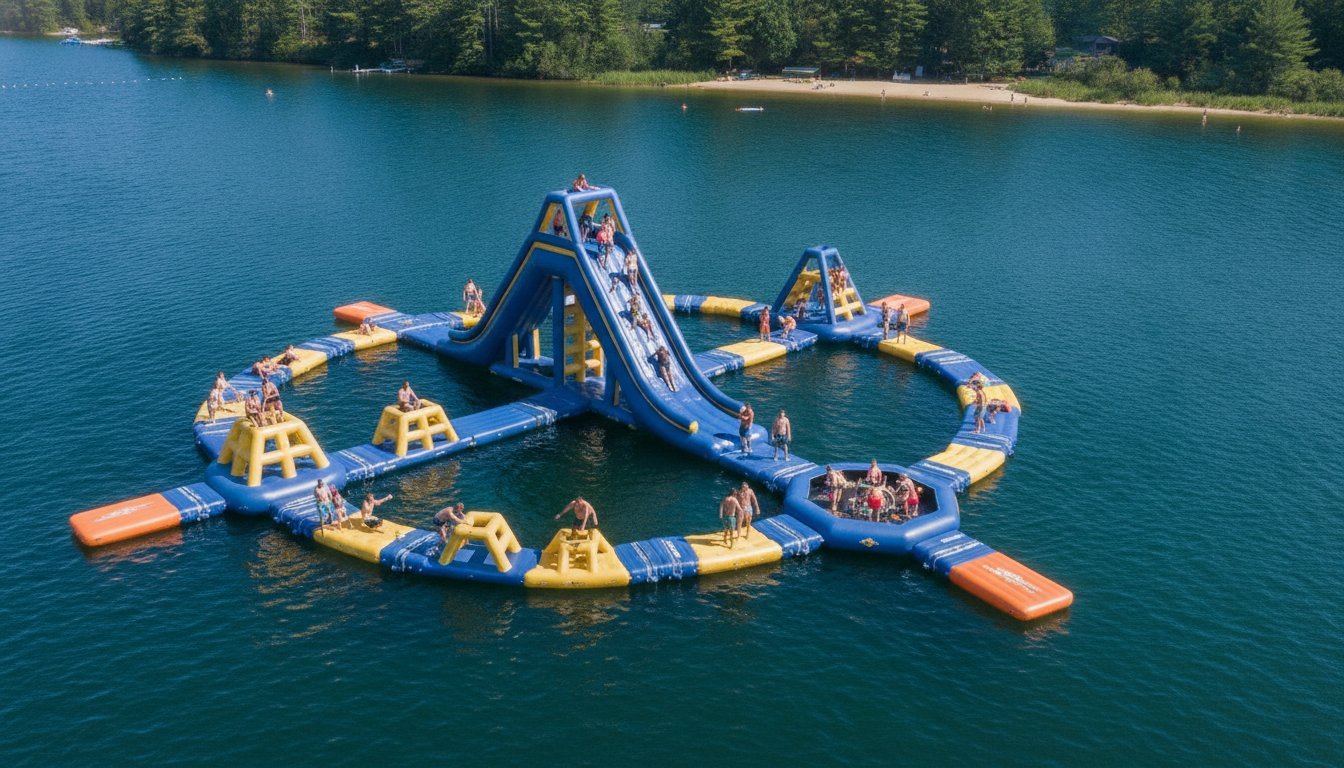
What if your biggest operational headache, the endless queue of frustrated guests, was actually your greatest untapped revenue stream? You’ve likely realized that a basic setup eventually hits a ceiling. Overcrowded modules lead to mediocre reviews, and stagnant layouts simply don’t bring the crowds back for a second season. It’s frustrating to watch your ROI plateau while the potential of your waterfront remains locked behind a modest, entry-level park. You want growth that feels like a leap, not a crawl.
This strategic guide reveals exactly how to expand a floating water park using a modular evolution that turns your location into a high-capacity, high-adrenaline destination. We’ll show you how to swap installation anxiety for massive cash flow by integrating world-class monster slides and custom designs that demand attention. You’ll gain a clear roadmap for scaling your footprint and increasing your guest capacity while securing the kind of seasonal ROI that only comes from being the boldest attraction on the water. From optimizing your layout to choosing high-impact pieces, we’re diving into the mechanics of a truly profitable expansion.
Key Takeaways
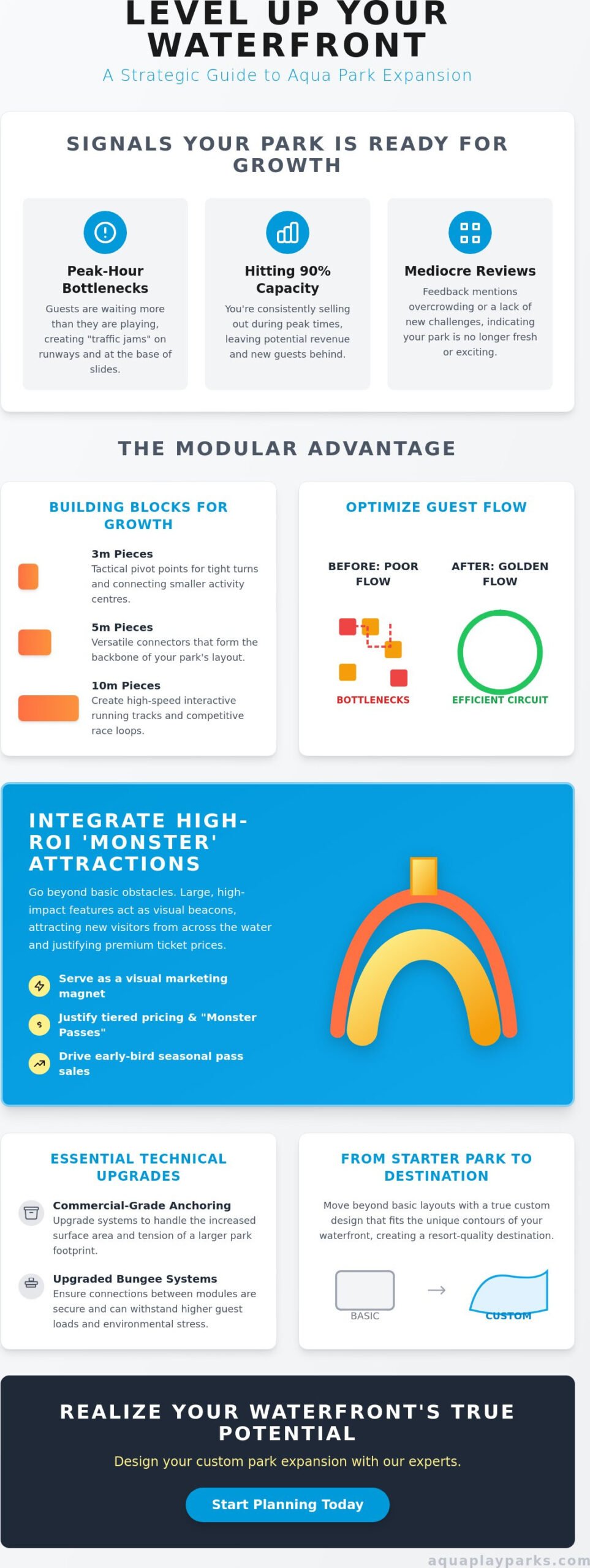
- Identify the specific operational signals, such as peak-hour bottlenecks and ticket sales data, that indicate your park is ready for a strategic expansion.
- Discover how to expand a floating water park using modular 3m, 5m, and 10m pieces to organize your layout for maximum variety and guest flow.
- Scale your revenue by integrating high-impact “Monster” slides and stand-alone climbing zones that serve as visual beacons for new visitors.
- Upgrade your technical infrastructure with commercial-grade anchoring and bungee systems designed to handle the increased surface area of a larger park.
- Move beyond basic setups with true custom designing to realize a resort-quality destination that fits the unique contours of your waterfront.
Planning Your Waterfront Growth: When to Expand Your Floating Water Park
Your waterfront is a machine. Like any high-performance engine, it has a maximum output. If you’re seeing lines snake around your entry gate or guests hovering at the base of your slides, you’ve hit the redline. Don’t wait for the negative reviews to pile up before you realize your current layout is suffocating your profit potential. Growth isn’t just about buying more PVC; it’s about strategic scaling that transforms a simple park into a landmark destination. Understanding how to expand a floating water park requires a cold, hard look at your operational data and guest behaviour.
Start with your ticket sales. If you’re consistently hitting 90% capacity during peak Saturday afternoon sessions, you’re leaving money on the table. Guests who feel cramped won’t return, and they certainly won’t recommend you to their friends. You need to evaluate the “thrill factor” of your current setup. Is it still the premier local attraction, or has a competitor down the lake added a massive new feature? Looking back at the history of inflatable attractions, it’s clear that the industry moves toward complexity and scale. If you stay stagnant, you become obsolete.
Identifying Capacity Bottlenecks
Audit your park during a busy weekend. Look for “traffic jams” on your floating runways. These bottlenecks usually happen because your current layout lacks a “Golden Flow,” a design principle that moves guests efficiently from entry points to high-thrill zones. If your guests are spending more time waiting than splashing, your ROI is dying. Assess your lifeguard-to-guest ratio now. A larger footprint requires more eyes on the water, but the increased ticket volume from a higher capacity usually covers these labour costs within the first few weeks of the season.
Seasonal Revenue Scaling
Smart operators plan in the frost to profit in the sun. Use the off-season to map out your modular growth. Adding new, high-adrenaline pieces allows you to justify a tiered pricing structure, perhaps a “VIP Monster Pass” for your largest slides. This expansion serves as your primary marketing hook for the upcoming year. It drives early-bird seasonal pass sales by promising a fresh, expanded experience. You aren’t just selling a ticket; you’re selling the promise of a bigger, better summer adventure that your basic setup simply can’t match.
The Modular Advantage: Utilizing 3m, 5m, and 10m Obstacle Pieces
Stop thinking about expansion as a cluttered inventory addition. Your park isn’t a static object; it’s a high-stakes Lego set designed for commercial dominance. When you master the logic of modularity, you realize that figuring out how to expand a floating water park is actually about building a high-performance circuit. By utilizing standardized 3m, 5m, and 10m pieces, you can reorganize your entire layout in a single afternoon. This flexibility ensures your park stays fresh every season without requiring a total overhaul of your existing assets.
The 3m modules are your tactical pivot points. They’re ideal for creating tight turns or connecting smaller activity centres where space is at a premium. In contrast, the 5m and 10m modules serve as the heavy-duty backbone of your park. These longer sections create high-speed interactive running tracks that define the guest experience. Recent data on the economic impact of outdoor recreation shows a massive surge in consumer spending, proving that guests are hungry for more sophisticated, large-scale experiences. If you aren’t scaling your footprint to meet this demand, you’re handing your market share to the competition.
Creating Interactive Running Tracks
Speed sells. Connect your 10m straightaways with challenging balance obstacles to keep guests engaged and moving. Design loops that allow for competitive racing. This isn’t just for kids; competitive layouts are a massive draw for high-value corporate team-building events. Ensure your track layout centres around a major visual beacon to maintain the aesthetic appeal of your waterfront. If you’re ready to see how these modules fit your specific shoreline, explore our Floating Aqua Park Designs to visualize the possibilities.
Balancing Flow and Difficulty
Smart design manages guest energy. Mix 3m “rest” platforms with 10m “sprint” sections to prevent exhaustion and keep the “Golden Flow” moving. Place your easiest obstacles near the entry to build confidence, then ramp up the difficulty toward the park’s centre. Use modular pieces to create multiple lanes of varying difficulty. This allows you to cater to different age groups simultaneously. You’ll increase your total capacity while ensuring every guest, from the cautious toddler to the adrenaline-seeking teenager, finds a path that thrills them. It’s a direct, transparent way to maximize your seasonal ROI.
Integrating High-ROI ‘Monster’ Attractions for Maximum Impact
Scale is your most powerful marketing tool. If you want to dominate your local market, you need a visual magnet that stops traffic and demands attention. When considering how to expand a floating water park, many operators make the mistake of only adding more of the same. They build longer runways but forget to add the “wow” factor that justifies a higher entry fee. To truly scale your revenue, you need high-impact pieces that serve as the centrepiece of your attraction. These aren’t just toys; they’re B2B commercial resort quality assets designed to maximize guest throughput and drive ticket prices higher.
The Draw of the Monster Slide
Scale matters. A massive slide isn’t just a fun feature; it’s a billboard. When you install one of the Worlds largest Floating, Money Earning Monster Slides, you’re creating a visual beacon visible from the road and across the lake. This draws in passing tourists who might have otherwise driven by your location. Beyond the marketing value, these slides offer incredible throughput. Large slides allow multiple guests to descend in rapid succession, which drastically increases your hourly capacity. For the best results, place your monster slide at the furthest point from the entry. This encourages guests to explore the entire park, reducing congestion in your starter zones and spreading the crowd efficiently across your footprint.
Standalone Magnets: Icebergs and Pyramid Bag Jumps
You don’t always need complex linking to increase your capacity. Stand-alone pieces like iceberg climbers create high-capacity play zones instantly. An iceberg provides 360-degree play, accommodating dozens of guests at once without clogging up your modular tracks. If you want to capture the “thrill-seeker” demographic, look at pyramid bag jumps. These high-adrenaline attractions justify premium ticket prices and “VIP” access tiers, allowing you to segment your audience and capture more revenue per guest.
These pieces also act as a social media magnet. Guests love sharing photos of themselves conquering a massive climber or flying off a bag jump. This provides you with free organic marketing that reaches thousands of potential visitors. Understanding how to expand a floating water park with these standalone anchors is the ultimate shortcut to transforming a basic setup into a high-ROI destination. You can add these pieces to any waterfront, even if you are currently operating a Campers Starter Park. They provide the immediate impact needed to transition from a local spot to a regional landmark.
Technical Logistics: Anchoring and Safety for a Larger Footprint
You’ve secured the visionary “Monster” slides. Now, you need to hold them down. Expanding your footprint isn’t just a matter of clipping modules together. It’s a structural challenge that requires a pragmatic, engineering-first mindset. When you’re determining how to expand a floating water park, your current anchoring grid is the first thing that needs a brutal audit. A larger surface area acts like a massive sail. Wind load and water drag increase exponentially with every new module you add to the circuit. If your foundation is weak, your entire commercial investment is at risk during the first major storm.
Don’t guess at the physics. Calculate the increased forces at play. Switching to a sophisticated, grid-based anchoring system is a non-negotiable step for any operator looking to move beyond a basic setup. This system allows for easier future modular changes and ensures your park stays exactly where you put it, regardless of shifting tides or heavy guest traffic. Expansion often requires heavier-duty commercial-grade bungee systems that can handle the violent energy of wave action without snapping. You must also realize that your new, larger footprint must maintain consistent safety depths. While standard obstacles typically require a depth of 2 to 3 metres, your massive climbing towers and slides often demand 3 metres or more to comply with international safety standards.
Reconfiguring Anchoring Systems
Assess your current lakefront setup for hidden vulnerabilities. A larger park means more surface area for the wind to catch, which can put immense strain on individual anchor points. By consulting with a professional technician, you can realize a secure, permanent setup that uses weighted blocks or screw anchors arranged in a grid. This prevents the park from “walking” across the water or twisting during high-use periods. It’s about building for stability so you can focus on the joy of recreation.
Updating Staff Training Protocols
Your team’s expertise must grow at the same rate as your park. A larger layout creates entirely new blind spots and operational challenges. You need to revise your lifeguard zones immediately to ensure 100% visibility across every new high-impact obstacle. This is why we provide professional On-Site Technician Training to ensure your crew can handle the technical demands of a resort-scale installation with confidence. Implement a rigorous mid-season maintenance checklist to keep your commercial quality at its absolute peak. This includes checking valve integrity, seam tension, and anchor line wear. You aren’t just managing a playground; you’re managing a high-performance professional operation where safety and profit are inextricably linked. Be the straight-shooter who prioritizes the technical foundation of their success.
From Starter Park to Destination: Custom Designing Your Expansion
Stop settling for a cookie-cutter layout that looks like every other campground in the state. Realizing your waterfront’s full potential requires moving beyond the basic “off-the-shelf” mindset. Learning how to expand a floating water park is about more than just adding volume; it’s about shifting your entire business model from a local attraction to a regional destination. Many operators begin with The Campers Starter Park to prove the concept, but the transition to a full resort-scale attraction is where the real commercial dominance happens. This evolution must be a phased, strategic process that prioritizes B2B commercial resort quality to ensure your equipment survives the high-volume traffic of a successful site.
True custom designing is the secret weapon of the industry’s top earners. You need a layout that respects the specific contours of your lake, the depth of your shoreline, and the flow of your existing amenities. Don’t force a generic rectangle into a curved bay. Instead, work with a partner who understands the nuances of aquatic engineering and guest psychology. Just as a resort might rely on Rod Cameron Pools for precision in permanent aquatic construction, your floating expansion requires a similar commitment to quality. With 35 years of experience in the field, we’ve seen every growth pitfall imaginable. We help you avoid the expensive mistakes that come from poor planning, ensuring your expansion is a seamless addition to your business rather than a logistical nightmare.
Beyond Generic Layouts
Your brand is your promise to the guest. Customise your park’s colour and configuration to match your resort’s specific branding to create a cohesive, professional look. Organize your expansion to complement existing features like docks, swim platforms, or beach zones. A well-integrated park feels like a natural part of the landscape, not an afterthought. To dive deeper into the technical side of this process, explore our guide on custom inflatable water park design for high-ROI destinations. It’s time to build something that looks as good as it performs.
Partnering for Long-Term Success
Visionary owners don’t just think about next month; they think about the next five years. Work directly with a designer to visualize a long-term growth plan that allows you to add pieces incrementally as your revenue climbs. This phased approach keeps your attraction fresh for returning guests while managing your capital expenditure. We don’t just ship boxes; we provide on-site technician training to empower your staff as the park grows in complexity. Take the next step in your business journey today. Contact Aqua Play Parks for a custom expansion plan that turns your waterfront into a high-earning landmark.
Scale Your Vision for Seasonal Dominance
You’ve seen the roadmap. Growth isn’t just about adding vinyl; it’s about a strategic evolution that transforms your waterfront into a high-performance revenue engine. By mastering the modular logic of 3m and 10m pieces and anchoring your success with the world’s largest money-earning Monster Slides, you’re building a destination designed for maximum ROI. Stop watching guests drift away to competitors and start scaling your capacity to meet the demand you’ve already built.
Success in this industry requires more than just equipment. It requires a partner with 35 years of direct industry experience who understands the technical nuances of a large-scale installation. We provide the specialized on-site technician training your team needs to maintain B2B commercial quality throughout the season. Learning how to expand a floating water park is the definitive step toward securing your legacy as a premier local landmark. Ready to grow your waterfront? Explore our Custom Aqua Park Designs today! Your future as a visionary operator starts with a single, bold decision. Let’s build something legendary together.
Frequently Asked Questions
Can I expand my floating water park with pieces from different manufacturers?
Mixing manufacturers is a recipe for operational failure. Connection systems are rarely universal, and forcing a fit compromises the structural integrity and safety of your park. Stick to a single commercial-grade ecosystem to ensure your seams and bungees work in harmony. This is the only way to realize a safe, high-performance expansion that stands up to heavy resort use without constant maintenance headaches.
How much additional water depth is required for a Monster Slide?
Massive features demand deeper water for guest safety. While standard obstacle modules often function in 2 to 3 metres, our Monster Slides and climbing towers typically require a minimum depth of 3 metres or more. Always measure your new footprint’s depth profile across the entire area before installation. Ensuring proper clearance is a non-negotiable safety requirement for high-impact attractions.
Will expanding my park significantly increase my insurance premiums?
Your premiums reflect your risk management and total capacity. While a larger footprint increases your guest volume, operators who comply with safety standards like ASTM F2374 often see more favourable rates. Research indicates annual liability insurance for commercial operations can range from $500 to $3,000. Keeping your safety protocols tight during an expansion is the best way to manage these costs effectively.
How do I reorganize my anchoring system when adding new modular pieces?
Move from a linear setup to a grid-based system for maximum stability. When you’re figuring out how to expand a floating water park, you must calculate the new wind load and water drag created by the larger surface area. Replace standard lines with commercial-grade bungee systems to handle the increased energy of wave action. A grid allows you to swap modules easily without pulling up every anchor.
What is the best time of year to install a water park expansion?
Install during the shoulder season to avoid peak-time disruptions. Spring is the ideal window to ensure everything is tested and ready for a high-impact summer launch. This allows you to use the expansion as a marketing hook for early-bird season pass sales. Avoid mid-season installations that disrupt your guest flow and cost you valuable revenue during your busiest months.
Do I need to hire more lifeguards if I expand my park’s footprint?
Yes, your staffing must scale alongside your footprint. A larger layout creates new blind spots that require dedicated observation zones. Don’t compromise on safety; if you add a Monster Slide, you need eyes on both the entry and the splash zone. Your lifeguard-to-guest ratio must reflect the increased complexity and capacity of your resort-scale attraction.
How long does it take to install a new 10m modular obstacle section?
A single 10m section can be inflated and connected in under two hours by a trained crew. However, the total time for a strategic expansion includes reconfiguring your anchoring grid and performing safety stress tests. It’s a fast process when you have the right tools, but you shouldn’t rush the technical foundation. Proper setup ensures your park stays secure during heavy use.
Is on-site technician training necessary for every expansion?
Training is essential for long-term ROI and operational safety. While the mechanics of how to expand a floating water park seem simple, the technical logistics of anchoring and maintenance are complex. On-site technician training ensures your team can handle high-volume resort use without premature wear. It’s a pragmatic investment in the longevity and professionalism of your commercial recreation assets.
Leave a Reply