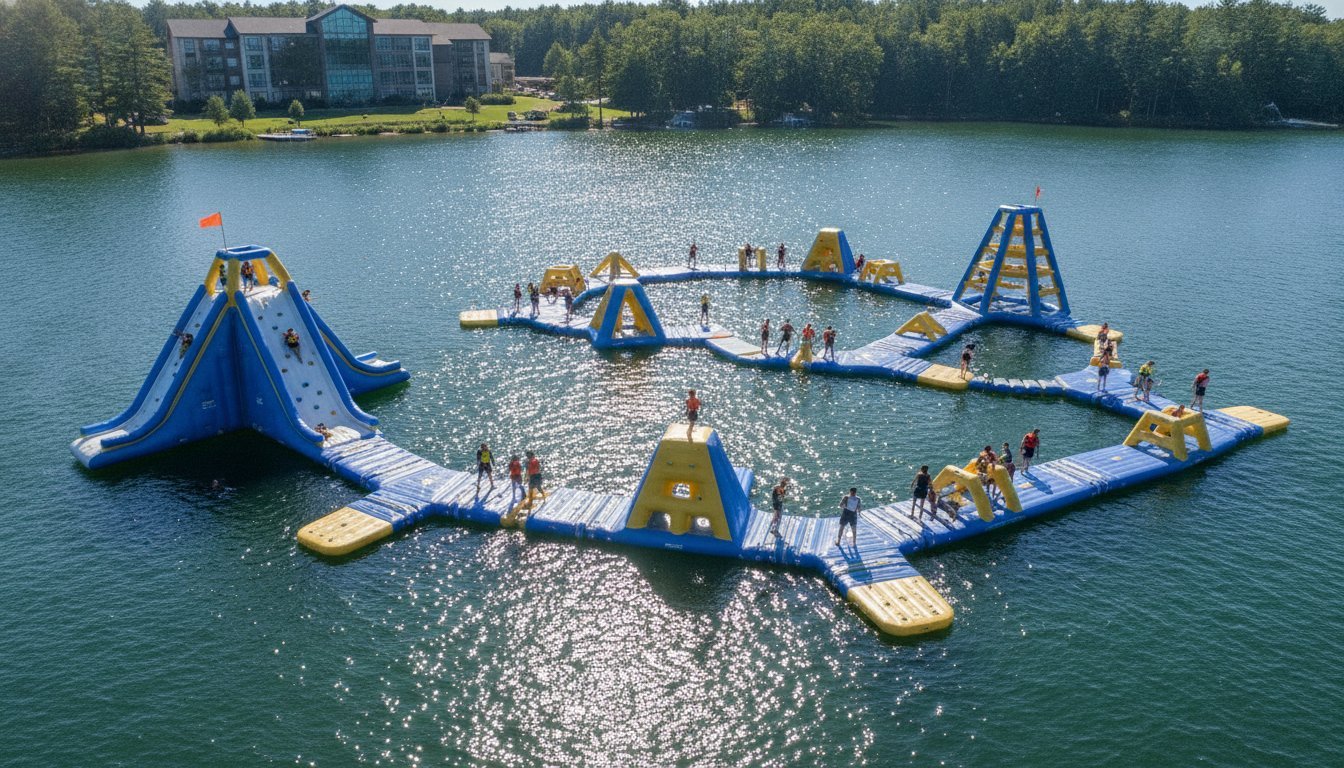
Stop thinking of your waterfront as just a scenic view and start seeing it as a high-yield commercial asset. A modular floating water park isn’t just a collection of inflatables. It is a precision-engineered system designed to move hundreds of guests through an adrenaline-pumping experience without a single bottleneck. You’ve likely seen the cheap imitations that deflate by mid-July, and you’re right to be skeptical. Serious commercial success requires more than just air. It requires a strategic layout, heavy-duty materials that meet the latest safety standards, and an anchoring system that stays put when the weather turns.
You want to build a destination, not a liability. You realize that the difference between a “toy” and a “tool” is the ROI it generates over multiple seasons. This guide provides the clear roadmap you need to design, install, and scale a park that transforms your shoreline into a premier destination. We will explore the engineering behind commercial-grade materials, the logistics of secure anchoring, and the design secrets that prevent guest congestion. It’s time to turn your water into a high-energy hub that scales as fast as your ambition.
Key Takeaways
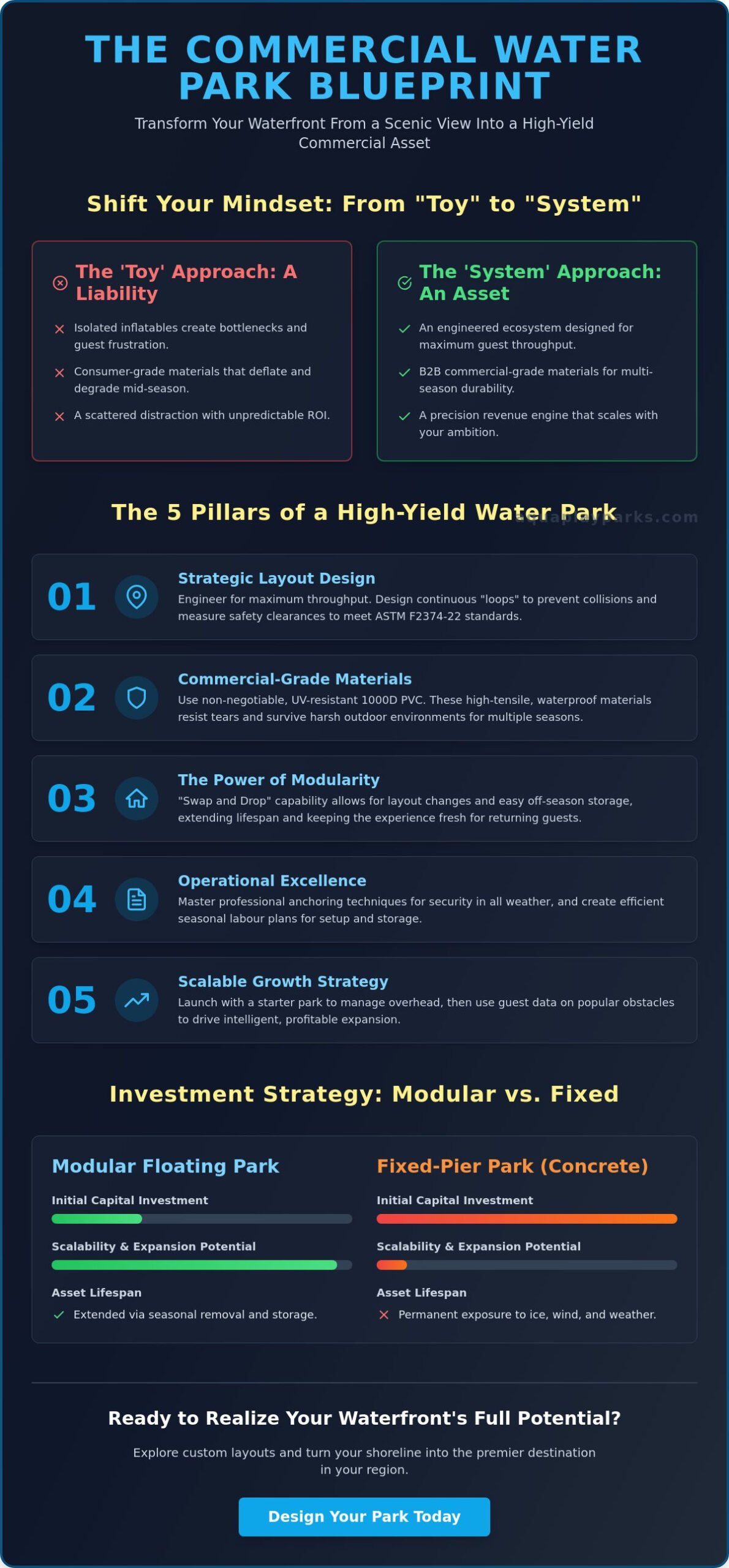
- Shift your mindset from buying individual inflatables to building a high-yield commercial system that allows you to realize the full revenue potential of your waterfront.
- Master the logistics of layout design by measuring safety clearances and creating “loops” that prevent collisions while maximizing guest throughput.
- Understand why B2B commercial-grade materials like UV-resistant 1000D PVC are non-negotiable for surviving multiple seasons in harsh outdoor environments.
- Get a clear roadmap for securing your modular floating water park with professional anchoring techniques and efficient seasonal labour planning.
- Learn a scalable growth strategy to expand from a starter park into a massive destination by using guest data to drive your expansion.
Understanding the Modular Floating Water Park System
Forget the idea of a single floating slide or a scattered collection of rafts. A modular floating water park is a high-performance ecosystem of interconnected, B2B commercial-grade inflatable obstacles. It’s a strategic asset designed for one specific outcome: maximum throughput. Many operators struggle because they treat their waterfront like a backyard pool, buying isolated “toys” that don’t integrate. A toy is a distraction. A system is a revenue engine. By utilizing standardized modular components in 3m, 5m, and 10m lengths, you build a continuous circuit that keeps guests moving and money flowing. This modularity gives you the power to realize a custom vision that fits your specific shoreline perfectly.
The Anatomy of a Modular Piece
Precision is everything in a commercial setting. The connection systems between individual modules must remain perfectly flush. Gaps aren’t just an eyesore; they’re a safety hazard. High-performance parks rely on “Interactive Running Tracks” to manage guest capacity effectively. These tracks act as the arterial system of your park, directing traffic and preventing the bottlenecks that frustrate guests and limit ticket sales. For a commercial inflatable water park to survive the rigours of hundreds of daily visitors, waterproof, high-tensile materials are non-negotiable. We use 1000D PVC that resists tears and handles the immense pressure of constant use. This level of engineering shares foundational principles with Very Large Floating Structures (VLFS), where the focus is on stability, buoyancy, and structural integrity across massive aquatic platforms.
Why Modular Beats Fixed Structures
Concrete is permanent. Modularity is profitable. Fixed-pier parks require massive initial capital and permanent environmental permits that can take years to secure. A modular system allows you to launch with lower overhead and scale as you see the returns. When the season ends, you don’t leave your investment to the mercy of the ice and wind. You remove it, clean it, and store it safely to extend its lifespan. This “Swap and Drop” capability means you can reorganize pieces or add a new “Monster Slide” every single season. It keeps the experience fresh for repeat guests. They won’t get bored because the park they conquered last year isn’t the same one they’ll face this year. You gain the ability to adapt your layout based on what guests love most, ensuring your park remains the top attraction in your region.
Designing Your Waterfront Layout for Maximum Throughput
Designing a high-performance park requires more than an eye for colour. It requires a commitment to engineering and guest psychology. Your layout is the blueprint for your profit. If your guests are bumping into each other or waiting in lines on the water, your ROI is leaking away. Start with the fundamentals: measure your water depth and lakefront perimeter with absolute precision. You must ensure safety clearances that align with ASTM F2374-22 Safety Standards to protect your business and your guests. Once the boundaries are set, define your guest flow. The most successful operators create a continuous “loop” that prevents collisions and keeps the momentum high. Strategically place your “Monster Slides” as visual anchors. These massive features draw the crowds in, while smaller modular pieces keep them engaged. Don’t forget to integrate rest zones and specific entry points. These aren’t just features; they’re control valves that manage the number of people on the park at any given time.
The Science of the Running Track
Think of your modular floating water park as an aquatic obstacle course. By mixing 3m, 5m, and 10m pieces, you can create varying levels of difficulty that cater to different age groups and athletic abilities. Throughput is the number of guests who can safely navigate the park per hour. To maximize this number, your track must be intuitive. You can still include standalone pieces like iceberg climbers or pyramid bag jumps, but they must be positioned so they don’t break the primary flow. If a guest wants to tackle a high-energy challenge, they should be able to do so without creating a traffic jam for those behind them. If you want to see how these pieces come together, you can explore our custom layout options to find the right fit for your goals.
Custom Design for Your Specific Venue
Off-the-shelf packages are built for the average lake, but your venue isn’t average. Choosing a generic layout often means you’re failing to utilize unique shoreline features or local water conditions. This is where custom inflatable water park design becomes your greatest competitive advantage. It allows you to build a brand that guests recognize and return to year after year. Working with a designer who brings decades of industry experience helps you avoid common pitfalls, such as placing a high-speed slide in a shallow area or creating “dead zones” where guests get stuck. A commercial floating water park design service ensures that every square metre of your waterfront is tactically engineered for guest throughput and revenue density, turning your ordinary lake into a high-ROI destination that dominates your local market.
Commercial Quality Standards: Why Material Specs Matter
Stop treating your waterfront like a backyard pool. A modular floating water park in a commercial setting is a high-stakes environment where “good enough” leads to downtime and lost revenue. The difference between a residential toy and a B2B commercial asset starts with the fabric. We use 1000D PVC, a high-density material that provides the puncture resistance and tensile strength required for daily public use. While cheap alternatives use thin-gauge vinyl that stretches and sags, commercial-grade PVC maintains its shape and air pressure under the weight of hundreds of guests. This material also features advanced UV resistance. It is designed to survive the intense glare of the Canadian and American sun without fading or cracking, ensuring your park looks as professional in August as it did in May.
Seam failure is the primary reason low-quality inflatables end up in the landfill before the season ends. Commercial pressure demands reinforced seam technology. Every joint on our modules is double or triple-reinforced to handle the constant stress of climbing, jumping, and sliding. This engineering prevents the slow leaks that force you to pull pieces out of the water for repair. Safety isn’t just about durability; it’s about compliance. Your equipment must meet international standards to ensure public safety and satisfy insurance requirements. Adhering to the CDC’s Model Aquatic Health Code (MAHC) gives you a science-based blueprint for aquatic safety that goes beyond simple buoyancy and basic flotation. Partnering with the right floating aqua park manufacturer ensures your equipment meets these evolving standards while delivering the structural performance your commercial operation demands.
Durability in High-Traffic Environments
Commercial operators need gear that works as hard as they do. When you have a line of guests waiting to enter, you can’t afford a deflated module. High-traffic environments require specific reinforcements, like the extra-thick base materials found on standalone climbers. These “Iceberg” style pieces take the most abuse, acting as the foundation for high-energy play. Because a modular floating water park is a significant investment, choosing B2B quality ensures you are acquiring a multi-season asset. You don’t just want it to last the summer; you want to realize a profit over several years of consistent operation.
Safety Features Guests Don’t See
True safety is often invisible to the guest, but it is the backbone of your reputation. It’s found in the flush-fit connection flaps that bridge the gaps between modules, eliminating the toe-traps and trip hazards that plague inferior designs. High-speed running tracks must include integrated anti-slip textures to keep guests upright when the action gets intense. Every handle and climbing aid is positioned to help guests of all sizes navigate the course with confidence. These details protect your guests and your business, turning your waterfront into a premier, worry-free destination that parents trust and kids love.
Operational Excellence: Setup, Safety, and Training
Your vision is only as strong as your anchor. A modular floating water park requires a sophisticated anchoring system to remain a safe, profitable destination. You aren’t just tying a rope to a rock. You’re managing thousands of kilograms of tension and the unpredictable forces of nature. Whether your lakebed is soft silt, shifting sand, or solid rock, the hardware must be specific to the environment. Setup and teardown are your two biggest labour events of the year. Plan your crew requirements weeks in advance to ensure a smooth transition. Once the park is live, daily maintenance is your best defence against downtime. You must verify air pressure every morning as temperatures shift and perform surface cleanings to maintain the professional look guests expect. This level of operational discipline is what separates the amateurs from the industry leaders.
The Anchoring Blueprint
Calculating the tension for a massive 10m monster slide is a matter of physics and safety. These high-profile pieces catch the wind like a sail, putting immense pressure on your connection points. You need a bungee-mooring system that allows the park to breathe with water level fluctuations without drifting toward the shore. This flexibility prevents the hardware from snapping during a storm. Keeping the system centred ensures that your safety perimeters remain intact throughout the season. If your park drifts even a few metres, you risk guests entering shallow water or colliding with submerged hazards. Precision in your anchoring blueprint is non-negotiable for commercial success.
Professional Technician Training
Staffing is where the rubber meets the road. Your team needs to be more than just observers. They need to be experts who understand the nuances of a commercial inflatable system. On-site training reduces insurance premiums and guest accidents. We move beyond the manual to provide hands-on experience with rapid-inflation techniques, emergency deflation protocols, and minor on-site repair skills. This training empowers your staff to handle minor issues before they become major liabilities. It eliminates operational friction and keeps your park running at peak efficiency even during the busiest weekends of the summer. Ready to professionalize your operation and protect your bottom line? Book On-Site Technician Training to secure your investment and ensure your team is prepared for anything.
Scaling Your Investment from Starter Park to Monster Destination
Don’t settle for a static attraction. The beauty of a modular floating water park lies in its ability to grow alongside your ambition. You don’t need to build a massive kingdom on day one. Many successful operators realize their full potential by starting small, proving the business model, and reinvesting profits into expansion. It’s a low-risk, high-reward strategy that turns a modest waterfront into a regional powerhouse. By starting with a water park starter package campground, you can establish your guest base and begin collecting the data needed for a massive phase-two expansion. Growth isn’t a guess; it’s a calculation based on how your guests actually use the park.
Smart operators use the first season to identify “heat maps” on their layout. You’ll quickly see which modular pieces are the most popular and where guests tend to congregate. Use this feedback to identify exactly where to add new obstacles or high-energy tracks. As your revenue grows, you can reinvest into “Money Earning Monster Slides” that act as the ultimate draw for new and repeat visitors. Because the system is modular, the scaling is virtually infinite. You can add, move, or swap pieces without ever needing to overhaul your entire infrastructure or re-apply for permanent construction permits. Industry data suggests many operators recover their initial investment within one to two operating seasons, providing the capital needed to fund rapid growth.
The Campground Growth Model
- Phase 1: The Campers Starter Park — Launch with a basic loop of 3 to 5 modular pieces to establish throughput and safety protocols.
- Phase 2: The Attraction Phase — Introduce standalone high-value pieces like the Pyramid Bag Jump to increase the “wow” factor and justify higher ticket prices.
- Phase 3: The Monster Destination — Implement massive 10m slides and complex multi-track systems that can handle hundreds of guests simultaneously.
Maximising ROI Through Strategic Additions
Each new season is a marketing opportunity. By adding even one or two new modular pieces every year, you give your marketing team a fresh story to tell. It keeps your brand relevant and ensures that repeat guests always have a new challenge to conquer. The “Monster Slide” effect is real; adding a single massive, high-visibility attraction can lead to a substantial increase in attendance as it becomes a landmark for your destination. This strategic growth keeps your overhead manageable while your revenue climbs. Working directly with a designer for your modular floating water park ensures that as you add pieces, the structural integrity and guest flow of the entire system remain optimized. You aren’t just adding parts; you’re evolving a high-performance commercial machine.
Own the Water: Build Your High-Yield Destination
Building a world-class waterfront destination is a bold move that requires more than just air and water. It demands a strategic approach to design, a commitment to B2B quality, and a relentless focus on operational safety. You now have the roadmap to move from a basic lakefront to a high-capacity revenue engine. By prioritizing throughput and investing in materials that survive the elements, you ensure your modular floating water park remains a premier attraction for years to come. Success in this industry isn’t about luck. It’s about precision engineering and professional execution.
We bring 35 years of industry design experience to every project, specializing in the world’s largest money-earning monster slides. We don’t just ship products; we provide professional on-site technician training to ensure your team is ready for the rush from day one. Stop dreaming about potential and start building your legacy. Launch your waterfront destination with a custom design from Aqua Play Parks today!
The water is waiting. It’s time to realize your vision and dominate your local market with a park that guests will never forget.
Frequently Asked Questions
How much water depth do I need for a modular floating water park?
You typically require a minimum water depth of 2.5 to 3 metres for most commercial-grade obstacles. This depth ensures that a guest falling from the highest point of a module will not strike the lakebed. Always measure the depth at the specific location where your tallest features, such as monster slides, will be positioned. Maintaining these safe clearances is a critical component of your liability management and guest safety protocol.
Can I install a modular water park in a lake with fluctuating water levels?
Yes, you can successfully operate a modular floating water park in locations with fluctuating water levels by utilizing a professional bungee-mooring system. These elastic mooring lines allow the entire park to rise and fall with the water level while maintaining constant tension on the anchors. This flexibility prevents the system from drifting and protects your hardware from the snapping forces that occur with static ropes or chains during sudden depth changes.
How long does it take to set up a commercial-grade inflatable water park?
A standard commercial installation typically takes between one and three days to fully implement. The exact timeline depends on the complexity of your custom design and the size of your labour crew. Using high-output commercial pumps and having a pre-installed anchoring system will significantly accelerate the process. Efficiency during this phase is essential to ensuring your waterfront is revenue-ready for the start of the high season.
What kind of maintenance is required for modular water park pieces?
Daily maintenance focuses on monitoring air pressure, inspecting connection points, and cleaning the PVC surfaces. You must adjust the pressure as the air inside the modules expands in the afternoon heat and contracts in the cooler morning water. Regular cleaning prevents algae buildup and ensures the park maintains its professional, high-energy aesthetic. Handling minor repairs immediately with a commercial patch kit prevents small leaks from becoming operational disruptions.
Is on-site technician training really necessary for my staff?
On-site technician training is vital for reducing operational friction and ensuring guest safety. It empowers your team to manage rapid-inflation, perform emergency repairs, and monitor guest flow with professional confidence. Most insurance providers value this level of formal training, as it demonstrates a commitment to rigorous safety standards. Well-trained staff can identify potential issues before they escalate, protecting both your guests and your long-term investment.
How do I secure and anchor a modular park so it doesn’t drift?
You secure the park using a strategic grid of heavy-duty anchors tailored to your specific lakebed, whether it consists of sand, silt, or rock. These anchors are connected to the modular pieces via shock-absorbing bungee lines that keep the park centred even in high winds or choppy water. Proper anchoring prevents the park from drifting into shallow areas or shore hazards. It is the foundation of a safe and stable aquatic destination.
Can I add pieces from different manufacturers to my modular park?
You should avoid mixing modules from different manufacturers because the connection systems are rarely compatible. Each brand utilizes unique D-ring placements, Velcro flap widths, and tensioning systems that are designed to fit their own components perfectly. Attempting to bridge different systems often creates dangerous gaps or trip hazards that compromise guest safety. To maintain structural integrity, it’s best to build your modular floating water park using a single, high-quality system.
What is the typical payback period for a commercial inflatable water park investment?
Many commercial operators realize a full return on their initial investment within one to two operating seasons. This rapid payback is driven by the high demand for unique outdoor recreation and the lower capital requirements compared to permanent concrete water parks. By starting with a scalable layout, you can use the profits from your first season to fund the addition of new monster slides and obstacles, driving even higher ticket sales in subsequent years.
Leave a Reply