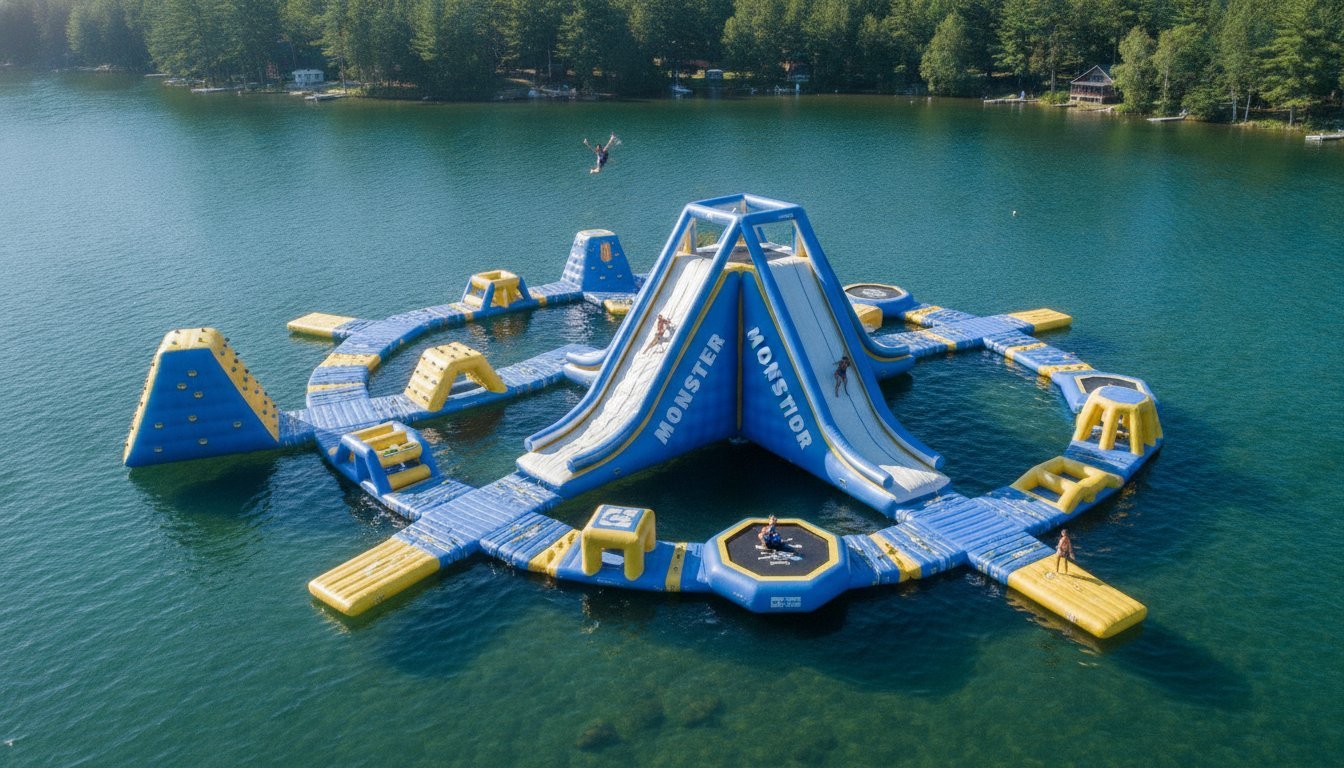
Your waterfront is either a liability waiting to happen or a high-velocity profit centre. Most operators realize too late that the bargain equipment they bought is just a glorified beach toy. It punctures. It fades. It fails. If you are searching for a commercial inflatable water park for sale, you are not just buying PVC; you are investing in a five-year ROI strategy. You need a park that withstands the heat of July and the chaos of a thousand guests without flinching.
We know the uncertainty that comes with vague safety standards and confusing modular configurations. It is exhausting. This guide provides a clear framework for evaluating equipment quality and maximizing guest throughput. You will gain the confidence to distinguish between cheap imitations and rugged, commercial-grade engineering that actually lasts. We are diving into the layout strategies and durability markers that turn a simple lake into a legendary destination. Prepare to master the essential criteria for a high-impact, revenue-generating park that dominates the 2026 season.
Key Takeaways
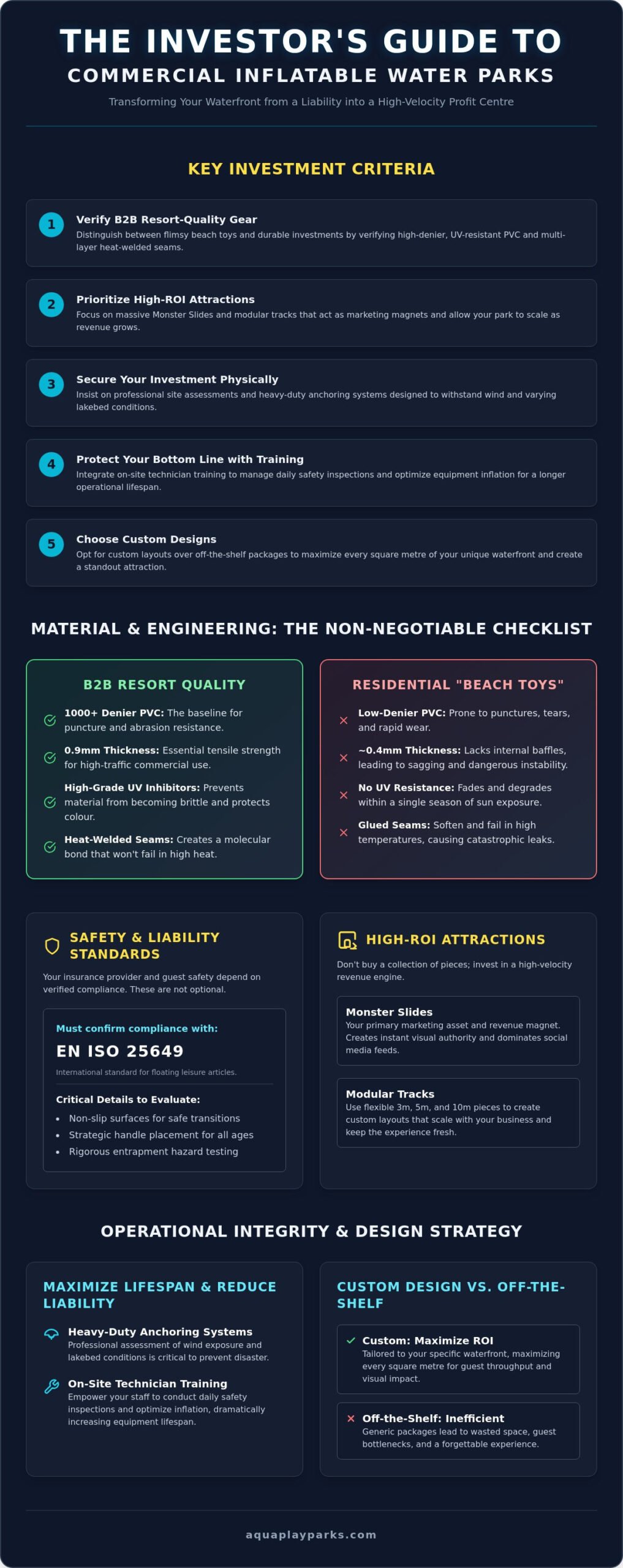
- Distinguish between flimsy beach toys and B2B resort-quality gear by verifying high-denier, UV-resistant PVC and multi-layer heat-welded seams.
- Identify high-ROI attractions by prioritizing massive Monster Slides and modular tracks that allow your park to scale as your revenue grows.
- Secure your investment with professional site assessments and heavy-duty anchoring systems designed to withstand wind exposure and varying lakebed conditions.
- Protect your bottom line by integrating on-site technician training to manage daily safety inspections and optimize equipment inflation for a longer lifespan.
- When searching for a commercial inflatable water park for sale, choose custom designs over off-the-shelf packages to maximize every square metre of your waterfront.
Defining B2B Resort Quality: What to Verify Before You Buy
Stop thinking about these installations as simple inflatables and start seeing them as floating infrastructure. When you are scouting for a commercial inflatable water park for sale, the price tag often reflects the invisible engineering that prevents a total operational shutdown. Residential-grade products fail within weeks because they aren’t designed for the constant friction and weight loads of a public attraction. They are beach toys. You need B2B Resort Quality. True commercial equipment is built for high-intensity throughput, engineered to survive the relentless traffic of 100+ daily users without losing its shape or structural integrity.
The Unbreakable Material Checklist
- Demand 1000+ Denier PVC: This is your baseline. A 0.9mm thickness is non-negotiable for commercial parks. It provides the necessary tensile strength to resist punctures from stray jewellery or heavy abrasions from constant use.
- Verify UV-resistance: Intense sun exposure across the States is brutal on synthetics. Without high-grade UV inhibitors, your investment will degrade, turn brittle, and lose its vibrant colour within a single season.
- Look for heat-welded seams: Forget traditional glue. Glue softens and fails in high heat. Heat-welding creates a molecular bond that stays air-tight through massive temperature fluctuations during peak July afternoons.
Safety and Liability Standards
Your insurance provider cares about one thing: certifications. You must confirm compliance with EN ISO 25649 or an equivalent commercial safety standard. This international benchmark ensures the equipment has been rigorously tested for stability, entrapment hazards, and load-bearing capacity. Safety features aren’t just about the big picture; they are in the details. Evaluate handle placement and non-slip surfaces. These are critical for guests of all ages to navigate the park safely. While there are many different types of water slides, floating commercial versions require extra attention to grip and transition zones to prevent accidents.
A residential inflatable is a liability in a professional setting. These products often use thin 0.4mm PVC and lack the internal baffles required to maintain rigidity. Within days, the seams will stretch and the material will sag. This creates a dangerous environment for guests and a reputational nightmare for you. If it isn’t B2B Resort Quality, it doesn’t belong on your waterfront. For a full breakdown of how these materials impact your bottom line, read our guide on Commercial vs Residential Inflatable Water Park: Why Material and Training Define Your ROI. Invest in equipment that works as hard as you do.
Selecting Revenue-Generating Attractions: Monster Slides and Modular Tracks
Don’t just buy equipment; buy a magnet. When you look for a commercial inflatable water park for sale, you’re looking for the engine of your business. Most operators make the mistake of buying a collection of small pieces that look busy but fail to move the needle on ticket sales. You need anchor attractions that define the skyline of your waterfront and modular pieces that keep guests coming back for more. It’s about engineering an experience that translates directly into high-velocity revenue.
The ROI of Monster Slides
The world’s largest floating slides are not just play structures; they are your primary marketing assets. A Monster Slide is a high-capacity revenue magnet for commercial venues that creates instant visual authority. It’s the piece that ends up on every guest’s TikTok and Instagram feed. By positioning these as standalone anchor points, you draw crowds from the shore and set the scale for the rest of your park. These massive structures are designed to handle high volumes, ensuring that your most popular attraction doesn’t become your biggest bottleneck. For a deeper dive into the numbers, see how Inflatable Monster Water Slides act as the ultimate revenue driver for commercial waterfronts.
Modular Obstacles: Building the Interactive Track
Flexibility is the key to longevity. Using 3m, 5m, and 10m modular pieces allows you to organize a custom-sized waterfront that fits your specific geography. This modularity means you don’t have to launch a massive park all at once. You can start with a high-impact core and expand as your profits grow. Design tracks that encourage competition. When guests race, they engage more deeply and stay longer. To ensure these competitive tracks remain safe under high-stress use, all components must adhere to ASTM F2374-22 safety standards for inflatable devices.
Think about guest throughput. Pieces like iceberg climbers and pyramid bag jumps are essential for retention because they offer varying levels of challenge. However, a park is only as profitable as its flow. If your layout forces everyone into a single lane, you’re capping your revenue. Balance your high-capacity standalone pieces with wide running tracks to maximize the number of tickets you can sell per hour. If you’re ready to see how these pieces fit together, you can explore custom aqua park designs that turn your lake into a high-ROI destination. Choosing the right commercial inflatable water park for sale means prioritizing pieces that move people, not just pieces that fill space.
Site Suitability and Technical Readiness: Planning Your Waterfront Layout
Your waterfront is the stage for your business, but the script is written in the technical details of your site. Finding a commercial inflatable water park for sale is only the first step. True success requires a meticulous site assessment to ensure your environment can support the physical demands of high-capacity equipment. Technical readiness isn’t just a box to check; it is the foundation of your safety protocol and your insurance compliance. You need to know exactly what is happening beneath the surface before a single anchor is dropped.
Anchoring is the backbone of your installation. Forget standard ropes or lightweight weights. Commercial parks require heavy-duty anchoring systems engineered for your specific lakebed composition. Whether you are dealing with silt, rock, or clay, your anchoring must be rock-solid to keep the park stable during high winds. Stability is what keeps your park open and your guests safe when the weather turns. Without a professional plan, you are just drifting.
The Waterfront Assessment Checklist
Large slides and massive bag jumps require specific water depths to function safely. Typically, you need a minimum depth ranging from 2.5 metres to 4 metres to ensure guests don’t strike the bottom. You must also analyze water currents and wind exposure. High winds can turn a poorly planned park into a drifting hazard, putting both your guests and your equipment at risk. For a step-by-step technical breakdown, consult our guide on Professional Site Assessment for Floating Water Parks.
The Campers Starter Park Strategy
If you are a campground owner, you don’t necessarily need a mega-park on day one. The Campers Starter Park concept allows you to launch a high-impact waterfront attraction with a curated package designed for smaller footprints. This strategy lets you test the market and generate immediate cash flow without an overwhelming initial layout. As your guest base grows and your revenue increases, you can easily scale by adding modular pieces. This incremental growth ensures your park remains a fresh destination every season. Learn how to get started with The Ultimate Water Park Starter Package for Campgrounds.
Finally, consider the reality of diverse weather patterns across the US. Your equipment must be easy to deflate, clean, and organize for seasonal storage. Professional-grade PVC is rugged, but it must be stored correctly to protect your investment from extreme seasonal shifts or winter elements. Adhering to industry safety guidelines during both the installation and the seasonal breakdown ensures your gear remains in top condition for years. When you invest in a commercial inflatable water park for sale, you are buying a long-term asset, so treat your site preparation with the respect it deserves.
The Operational Training Mandate: Reducing Liability and Maximizing Lifespan
Imagine your waterfront during a record-breaking heatwave in July. Your park is packed, the sun is blazing, and the internal air pressure of your equipment is climbing. This is where your investment is won or lost. Buying a commercial inflatable water park for sale is a major capital move, but the training you provide for your staff is what protects that capital. Never sign a purchase agreement without a clear plan for on-site technician training. It is the single most important factor in determining whether your gear lasts five years or burns out in a single season.
Technicians are the guardians of your ROI. They don’t just watch the water; they manage the physical state of your floating assets. On a hot day, air expands rapidly. Without proper pressure release or manual monitoring, even the highest-grade PVC can reach its breaking point. Trained staff realize how to balance internal pressure with ambient temperatures, preventing the micro-tears and seam stress that lead to catastrophic leaks. They are your first line of defence against preventable wear and tear.
On-Site Technician Training Protocols
A professional training program must go beyond simple setup. It should include deep-dive sessions on maintenance, seam repair, and emergency drills. Having a certified technician on-staff means you don’t have to wait for a third party when a minor issue arises; you fix it, you test it, and you get back to selling tickets. This level of autonomy is vital for maintaining a high-velocity business. For a full breakdown of what your team needs to master, consult our On-Site Water Park Technician Training guide.
Safety as a Business Strategy
Safety is your most powerful marketing tool and your best insurance policy. Insurance companies prioritize data and professional standards. When you demonstrate that your team follows rigorous, documented safety protocols, you are in a much stronger position to negotiate lower premiums. It proves you aren’t just running a “bounce house” on a lake; you are managing a sophisticated, professional attraction. Implementing daily checklists for anchor tension and material integrity keeps your liability low and your guest confidence high. Learn more about operating an inflatable water park to maximize your safety and ROI.
A reputation for a tight, professional operation builds long-term trust with families and resort guests. It transforms your waterfront into a reliable destination. When you are evaluating a commercial inflatable water park for sale, remember that the gear is only half the equation. The other half is the expertise to run it safely. You can book on-site technician training to ensure your team is ready for the demands of a high-traffic season.
Why True Custom Design Outperforms Off-the-Shelf Packages
Off-the-shelf packages are designed for the average waterfront, but your business isn’t average. When you settle for a pre-packaged configuration, you are leaving money on the table. Every square metre of your lakefront is potential revenue, and a generic layout often fails to maximize that space. True Custom Designing allows you to engineer a park that fits your specific shoreline, water depth, and guest capacity requirements. You aren’t just buying pieces; you are building a high-performance machine tailored to your unique location. When searching for a commercial inflatable water park for sale, the ability to customize is what separates a world-class destination from a standard seasonal attraction.
Collaborating with a designer who brings 35+ years of industry experience is the most effective way to avoid common layout mistakes. Amateurs often create bottlenecks or place high-intensity attractions too close together, leading to guest frustration and safety risks. A seasoned expert understands how to organize the flow to keep guests moving and ticket sales climbing. Beyond the layout, custom design lets you integrate unique branding. Custom colours and logos turn your B2B Commercial Resort Quality equipment into a massive floating billboard for your resort, enhancing your marketing reach without extra ad spend.
The Custom Design Process
The journey from an initial vision to a thriving park begins with 3D rendering. This allows you to visualize your park in its actual environment before you commit to the purchase. We focus on optimizing flow and capacity based on your specific guest demographics. If your resort attracts teenagers, we prioritize high-intensity obstacle tracks; if you cater to families, we balance the layout with more accessible play zones. This strategic approach to Floating Aqua Park Designs ensures you out-compete local parks that rely on basic, uninspired configurations. You get to see the exact footprint and guest pathing, ensuring every dollar spent contributes to a superior guest experience.
Direct-to-Designer Benefits
Eliminate the middleman and the communication lag that comes with corporate resellers. Dealing directly with the designer gives you a straight-talking advantage. You get technical answers directly from the source, which is vital when you are making high-stakes decisions about a commercial inflatable water park for sale. This direct line allows for faster pivots and adjustments during the design phase, ensuring the final product matches your vision perfectly. It also ensures your Monster Slide is positioned for maximum visual impact from the shore, acting as the ultimate hook for passersby. When you cut out the intermediaries, you realize better cost efficiency and a more transparent partnership, moving you quickly from concept to a revenue-generating reality.
Dominate Your Waterfront and Scale Your ROI
Your waterfront is a blank canvas for profit. You now possess the strategic framework to distinguish between flimsy toys and professional infrastructure. Success in the 2026 season requires more than just browsing for a commercial inflatable water park for sale. It demands a commitment to B2B Resort Quality materials and a layout specifically engineered for high-velocity guest throughput. By focusing on 1000+ Denier PVC and heat-welded seams, you are securing a five-year asset that thrives under pressure.
Stop guessing and start growing. We leverage 35+ years of industry design experience to craft bespoke parks that feature the world’s largest money-earning Monster Slides. Our partnership doesn’t end at delivery; we provide comprehensive on-site technician training to ensure your team operates with total confidence and safety. Ready to monetize your waterfront? Contact our lead designer today to start your custom aqua park design. Your journey toward a high-ROI destination begins with a single bold decision. Let’s build a park that sets a new standard for outdoor recreation and drives your business forward.
Frequently Asked Questions
How much water depth do I need to buy and install commercial water park equipment?
You need a minimum water depth of 2.5 metres to 4 metres for most high-capacity attractions like Monster Slides or bag jumps. This depth ensures a safe landing zone for guests and prevents impact with the lakebed. Always conduct a professional site assessment to verify the specific depth requirements for every piece in your custom layout before finalizing your purchase.
What is the typical payback period for a commercial inflatable water park investment?
A well-managed medium-sized park with a 100-person capacity can potentially recover its initial investment within 30 to 45 days of peak seasonal operation. This rapid ROI is driven by high ticket throughput and the visual gravity of signature attractions. When you evaluate a commercial inflatable water park for sale, focus on these high-ROI pieces that turn your waterfront into a high-velocity revenue engine.
Can I add modular pieces to my water park in later seasons?
Yes, modularity is a core advantage of professional aqua park engineering. You can start with a Campers Starter Park and scale your footprint as your revenue grows by adding 3m, 5m, or 10m track sections. This flexibility allows you to keep your destination fresh every year without requiring a total redesign of your existing anchoring system or layout.
What kind of maintenance does commercial-grade inflatable equipment require?
Commercial gear requires daily safety inspections of anchor tension and material integrity alongside strict air pressure management. Because air expands in the heat, your staff must monitor inflation levels throughout the day to prevent seam stress. Regular cleaning and proper seasonal storage are also vital to protect the high-denier PVC from environmental degradation and ensure a long lifespan.
Do I need a special permit to install a floating aqua park on a lake?
Permit requirements are a patchwork of local and regional regulations that vary significantly depending on your location. Some jurisdictions require comprehensive environmental assessments, insurance certifications, and annual operating permits that can range from $40 to over $500 per unit. Always consult with local authorities early in the design phase to ensure your custom park meets every legal and safety mandate.
How long does it take to set up and take down a modular floating water park?
A medium-sized modular park typically takes two to three days to fully install once your anchoring system is in place. Takedown is generally faster, but it requires meticulous cleaning and drying of the PVC before deflation and storage. Efficient setup and breakdown are essential for maximizing your operating season and protecting the equipment during the off-season months.
Is on-site training mandatory when buying commercial water park equipment?
On-site technician training is essentially mandatory if you want to protect your investment and minimize liability. Proper training ensures your team can handle daily safety checks, emergency drills, and mid-season repairs without costly downtime. It also positions you to negotiate better insurance premiums by proving your operation follows rigorous professional safety standards.
What is the difference between heat-welded and glued seams in water park inflatables?
Heat-welded seams create a molecular bond between the PVC layers that stays air-tight even during extreme temperature fluctuations. In contrast, glued seams rely on chemical adhesives that frequently soften and fail when exposed to high heat and constant friction. For a commercial inflatable water park for sale, heat-welding is the only choice that guarantees the durability required for a high-traffic environment.
Leave a Reply