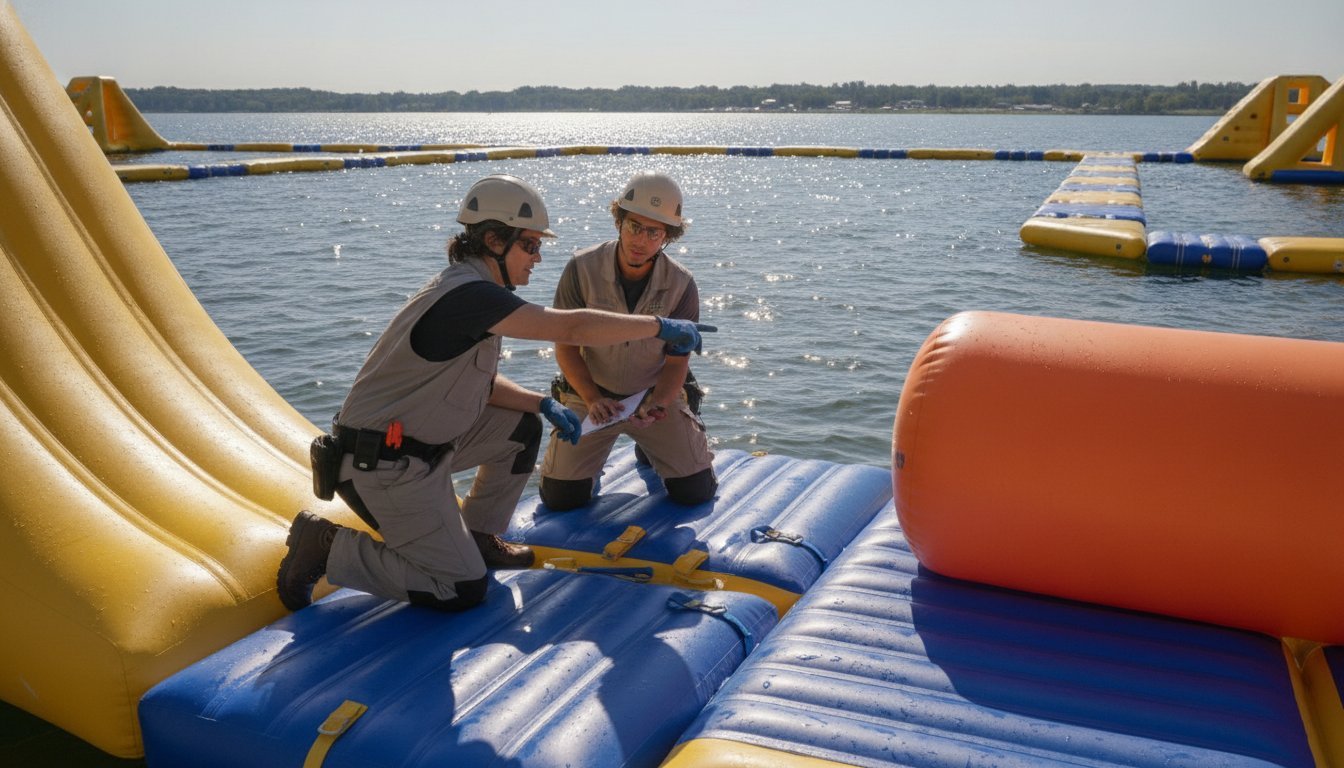
What if your biggest liability was actually your most powerful profit engine? You’ve poured capital into a world-class floating playground to realize a massive ROI, yet the fear of a botched anchoring job or a catastrophic equipment failure still keeps you awake at night. It’s a common struggle for resort owners who understand that a single technical oversight can jeopardize both guest safety and their commercial investment. Stop guessing. Start leading. Investing in professional on-site water park technician training is the only way to transform your crew from simple observers into technical masters of lakefront physics.
We agree that protecting your guests and your gear must be your top priority. This guide promises to show you exactly how to master the technical protocols and safety standards required to protect your commercial inflatable investment and maximize your waterfront ROI. We will explore the critical ASTM F2374-22 protocols, provide strategies to minimize insurance premiums through documented expertise, and show you how to eliminate the guesswork of lakefront pressure management to ensure your park stays inflated and profitable all season long.
Key Takeaways
- Master the physics of lakefront installations through professional on-site water park technician training to ensure your equipment remains stable, safe, and profitable.
- Learn the “Thermoregulation Rule” to manage internal PSI effectively, preventing costly over-inflation damage while maintaining structural integrity in changing temperatures.
- Identify and mitigate critical safety hazards like entrapment zones between modular pieces to protect your guests and significantly reduce liability risks.
- Streamline your daily operations with expert protocols for inspecting and maintaining running track components to extend the life-cycle of your resort-quality assets.
- Discover how customized training sessions help you organize a competent team that maximizes the ROI of your commercial waterfront investment.
Beyond the Manual: Why On-Site Water Park Technician Training is Critical
Imagine a crew staring at a tablet while a six-figure modular park drifts off-course during a storm. Manuals are fine for basic assembly, but they don’t teach your team the “feel” of a 10-metre running track under tension or how to react when a sandbar shifts. Professional on-site water park technician training is the bridge between reading about physics and mastering them on the water. It’s a hands-on, high-intensity education designed specifically for commercial inflatable systems. We don’t just hand you a PDF; we get your team on the water to realize the true potential of your asset.
Manuals lie by omission. They suggest every day is calm and every anchor point is perfect. Real-world lakefront operations are messy, dynamic, and demanding. By training your staff on-site, you’re protecting your investment with a “straight-shooter” approach. You aren’t just hiring summer help; you’re building a technical elite capable of defending your revenue against the elements. Competent staff are the ultimate insurance policy for your park’s survival.
Asset Protection and Lifecycle Management
Commercial gear is built for heavy abuse, but it isn’t invincible. The fundamental difference between commercial vs residential inflatable water parks isn’t just the thickness of the PVC; it’s the level of professional oversight required to maintain it. Improper handling during the daily setup or takedown leads to micro-tears and seam failures that can sideline your park during a peak July weekend. If one untrained staff member over-inflates a slide or botches a modular connection, they can halt your entire revenue stream instantly. Documented training is also a powerful leverage tool. When you can prove your team has mastered technical protocols, you’re in a much stronger position to negotiate lower insurance premiums.
The Dynamic Nature of Lakefront Operations
Pools are static, controlled environments. Lakes are living, breathing obstacles. A “pool plant” certification is useless when a sudden wind gust puts five tonnes of force on your anchoring lines. Technicians need to transition from a lifeguard mindset to a technical operator mindset. While lifeguards focus on the guests, your technicians must focus on the environment. They need to monitor current, wind speed, and water level fluctuations that a pool-based operator would never face. Understanding Operational Safety: Protocols to Minimize Liability means recognizing that a floating aqua park is a complex machine that requires constant calibration. On-site water park technician training ensures your crew knows how to read the water and the weather before a minor issue turns into a major claim.
The Core Curriculum: Mastering Commercial Inflatable Operations
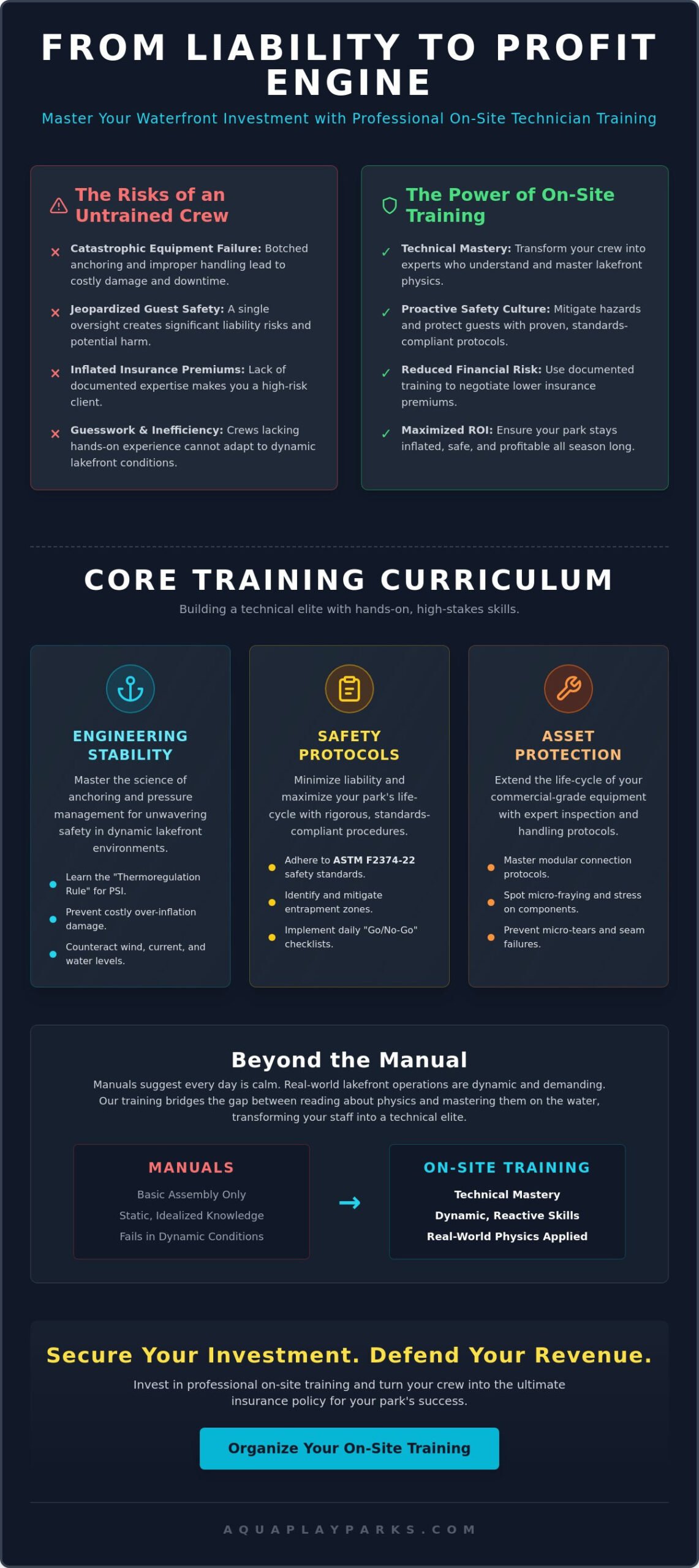
Speed and precision define your success. Your team needs to move beyond the idea of “inflating toys” to managing a complex B2B asset. This is where on-site water park technician training turns a basic seasonal crew into an elite operational unit. We focus on the high-stakes skills that matter: structural inspection, precise pressure management, and the rigorous daily “Go/No-Go” checklist. This checklist is your line in the sand. It evaluates wind speed, water clarity, and equipment integrity before a single guest steps onto the park. All protocols are designed to meet or exceed ASTM F2374-22 safety standards, ensuring your operation is both compliant and durable.
Modular Connection Protocols
Stability is everything. A loose connection isn’t just a trip hazard; it’s a structural failure waiting to happen. During training, technicians learn to master the modular connection system for 3-metre, 5-metre, and 10-metre running track pieces. We teach them to spot micro-fraying in connection straps and ensure stainless steel D-rings are tensioned perfectly. The goal is a gap-free, interactive running track that remains stable even under high guest volume. When your team understands the mechanics of these links, they can realize a safer, more fluid guest experience that keeps people coming back. If you are looking to scale your current setup, our floating aqua park designs provide the perfect blueprint for a high-capacity modular layout.
High-Adrenaline Attraction Maintenance
Your money-earning “Monster Slides” and high-adrenaline features require specialized care. These aren’t standard inflatables; they are the centre-stage attractions that drive your ROI. Training covers specific protocols for managing impact zones on iceberg climbers and pyramid bag jumps. Technicians must understand the unique stress points of the world’s largest floating slides, where the weight and velocity of guests create significant wear. We also emphasize the visual side of the business. A slide covered in lake algae or grime kills the “wow” factor. We teach efficient cleaning procedures that maintain the resort-quality shine without damaging the commercial-grade PVC. This ensures your park looks as impressive as it performs, protecting both your reputation and your revenue.
Effective maintenance isn’t a chore; it’s a discipline. By mastering these core curriculum skills, your team ensures that every piece of equipment, from the smallest connector to the massive slide tower, is ready for peak performance. This level of technical competency is what separates profitable resorts from struggling operations.
Engineering Stability: Anchoring and Pressure Management Science
Physics doesn’t take a day off. When you operate a commercial waterfront, you are constantly battling the laws of thermodynamics and fluid dynamics. Most operators treat inflation as a “set it and forget it” task, but that’s a recipe for a catastrophic blowout. Professional on-site water park technician training teaches your crew the “Thermoregulation Rule.” This rule dictates how the interaction between the cold lake water and the blazing afternoon sun affects internal PSI. Air expands as it heats. If your team doesn’t understand how to manage this expansion, the sun will eventually do the work for them by shredding your seams. Pressure Management is the balance between heat expansion and structural rigidity.
Over-inflation is the silent killer of commercial PVC, but under-inflation is equally dangerous. A soft module lacks the structural integrity to support guest weight, leading to sagging and potential entrapment risks. We bridge the gap between “guessing” and “knowing.” By referencing inflatable amusement device safety concerns, we provide your technicians with a data-driven framework for maintaining the perfect bounce. They learn that a park is a living machine that requires constant calibration to remain both safe and profitable. For a comprehensive overview of the operational standards required to run a compliant and profitable installation, our guide on how to operate an inflatable water park provides the tactical framework every commercial operator needs.
The Daily Pressure Cycle
Consistency is the hallmark of a professional resort. Your technicians must adopt a mandatory routine: morning inflation followed by a mid-day pressure release. As the sun peaks, the air inside your modules can expand rapidly, pushing the material to its breaking point. We insist on the use of commercial-grade pressure gauges for every check. Relying on “feeling” the inflatable by hand is an amateur move that leads to inconsistent results and unnecessary wear. On-site water park technician training ensures every staff member speaks the same technical language, using hard data to justify every adjustment they make to the park’s internal pressure.
Advanced Anchoring Systems
Anchoring is the foundation of your waterfront ROI. If a module moves, your liability increases. We dive deep into Anchoring 101, covering everything from shock-absorbing bungee systems to heavy-duty concrete blocks and specialized screw anchors for varied lakebeds. Your team will learn to calculate the specific load requirements for massive modular setups and standalone climbers, ensuring nothing drifts during a storm. Before your anchoring system is ever deployed, conducting a thorough site assessment for your floating water park is the critical first step to verifying lakebed composition and water depth requirements. We teach them how to inspect underwater anchor lines through a systematic process that doesn’t disrupt your daily operations. This includes managing the “swing” radius of the park, a critical calculation that ensures guests remain in safe water depths even when high winds push the structures to their limits. Stop hoping your anchors hold. Train your team to ensure they do.
Operational Safety: Protocols to Minimize Liability and Maximize Life-Cycle
Safety isn’t a suggestion; it’s the foundation of your B2B reputation. While lifeguards watch the guests, your technicians watch the system. Developing a comprehensive Emergency Action Plan (EAP) specifically for floating parks is a critical outcome of on-site water park technician training. Unlike static pool structures, floating parks are susceptible to rapid environmental shifts and mechanical stresses. Your EAP must account for sudden wind gusts, anchor shifts, and modular instability. This proactive stance is what separates a world-class resort from a liability nightmare. You aren’t just managing a playground; you’re commanding a high-performance aquatic machine.
One of the most overlooked risks in modular systems is the creation of “entrapment zones.” These are the dangerous gaps that can form between obstacle pieces if connections are not meticulously monitored and tensioned. Our training teaches technicians to identify these hazards before a guest ever leaves the shore. It is far more efficient to integrate these safety protocols during your custom inflatable water park design phase than to retroactively fix a dangerous layout. Your technicians also play a front-line role in guest orientation. They provide the technical briefings that ensure guests use the equipment as intended, which significantly reduces your risk profile and insurance exposure.
Risk Assessment and Mitigation
Vigilance is a daily requirement, not a weekly one. Technicians must conduct rigorous “walk-throughs” every morning to identify slippery surfaces, UV degradation, or loose connection straps that have shifted overnight. Establishing clear “Fall Zones” and “No-Swim Zones” around high-adrenaline features like monster slides is non-negotiable for guest safety. You must also manage guest capacity with precision. Structural overloading of modular tracks can lead to submerged pieces or failed anchors, putting the entire park at risk. By training your team to recognize these thresholds, you protect the equipment and your bottom line simultaneously.
Incident Response for Technicians
When things go wrong, speed is your only ally. Technicians need immediate, practiced protocols for handling a sudden puncture or a failed anchor line in the middle of a busy afternoon. This isn’t just about fixing the gear; it’s about coordinating with lifeguards to ensure a safe water rescue while the technical team stabilizes the park. Once the immediate threat is resolved, your team must follow a strict post-incident reporting and equipment re-certification process. This documentation is vital for maintaining your insurance standing and ensuring the park is ready for the next wave of guests. Ready to bulletproof your operation? Book your on-site water park technician training today and lead your team with absolute confidence.
Securing Your Investment with Aqua Play Parks On-Site Training
Visionary leadership requires more than just buying the best equipment. It demands a commitment to excellence that trickles down to every member of your waterfront team. When you partner with us, you aren’t just getting a manual; you’re gaining 35 years of Canadian design expertise. We’ve seen every lake condition and solved every anchoring challenge imaginable. This deep industry history allows us to provide on-site water park technician training that is unapologetically pragmatic and focused on your bottom line. We don’t believe in generic solutions. Every session is customized for your specific resort layout, water depth, and local environmental factors to ensure your park operates at peak efficiency from day one.
Our “Train the Trainer” model is designed for long-term scalability. We empower your senior staff to become the guardians of your operational standards, ensuring that technical knowledge stays within your organization even as seasonal crews rotate. This high-level oversight is essential whether you are managing a massive custom installation or launching the campers starter park. Even entry-level packages represent a significant commercial investment. Treating them with professional technical rigour is how you realize a faster ROI and extend the lifecycle of your PVC assets.
The Aqua Play Parks Training Experience
We believe the best classroom is the water. Our training experience is built around hands-on installation during your initial park setup. Your team will work side-by-side with experts to master the nuances of modular alignment and anchor tensioning. But we go beyond the hardware. We provide straight-talking business advice on how to maximize guest throughput and increase ticket sales through efficient park flow. You get direct access to the designer for ongoing technical support, ensuring you are never alone when facing a complex operational hurdle. This is a high-intensity partnership aimed at one thing: your success.
Next Steps: Booking Your On-Site Session
Timing is critical in the recreation industry. To maximize your revenue, we recommend scheduling your on-site water park technician training to coincide with your seasonal park opening. This allows your team to learn in real-time as the equipment is deployed. To prepare for the most productive session, ensure your facility is accessible and your core staff is ready to engage in a full day of technical and operational drills. Don’t leave your safety standards or your equipment’s longevity to chance. Contact Aqua Play Parks today to book your professional on-site technician training and transform your waterfront into a high-performance, high-profit destination.
Command Your Waterfront Future
Your floating park is a visionary commercial asset, not a temporary playground. Protecting that investment requires a team that masters the technical realities of the water. By focusing on precision anchoring, data-driven pressure management, and rigorous safety protocols, you transform a seasonal operation into a high-performance profit engine. We bring 35 years of industry-leading design experience directly to your shoreline, ensuring your staff can meet B2B commercial resort quality standards with every shift. Our on-site water park technician training is not a generic seminar; it is a hands-on deep dive tailored specifically to your unique lakebed and layout.
Stop reacting to the elements and start mastering them. A competent crew reduces equipment wear, minimizes liability, and ensures your guests have the high-adrenaline experience they expect. You’ve built the dream. Now, give your team the technical tools to defend it. Secure your waterfront ROI with professional on-site training. The future of your resort is on the water, and it’s looking more profitable than ever. Let’s get to work and make this season your most successful one yet.
Frequently Asked Questions
Do we need on-site training if we bought a smaller starter park?
Yes, professional on-site water park technician training is essential regardless of your park’s scale. Even entry-level packages like The Campers Starter Park represent a significant commercial investment that requires precise anchoring and pressure management to realize its full lifespan. Smaller parks face the same environmental stresses as massive installations, so technical competency is your first line of defence against premature equipment wear and tear.
How many staff members should attend the water park technician training?
We recommend that your entire core operational team, typically three to five senior staff members, attend the session. This structure supports our “Train the Trainer” model, ensuring your leadership can maintain high standards as seasonal crews rotate. Having multiple trained technicians prevents operational downtime if one staff member is unavailable, keeping your revenue stream protected throughout the peak summer months.
What is the difference between a lifeguard and a water park technician?
Lifeguards are responsible for guest supervision and water rescue, while water park technicians focus on the structural health and mechanical stability of the equipment. A technician manages internal PSI, inspects modular connections, and monitors anchoring tension to prevent failures. While their roles overlap during an emergency, the technician’s primary goal is maintaining the park’s integrity before it impacts guest safety.
Does on-site training cover the installation of the anchoring system?
Mastering the installation of your specific anchoring system is a fundamental part of our hands-on curriculum. We analyze your lakebed and resort layout to teach your team how to deploy concrete blocks, screw anchors, or bungee systems correctly. This practical experience ensures your park stays exactly where you designed it to be, even when high winds and currents test the limits of your setup.
How often should our staff undergo re-certification training?
Annual re-certification is the industry gold standard for maintaining B2B commercial safety and operational excellence. Training your team every spring before the seasonal opening ensures that technical protocols are fresh and any new equipment is integrated correctly into your workflow. Regular on-site water park technician training also helps your organization stay current with the latest safety regulations and maintenance techniques.
Can on-site training help reduce our insurance premiums?
Documented professional training is a powerful tool for negotiating lower insurance premiums with your provider. Underwriters value aggressive risk mitigation, and showing that your team is certified in technical operations proves you are proactive about guest safety. By reducing the likelihood of incidents through competent, documented maintenance, you present a much lower risk profile to insurance companies.
What technical equipment do we need to have ready for the training session?
You need to have your full modular park, anchoring hardware, and commercial inflation tools ready at your facility. Our training is most effective when conducted using the exact equipment your team will handle during daily operations. We also suggest having your current Emergency Action Plan (EAP) draft available so we can refine it together based on the technical realities of your specific waterfront.
Is training provided for custom-designed monster slides?
Absolutely, we provide specialized training for our world-leading monster slides and high-adrenaline attractions. These massive structures have unique impact zones and structural requirements that differ significantly from standard modular pieces. We ensure your technicians understand how to manage the high-velocity stress points and maintenance needs of these centre-stage profit earners to keep them safe and visually impressive.
Leave a Reply