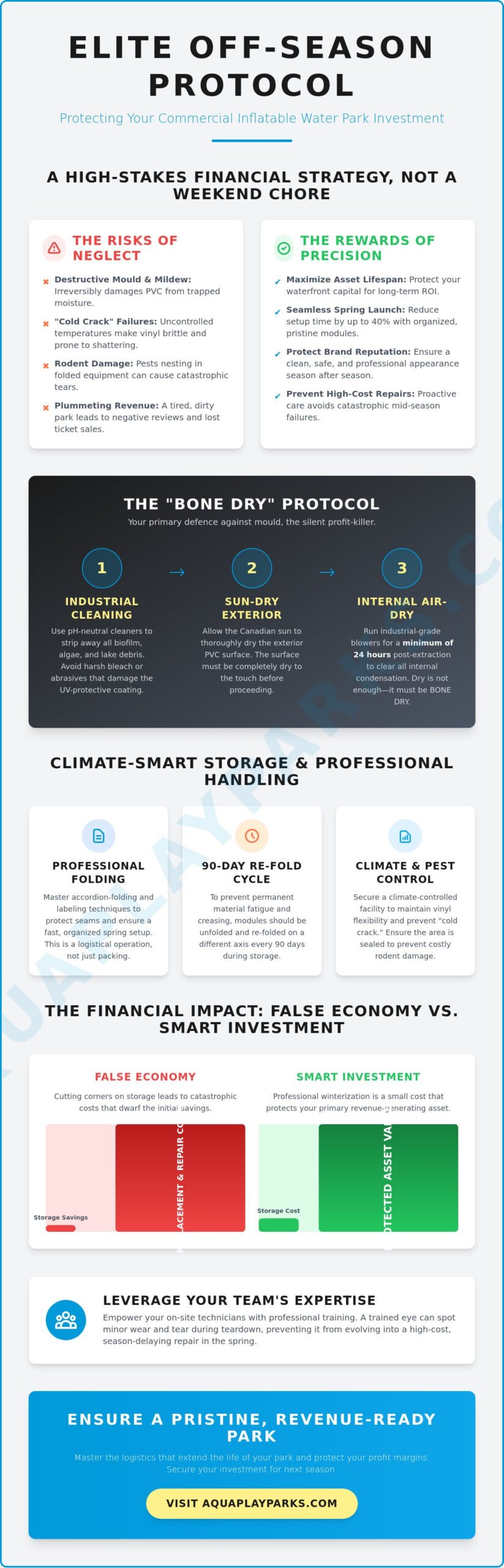
Your off-season strategy is the final phase of your annual revenue plan, not just a weekend chore. If you treat winter storage for commercial inflatable water park equipment as an afterthought, you’re essentially gambling with your most profitable assets. We understand the gut-wrenching anxiety of unrolling a 10m track in May only to find that mould or rodents have ravaged your PVC. It’s a high-stakes transition that demands professional precision and a visionary’s eye for detail.
You want your monster slides to emerge from the warehouse in the same pristine, revenue-ready condition they entered it. This guide delivers the elite protocols required to protect your waterfront capital and ensure a seamless, plug-and-play launch next season. We’ll walk through the critical “Bone Dry” 72-hour protocol, the necessity of climate-controlled environments, and the 90-day re-fold cycle that prevents permanent material fatigue. Get ready to master the logistics that extend the life of your park and keep your profit margins exactly where they belong.
Key Takeaways
- Treat your off-season care as a high-stakes financial strategy to protect the long-term value of your commercial-grade waterfront assets.
- Implement the “Bone Dry” protocol using industrial-grade cleaners to eliminate moisture and prevent destructive mould from forming in deep PVC seams.
- Optimize your spring launch by mastering professional accordion-folding and labeling techniques for winter storage for commercial inflatable water park modules.
- Shield your equipment from “cold crack” failures by securing climate-controlled storage that maintains vinyl flexibility during harsh Canadian winters.
- Leverage on-site technician training to empower your team to spot minor wear and tear before it evolves into a high-cost repair in the spring.
Protecting Your Waterfront Investment: The Critical Role of Winter Storage
Think of your aqua park as a fleet of high-revenue vehicles. You wouldn’t leave a luxury yacht uncovered in a blizzard, so why do it to your water park? Proper winter storage for commercial inflatable water park equipment is the most critical phase of your annual operational cycle. It’s the difference between a high-ROI season and a spring spent filing insurance claims. When you view your park as a high-performance financial asset rather than just recreation equipment, your maintenance strategy shifts from reactive to proactive.
The enemies of your park are silent but relentless. During the summer, UV rays weaken the molecular bonds of the vinyl. If you pack that material away while it’s still damp, you’re inviting “black mould” to feast on your investment. A disciplined, documented teardown protocol reduces spring setup time by up to 40%. That’s days of labour saved when you’re rushing to open for the Memorial Day weekend. Cutting corners now leads to catastrophic mid-season failures next year that no amount of duct tape can fix.
The Financial Impact of Improper Winterization
Neglecting your storage strategy is a false economy. The cost of climate-controlled warehousing is a fraction of the cost of replacing a single monster slide. When you invest in a custom inflatable water park design, you’re securing a long-term revenue generator. You must protect it to realize the full ROI. Beyond the physical damage, consider your brand’s reputation. Guests notice the smell of mildew and the sight of stained vinyl. A park that looks “tired” or dirty leads to plummeting ticket sales and negative reviews that haunt your business for years.
Commercial vs. Residential Storage Standards
Don’t confuse your B2B assets with a backyard Inflatable castle. Residential toys are light and disposable; your 10m modular tracks and monster slides weigh hundreds of kilograms and require specialized extraction. Managing the winter storage for commercial inflatable water park components is a logistical operation that demands professional-grade respect. You need industrial-grade blowers to ensure every cubic inch of internal air space is moisture-free. If you treat your park like a toy, it will fail like one. Keep your equipment at the centre of your business strategy by following these professional protocols:
- Industrial Cleaning: Remove all biofilm and lake debris before the PVC dries.
- Internal Desiccation: Use high-volume blowers to clear internal condensation.
- Climate Control: Maintain a stable temperature to prevent vinyl brittleness.
- Rodent Protection: Secure the storage area to prevent nesting damage.
The “Bone Dry” Protocol: Eliminating Moisture Before Packing
Moisture is a silent profit-killer. If you pack away your assets with even a hint of dampness in the seams, you aren’t just storing equipment; you’re cultivating a disaster. Black mould is the primary enemy during winter storage for commercial inflatable water park units. Once it takes root in the fabric of your modular tracks, the damage is often irreversible. It smells, it stains, and it signals to your guests that your standards have slipped. You’ve worked too hard to build a destination to let it rot in a warehouse.
To prevent this, we utilize a rigorous “Sun-Dry then Air-Dry” method. First, let the Canadian sun do the heavy lifting on the exterior PVC. Once the surface is dry to the touch, the real work begins. You must run industrial-grade blowers for at least 24 hours post-extraction. This clears the internal condensation that inevitably forms when warm lake air meets a cooling evening breeze. Skipping this step is the most common mistake in the industry. Dry is not enough. It must be bone dry.
Cleaning Agents for Commercial Vinyl
Professional maintenance requires professional chemistry. You must choose pH-neutral cleaners that effectively strip away algae, biofilm, and lake debris without compromising the integrity of the material. Avoid bleach or harsh abrasives at all costs. These chemicals strip the UV-protective coating and make your interactive running tracks brittle. Adhering to standards like ASTM F2374-22 ensures your cleaning and maintenance protocols align with global safety and longevity benchmarks. Removing stubborn calcium deposits from the park’s underside now prevents them from becoming permanent scars on your vinyl.
The Internal Moisture Challenge
Internal moisture is a different beast entirely. As temperatures shift during the teardown process, humid air trapped inside your monster slides condenses into water droplets. You must master the technique of “burping” your modular pieces. This involves strategically manipulating the air valves to force out humid pockets before final deflation. Internal moisture is significantly more dangerous than external dampness because it remains trapped in an airtight environment, accelerating material degradation from the inside out.
If you’re unsure if your current setup is truly moisture-free, it might be time to consult with a technician who understands the intricacies of B2B water park maintenance. Don’t let a single humid pocket compromise your entire fleet.
Organizing Modular Assets: Handling 10m Tracks and Monster Slides
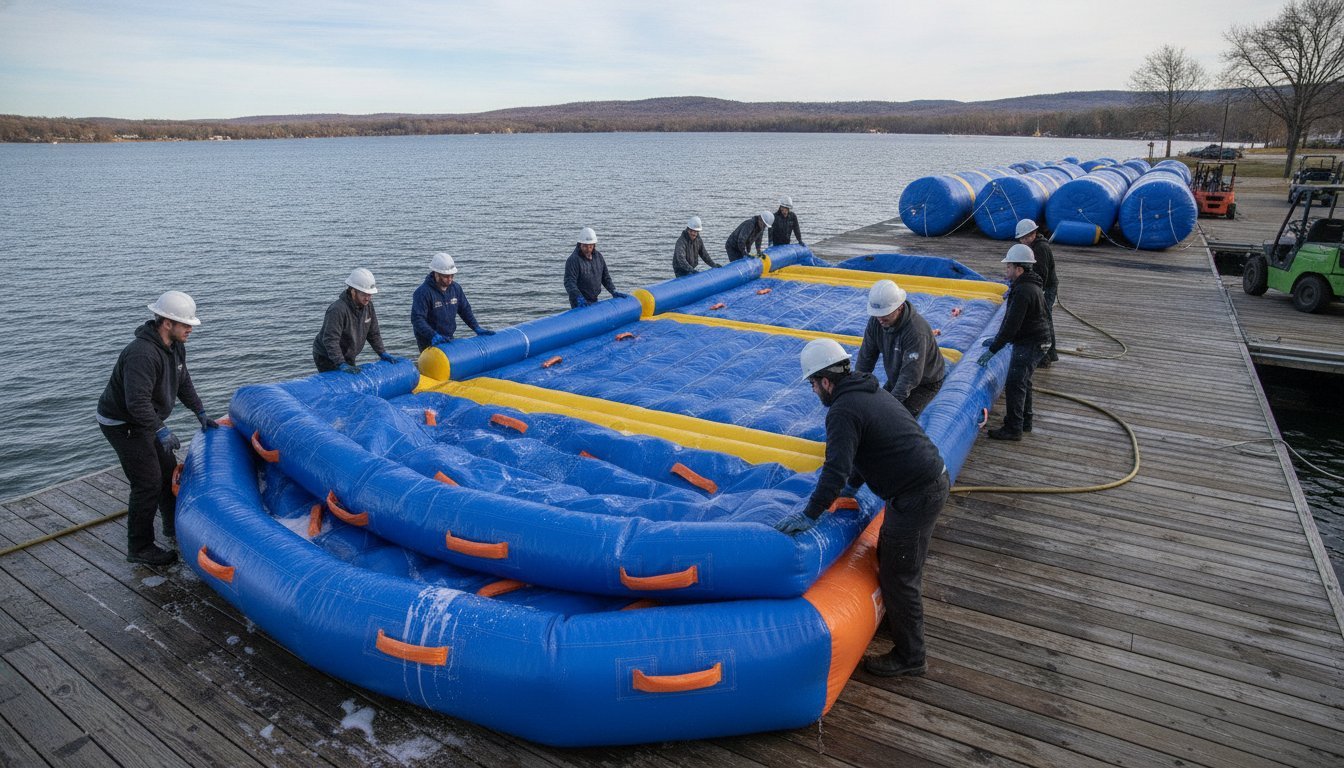
Stop treating your teardown like a clean-up. Start treating it like a logistical deployment. When you are managing winter storage for commercial inflatable water park assets, the scale of the equipment is your biggest challenge. A 10m track isn’t a toy; it is a heavy, modular asset that requires a systematic inventory process. Labelling is your first line of defence. Mark every 3m, 5m, and 10m piece before it even leaves the water. Use waterproof, industrial tags that correspond to your master layout. This eliminates the “puzzle piece” frustration that kills your momentum during the spring launch.
Monster Slides are your highest-revenue assets, and they demand the most respect. Their massive surface area makes them prone to permanent creasing if handled poorly. While the “Roll” method is the gold standard for modular tracks to minimize sharp bends, some oversized obstacles require a strategic “Accordion Fold” to manage their footprint. Regardless of the method, the goal is the same: prevent sharp, repeated folds in the sliding surface. Once secured, get these units off the warehouse floor. Utilize heavy-duty pallets and industrial shelving to ensure airflow and protect the PVC from ground-level moisture or pests.
Managing the Modular Puzzle
Efficiency is born from organization. Create a storage map that mirrors your interactive running track layout. If two pieces connect on the water, store them side-by-side in the warehouse. This “logical proximity” saves hours of labour in May. Don’t let your connection hardware become a mystery. Store all bungees, anchors, and stainless-steel components in clearly marked, ventilated bins. For those operating a Campers Starter Park, keep these specific modules grouped together. They are designed for rapid deployment, and your storage strategy should reflect that speed.
Folding Techniques for Large Scale Inflatables
The floor is your most important tool during the fold. Never collapse your 10m obstacles on gravel or asphalt. A single sharp stone can puncture your ROI before you even realize it. You need a dedicated, clean, and dry folding floor, ideally a swept warehouse bay or a heavy-duty tarp system. To collapse a massive obstacle without trapping air, work in rhythmic sections starting from the end furthest from the relief valves. Once you’ve achieved a tight, uniform roll, secure it with commercial-grade straps. This prevents unravelling during transport and keeps your storage unit professional and safe for your team.
Climate-Smart Storage: Shielding Inflatables from Harsh Winters
Severe winter weather is a brutal test for any outdoor asset. While your waterfront might be frozen solid, your business strategy shouldn’t be. If you think an unheated shed is a safe place for your fleet, you’re taking a high-risk gamble with your capital. Extreme cold is the primary catalyst for “cold crack” failures. When commercial-grade PVC drops below freezing, the plasticizers that keep the material supple begin to lock up. Move that brittle material even slightly in January, and you’ll hear the sickening snap of a structural failure that no patch kit can truly fix.
Effective winter storage for commercial inflatable water park equipment requires more than just a roof. You need a climate-controlled environment that respects the chemistry of your investment. Beyond just temperature, you must consider the “greenhouse effect” that occurs inside storage bags. If temperature fluctuates wildly, moisture trapped in the air condenses against the vinyl, creating a micro-climate where fungi and mould thrive. A stagnant warehouse is a breeding ground for disaster. You need active ventilation to keep the air moving and the humidity low.
Managing Temperature and Humidity
The optimal storage temperature for commercial vinyl ranges between 5°C and 25°C with humidity levels kept strictly below 60% to prevent material degradation. Maintaining this stable environment ensures the PVC remains flexible and ready for the spring thaw. For operators in regions with extended freezing periods, we recommend a 90-day “re-fold” cycle. This involves unfolding your modular pieces, inspecting them in a warm environment, and refolding them along different crease lines. This simple act of maintenance prevents permanent “memory” creases from weakening the fabric over the long haul.
Pest Control and Physical Protection
Mice don’t just look for warmth; they love the taste of certain PVC additives. A single rodent family can chew through a 10-metre track in a matter of weeks, leaving you with a repair bill that eclipses your storage costs. While original packaging is great for shipping, commercial-grade storage bags offer superior protection against pests. Combine these with natural and chemical deterrents around the perimeter of your shelving. Finally, follow the “No-Stack” rule. Never stack your modular sections or monster slides directly on top of each other. The sheer weight of these units can cause “pressure welding” or permanent deformation in the bottom pieces, compromising their structural integrity.
Don’t leave your park’s future to chance. If you’re ready to upgrade your facility with B2B resort-quality equipment that stands the test of time, explore our professional aquatic solutions and start planning your next high-ROI season today.
Professional Teardown: Leveraging Technician Training for Longevity
The teardown isn’t the end of your season; it’s the first day of your next one. If you treat the extraction process as a race to the finish line, you’re likely sprinting toward a spring disaster. Professional winter storage for commercial inflatable water park assets starts with a mindset shift. You need to move away from using a generic clean-up crew and toward a team of asset protectors. This is where on-site technician training pays for itself ten times over. When your staff understands the physics of PVC and the financial stakes of the equipment, they stop being seasonal workers and start being stakeholders in your success.
A disciplined extraction requires a set of Standard Operating Procedures (SOPs) that prioritize both safety and speed. You aren’t just pulling vinyl out of the water; you’re conducting a high-stakes audit of your entire fleet. Every 10m track and modular obstacle must be handled with a level of precision that prevents structural stress. By implementing a professional protocol now, you ensure that your spring “Grand Opening” is a matter of simple deployment rather than a frantic scramble for repairs.
Empowering Your Staff
Use the teardown as a high-intensity training opportunity for your lead technicians. This is the perfect time to teach them how to identify the subtle signs of wear that lead to mid-season downtime. Every modular piece requires a comprehensive “Condition Report” before it enters winter storage for commercial inflatable water park facilities. This report should detail everything from micro-abrasions to valve integrity. Beyond equipment health, professional training reduces your labour liability. By teaching proper lifting and moving techniques for massive monster slides, you protect your most valuable asset: your people.
Transitioning to Spring Success
Visionary owners use the winter months to eliminate the “May bottleneck.” While your park is tucked away, start scheduling your spring re-certification visits. This is also the strategic window for ordering replacement parts or modular upgrades. Waiting until April to realize you need a new connection system is a recipe for delayed revenue. If your goal is to dominate your local market next year, the off-season is the time to finalize your expansion plans. Ready to upgrade your park for next season? Discover our latest Monster Slides and modular designs.
By the time the ice thaws, your park should be ready to hit the water. A professional teardown ensures your equipment remains in B2B resort-quality condition, allowing you to focus on marketing and ticket sales rather than patch kits and mould remediation. Take control of your off-season logistics now, and you’ll reap the rewards of a seamless, high-revenue spring launch.
Secure Your Success for Next Season
Your off-season decisions dictate your spring profitability. By mastering the “Bone Dry” protocol and enforcing climate-smart warehouse standards, you aren’t just cleaning up; you’re protecting a high-performance financial asset. We’ve seen how professional winter storage for commercial inflatable water park modules prevents the mould, pests, and material fatigue that sink lesser operations. It’s about maintaining that commercial resort-grade durability that your guests expect and your bottom line requires.
With 35 years of industry design experience, we know that operational excellence is built during the off-season. Don’t leave your 10m tracks and monster slides to chance. Protect your investment; contact us for professional on-site technician training and winterization advice. Our specialized on-site training empowers your team to spot minor issues before they become spring disasters. Let’s ensure your park is the first one ready to launch when the sun returns. Your next record-breaking season starts today.
Frequently Asked Questions
Can I store my commercial inflatable water park outside if it is covered?
You should never store your park outside during a Canadian winter. Even under a heavy-duty tarp, your equipment is exposed to extreme temperature swings and moisture cycles that lead to “cold crack” failures. Commercial PVC becomes brittle when frozen. Moving or even slightly shifting a frozen unit can cause structural snaps that are impossible to repair. Always utilize a climate-controlled indoor space to protect your waterfront capital.
How long does it take to properly dry a 10m modular section?
Plan for a minimum of 24 to 48 hours of active drying time for modular tracks. Large monster slides require an extended window of at least 72 hours to ensure every internal chamber is moisture-free. You must use industrial-grade blowers to circulate air through the interior. If you don’t achieve a “bone dry” state inside and out, you’re essentially storing a mould factory that will degrade your vinyl all winter.
What is the best temperature for storing commercial-grade PVC inflatables?
The ideal temperature range for winter storage for commercial inflatable water park equipment is between 5°C and 25°C. Keeping the environment within this range ensures the plasticizers in the vinyl remain supple and flexible. Stable temperatures prevent the material from entering a brittle state, which is vital if you plan to conduct mid-winter inspections or re-folding cycles to maintain the equipment’s structural integrity.
Should I use a pressure washer to clean my aqua park pieces?
Avoid using pressure washers because the high-intensity stream can strip the UV-protective coating from your vinyl. It can also force water into heat-welded seams, leading to delamination and structural weakness. Use low-pressure hoses and pH-neutral industrial cleaners instead. A soft-bristled brush is all you need to remove biofilm and algae without compromising the resort-quality finish of your assets.
How do I prevent mice and rats from eating my stored water park?
Store your equipment in commercial-grade bags and keep all units on industrial shelving at least 12 inches off the floor. Rodents are attracted to certain additives in PVC and can chew through a 10m track with devastating speed. Combine these physical barriers with natural or chemical deterrents placed around the warehouse perimeter. Monthly inspections are a non-negotiable part of a professional winterization strategy to catch any pest activity early.
What happens if I fold my monster slide while it is still slightly damp?
Folding a damp slide creates a micro-climate where black mould will thrive. This isn’t just an aesthetic issue; mould causes permanent staining and eats away at the PVC fabric, significantly reducing its lifespan. Once mould takes hold in the deep seams of a monster slide, it’s incredibly difficult to eradicate. Ensuring the unit is bone dry before it enters winter storage for commercial inflatable water park modules is the only way to guarantee a clean launch in the spring.
Is it necessary to have a technician present for the winter teardown?
Having a trained technician present transforms your teardown into a professional asset audit. Technicians identify minor abrasions, valve leaks, and structural fatigue that seasonal staff typically overlook. This expertise allows you to organize repairs during the off-season when downtime doesn’t cost you ticket sales. It’s a strategic investment that ensures your park meets B2B resort-quality standards year after year.
How should I store the anchors and bungees over the winter?
Clean all hardware and bungees to remove lake debris and minerals, then store them in ventilated, labelled bins. Don’t let your connection hardware sit in damp, airtight containers where corrosion can take hold. Organizing these components by their specific modular sections ensures your team can move with speed during the spring deployment. Proper organization now eliminates the “missing part” frustration that can delay your grand opening by days.
Leave a Reply