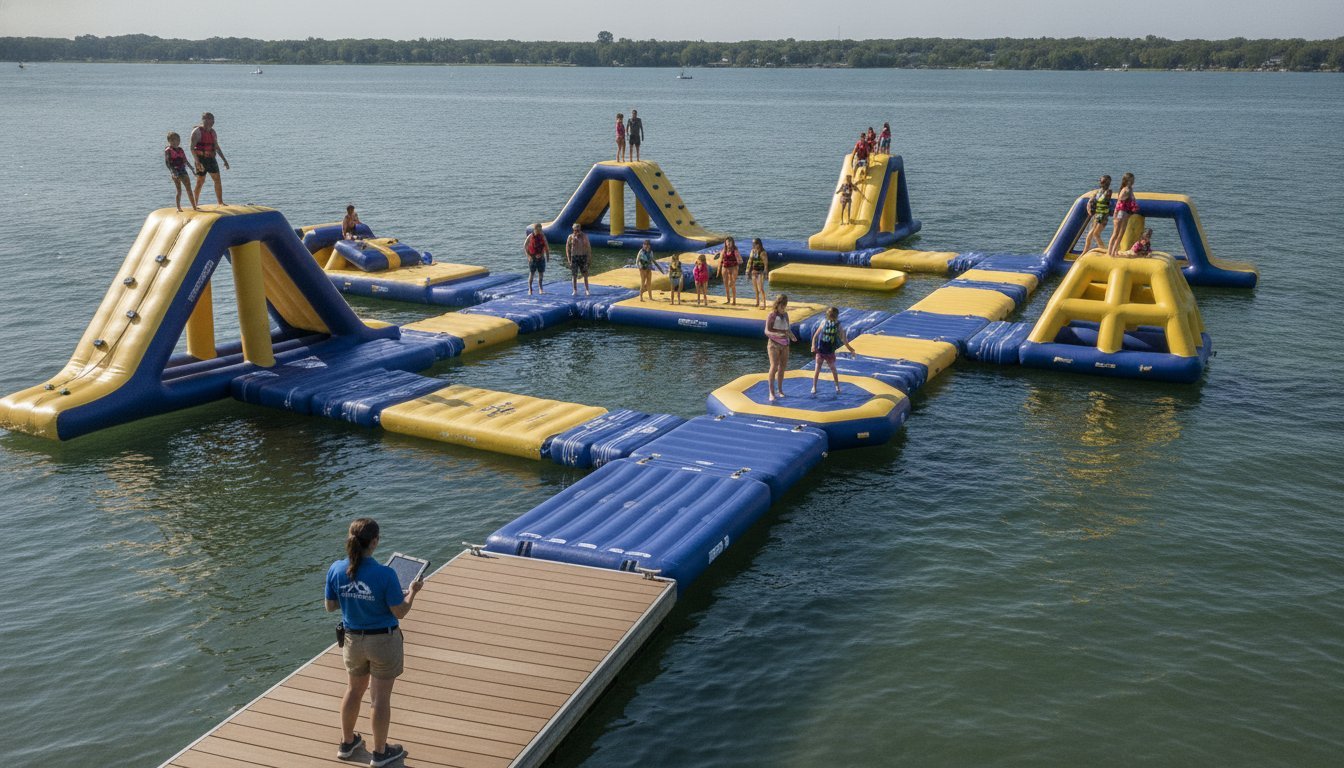
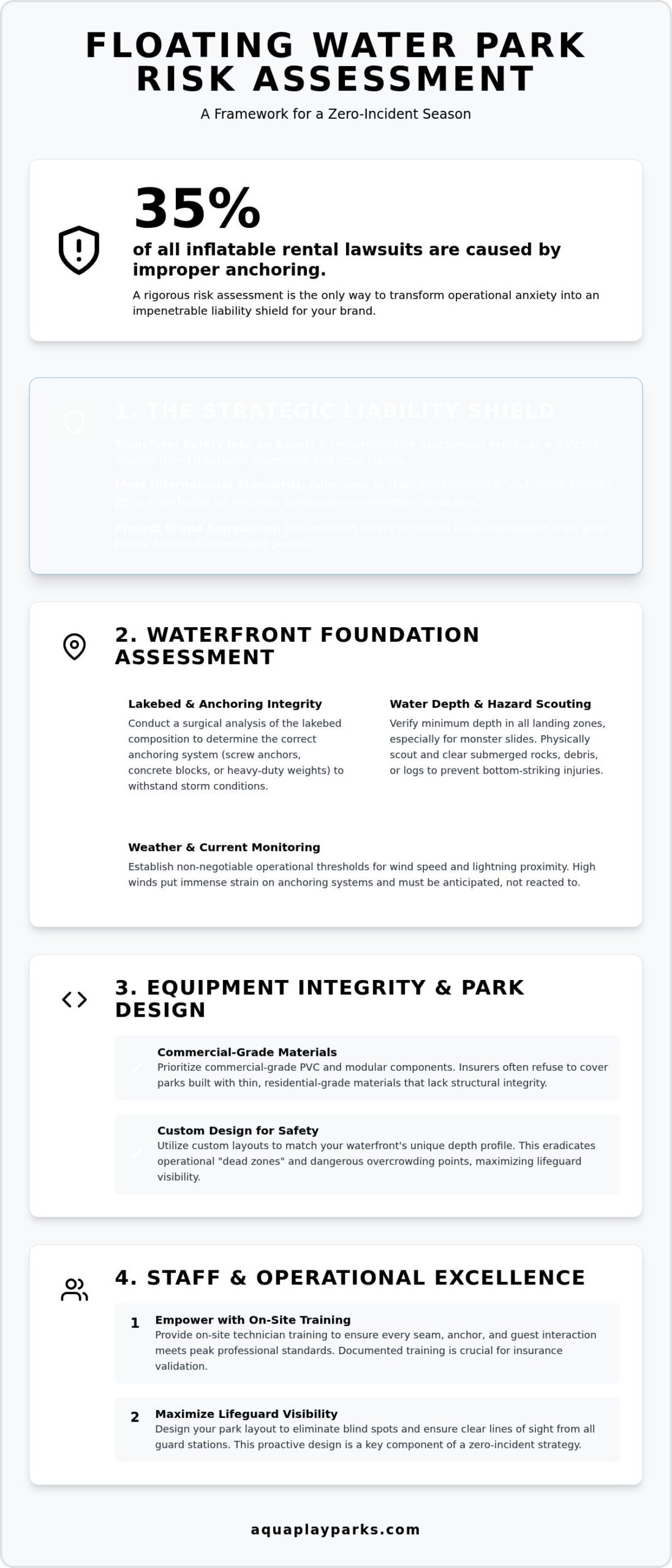
Improper anchoring causes 35% of all inflatable rental lawsuits, turning a high-growth season into a legal nightmare in seconds. You’ve built your park to be a powerhouse of ROI, but the weight of shifting regulations and the constant worry of equipment failure can keep even the most seasoned operator awake at night. Conducting a rigorous floating water park risk assessment is the only way to transform that operational anxiety into an impenetrable liability shield for your brand. It’s a high-stakes environment where one oversight can jeopardize your entire investment.
We’re here to help you realize a future where safety is a competitive advantage rather than a bureaucratic hurdle. You’ll learn how to implement a repeatable safety framework that satisfies the latest ISO 25649-6:2026 standards and protects your bottom line from rising insurance costs. This guide breaks down the essential technical protocols and operational checklists you need to ensure a zero-incident season and keep your business drifting toward growth, not disaster. By the end of this checklist, you’ll have the tools to protect your guests, your investment, and your professional reputation.
Key Takeaways
- Transform safety protocols into a strategic asset; a comprehensive floating water park risk assessment serves as a shield against rising insurance premiums and legal liability.
- Secure your park’s foundation with precise environmental evaluations, focusing on lakebed anchoring integrity and safety clearance zones for monster slides.
- Protect your ROI by prioritizing commercial-grade PVC and modular components that strictly adhere to 2026 international safety standards.
- Eradicate operational “dead zones” through custom designs that maximize lifeguard visibility and eliminate dangerous overcrowding points across your waterfront.
- Empower your team with on-site technician training to ensure every seam, anchor, and guest interaction meets peak professional standards for a zero-incident season.
The Strategic Value of a Comprehensive Risk Assessment
A floating water park risk assessment is far more than a static checklist. It’s a live business document that evolves alongside your waterfront operations. In 2026, the industry has shifted away from generic safety rules toward site-specific mitigation strategies. You must address the unique intersection of environment, hardware, and human behaviour to truly protect your investment. This proactive approach doesn’t just prevent accidents; it directly fuels your seasonal ROI. When you eliminate operational friction through superior design and rigorous training, you create a seamless guest experience that drives repeat bookings and builds long-term value.
Current Water park safety standards, including the updated ISO 25649-6:2026 and ASTM F2374-22, demand a holistic view of your park. You can’t simply focus on the durability of your PVC. You have to analyze how wind patterns, water depth, and guest flow interact with your specific layout. Ignoring these variables is a gamble that no serious commercial operator should take. Professionalism in this industry is defined by your ability to anticipate risks before they manifest as liabilities.
Protecting Your Brand Reputation
A single safety incident can haunt your bookings for years. In the digital age, news of an accident travels faster than a guest down a monster slide. Conversely, safety transparency is a massive marketing advantage. Family-oriented resorts realize that parents prioritize peace of mind above all else. A floating water park risk assessment is the definitive blueprint for waterfront dominance, ensuring every splash is as safe as it is profitable. Highlighting your commitment to commercial-grade standards and on-site technician training builds immediate, unshakable trust with your audience.
The Legal and Insurance Landscape
Documented risk assessments are your primary line of defence in the event of a claim. Canadian insurance providers have become exceptionally strict; they often refuse to cover parks built with thin, residential-grade materials that lack structural integrity. To secure competitive rates for North American commercial-grade insurance, you must demonstrate a rigorous management plan. This means meeting ASTM F2374-22 benchmarks for material strength and anchoring stability. Third-party certifications and documented training sessions serve as proof points of your operational excellence. They show adjusters that you aren’t just running a park; you’re managing a sophisticated commercial asset with precision. By documenting every technical and operational protocol, you reduce your liability and create a clear path to lower premiums over time.
Environmental Risks: Assessing the Waterfront Foundation
Your waterfront is more than just a scenic backdrop. It’s the structural foundation of your entire operation. A truly effective floating water park risk assessment begins beneath the surface. You can’t just drop anchors and hope for the best. You must dominate the environment by understanding it. This means conducting a surgical analysis of water depth, lakebed composition, and hydraulic forces before a single modular piece touches the waves. Analyze the lakebed composition to determine if you need screw anchors, concrete blocks, or heavy-duty weights to maintain park integrity during a storm.
Water Depth and Submerged Hazards
Landing zones are the highest-risk areas in any park. For massive monster slides, the “Safety Clearance Zone” isn’t a suggestion. It’s a non-negotiable requirement for guest safety. You must verify minimum depth requirements across the entire impact area to prevent bottom-striking injuries. Before installation, your team should physically scout for submerged rocks, discarded debris, or shifting logs. Naturalizing the waterfront helps prevent erosion around anchor points, ensuring your park stays exactly where you intended. If you want to ensure your layout fits your specific depth profile, consider custom designing your park to match your waterfront’s unique contours. This eliminates dangerous “dead zones” and ensures every slide terminates in a safe, deep-water pocket.
Weather and Current Monitoring
Weather is your most volatile operational variable. High-energy operators don’t react to storms. They anticipate them. You must establish hard operational thresholds for wind speed and lightning proximity. When wind exceeds safe limits, the surface area of large inflatables acts like a sail. This puts immense strain on your anchoring system. Adhering to ASTM F2374 inflatable safety standards ensures your hardware is rated for these stresses, but the human element remains critical. Create a punchy, fast-paced evacuation plan that your staff can execute in minutes. Don’t wait for the first whitecap to decide how to clear the park.
Current flow and wave action also dictate modular connectivity. Constant tension from a strong current can fatigue D-rings and bungee connectors over time. Daily inspections of anchor tension and seam alignment are mandatory. You’re building a business on moving water. Treat the environment with the respect it demands. It will reward you with a seamless, profitable season. Monitoring water quality and perimeter hazards ensures guests stay within the safe zone, away from boat traffic or sharp shoreline features. Total environmental control is the only way to realize your vision of a high-impact, zero-incident summer.
Equipment Integrity: Validating Commercial-Grade Safety
Guest safety is only as strong as the physical material beneath their feet. A rigorous floating water park risk assessment must scrutinize the engineering of every modular piece with the same intensity you apply to your financial projections. In the high-traffic environment of a commercial resort, equipment is subjected to relentless stress from sun, salt, and thousands of jumping guests. Using anything less than B2B commercial-quality hardware isn’t just a poor business decision; it’s a massive liability risk. You need to ensure every seam and valve is designed to withstand the brutal reality of a 90-day peak season without failure.
Inferior designs often hide structural flaws in their architecture that only manifest under heavy load. T-junction failures are a prime example of poor engineering where three seams meet at a single point without adequate reinforcement. These points are prone to catastrophic tearing that can deflate a module in minutes. Furthermore, you must ensure all connection points between obstacles are perfectly flush. Gaps between modular pieces create entrapment hazards that even the most vigilant staff cannot always see. Eliminating these “dead zones” through superior engineering is the only way to realize a zero-incident operational season.
Material Standards and Durability
The difference between success and a lawsuit often comes down to denier count and PVC thickness. When you choose 1000D PVC over residential-grade materials, you’re investing in superior puncture resistance and structural memory. This commercial-grade fabric maintains its shape even under extreme heat, whereas thinner materials often sag and create dangerous tripping hazards. Understanding the commercial vs residential inflatable water park distinction is vital for any operator who wants to protect their ROI. High-quality UV-resistant coatings are also essential; they prevent the sun from “cooking” the PVC and making it brittle, which is the leading cause of seam bursts in cheaper alternatives.
Daily Hardware Inspections
Consistency is your best defence against equipment fatigue. Implement a 15-minute morning checklist that requires your technicians to physically check anchor line tension and air pressure stability before the first guest arrives. Pay close attention to “hot spots” for wear and tear, such as the climbing grips on monster slides and the high-impact landing zones of interactive running tracks. Valve maintenance is the quiet backbone of park stability; a single leaking seal can compromise the structural integrity of an entire modular run before noon. By documenting these daily checks, you create a paper trail of professional diligence that serves as an additional layer of protection for your business liability.
Operational Risk: Staff Training and Guest Behaviour
Engineering excellence and environmental planning are only half the battle. The human element is the most volatile variable in your daily operations. Even the most durable park can become a liability if guest behaviour is left unchecked or if staff are underprepared for the unique challenges of a modular environment. A high-impact floating water park risk assessment must codify exactly how your team manages the crowd. You need to transform your waterfront from a chaotic playground into a disciplined, high-performance machine. This starts with a non-negotiable safety briefing for every guest before they even touch the water.
Staffing for maximum visibility is a science. You shouldn’t just “have lifeguards.” You need a strategic lifeguard-to-obstacle ratio that ensures every “dead zone” is covered. High-risk behaviours like pushing, jumping from unauthorized heights, or attempting backflips must be met with immediate, firm correction. Consistency is your best friend here. Enforcing strict life jacket protocols and respecting the weight capacity limits of each individual module prevents the overcrowding that leads to structural strain or guest injury. When your guests know the rules, they can focus on the thrill of the park without compromising your business safety.
The Role of the On-Site Technician
General lifeguard certification is a baseline; it’s not the finish line. Operating a complex B2B commercial resort park requires specialized knowledge that covers both water rescue and equipment maintenance. Your team must be empowered to close specific modules instantly if they detect a drop in air pressure or a shift in current that threatens guest safety. Rapid response in a modular layout is different than in a swimming pool; rescuers must navigate slippery interactive running tracks and high-profile obstacles. If you want to realize a truly zero-incident season, you need to invest in professional development. If you are ready to elevate your team, explore our on-site technician training to turn your staff into waterfront experts.
Guest Capacity and Flow Management
Bottlenecks are where accidents happen. You must use your park’s modular design to your advantage by creating a flow that prevents “overloading” on popular pieces. Managing the queue for your Monster Slides is particularly critical; allowing too many people on the upper platforms creates a top-heavy risk and increases the chance of collisions in the landing zone. Use clear, colour-coded signage to designate zones for different age groups or skill levels. This keeps younger campers in the “Starter Park” areas while allowing more adventurous guests to tackle the high-intensity interactive tracks. By controlling the rhythm of the park, you reduce friction and maximize the enjoyment of every paying guest.
Reducing Liability Through Custom Design and Training
Generic, off-the-shelf layouts are a liability trap. They don’t account for your specific shoreline, current patterns, or guest demographics. A comprehensive floating water park risk assessment often reveals that one-size-fits-all parks create “dead zones” where staff cannot maintain a clear line of sight to every guest. We eliminate this operational friction through True Custom Designing. We map your waterfront with surgical precision to ensure every interactive track and monster slide is positioned for maximum visibility and safety. You can’t manage what your team can’t see.
Our “Safety-First” engineering approach for 2026 transforms your park from a simple playground into a sophisticated, high-performance asset. We don’t just sell PVC; we sell a blueprint for waterfront dominance. By integrating modular pieces that naturally regulate guest flow, we reduce the risk of collisions and overcrowding. Whether you’re starting small with a Campers Starter Park or scaling to a massive custom destination, our designs ensure that growth never comes at the expense of safety. Realizing a zero-incident season starts on the drawing board.
Engineering Safety into the Layout
Spacing is safety. We design interactive running tracks that naturally disperse crowds and prevent dangerous bottlenecks at entry points. Strategic placement of the world’s largest money-earning monster slides ensures that high-energy activity is concentrated in deep-water zones with clear exit paths. This intentional layout reduces the physical strain on your equipment and the mental strain on your lifeguards. To see how we build these high-performance environments, explore our guide on custom inflatable water park design and learn how engineering drives both ROI and guest security.
The ROI of Expert Implementation
Professional implementation is the ultimate liability shield. Having a Canadian designer with 35 years of industry experience means your park is built to withstand the unique rigours of North American waterfronts. We provide on-site technician training that empowers your staff to identify and mitigate risks before they manifest as accidents. This training ensures your team can manage anchor line tension and air pressure with professional-grade precision. Don’t leave your investment to chance or inferior “beach toy” standards. Protect your investment with a professional risk assessment and custom design from Aqua Play Parks and ensure your business is built for long-term, incident-free success.
Secure Your Waterfront Legacy
Dominating the waterfront market in 2026 requires more than just high-energy attractions; it demands a surgical commitment to guest safety and operational excellence. You’ve seen how a rigorous floating water park risk assessment transforms potential liabilities into a strategic business advantage. By combining B2B commercial-grade materials with a custom layout that eliminates blind spots, you protect your investment from the ground up. The final piece of the puzzle is empowering your team through specialized training to maintain peak performance throughout the season.
Aqua Play Parks brings 35 years of Canadian design expertise to your shoreline, ensuring every monster slide and running track meets the highest international standards. We don’t just deliver equipment; we provide the on-site technician training necessary to realize a zero-incident operational season. It’s time to stop worrying about the “what-ifs” and start building your legacy on the water. Launch your safe, high-ROI waterfront destination with Aqua Play Parks and lead the industry with confidence. Your future as a premier destination starts with a vision backed by world-class engineering.
Frequently Asked Questions
What is the most common risk in a floating water park?
Improper anchoring is the most frequent risk, accounting for 35% of all inflatable rental lawsuits according to industry research. When anchors fail, equipment can drift or flip, leading to catastrophic guest injuries and massive liability. You must ensure your system is rated for your specific waterfront conditions. We mitigate this through True Custom Designing, ensuring your park remains stable even during peak seasonal demand or unexpected weather shifts.
How often should I perform a formal risk assessment for my aqua park?
You should perform a formal floating water park risk assessment at least once per season before opening, supplemented by daily operational checks. A formal review is also mandatory after any severe weather event or equipment modification. Treat this as a live document that evolves with your business. Documenting these assessments creates a vital paper trail that protects your brand from liability and helps lower long-term insurance premiums.
Does my insurance cover inflatable water park accidents?
Standard general liability often isn’t enough; you need comprehensive amusement insurance specifically for floating aqua parks. For 2026, a budget between $5,000 and $15,000 annually is recommended for high-coverage policies. Insurance providers, especially in Canada, require proof of commercial-grade PVC and documented safety protocols. Without a rigorous risk management plan and on-site technician training, you may find your coverage is insufficient or your claims are denied.
What is the minimum water depth required for a floating water park?
Minimum depth requirements depend entirely on the height of your obstacles, but high-impact landing zones for monster slides require specific safety clearances. You must maintain a zone that prevents guests from striking the lakebed upon entry. We analyze your waterfront contours during the design phase to ensure every module is placed in a safe depth pocket. Never guess your depth; use professional sounding equipment to verify the foundation of your park.
Can I operate a floating water park without certified lifeguards?
Operating without certified lifeguards is a massive liability risk that most insurance providers will not tolerate. While we provide on-site technician training for equipment maintenance, you still need a professional rescue team to manage guest behaviour. The key is maintaining a strategic lifeguard-to-obstacle ratio that eliminates blind spots. A proactive safety culture, backed by professional surveillance, is the only way to realize a zero-incident season and protect your ROI.
How do I manage the risk of overcrowding on modular obstacles?
Managing overcrowding starts with a custom design that naturally regulates guest flow and prevents bottlenecks. You must enforce strict weight capacity limits per module and use colour-coded zones to separate different skill levels. Our interactive running tracks are engineered to space out guests, reducing the physical strain on the PVC. Signage and a mandatory pre-entry safety briefing ensure guests understand the rules before they begin their experience on the water.
What are the ASTM standards for commercial inflatable water parks?
ASTM F2374-22 is the primary global benchmark for 2026, governing material strength, entrapment prevention, and anchoring. For example, units over 400 square feet require stakes of at least 24 inches or an equivalent weighted system. Adhering to these standards is non-negotiable for securing commercial-grade insurance. Our B2B commercial resort quality equipment is engineered to exceed these benchmarks, ensuring your park is as durable as it is profitable and safe.
How does weather affect my park’s risk assessment?
Weather is the most volatile variable in your risk assessment, requiring hard operational thresholds for wind speed and lightning. High winds turn large inflatables into sails, putting immense tension on your anchors and modular connectors. You must have a fast-paced evacuation plan that your staff can execute in minutes. Monitoring daily wave action and current patterns is essential to prevent equipment fatigue and ensure the structural integrity of your entire installation.
Leave a Reply