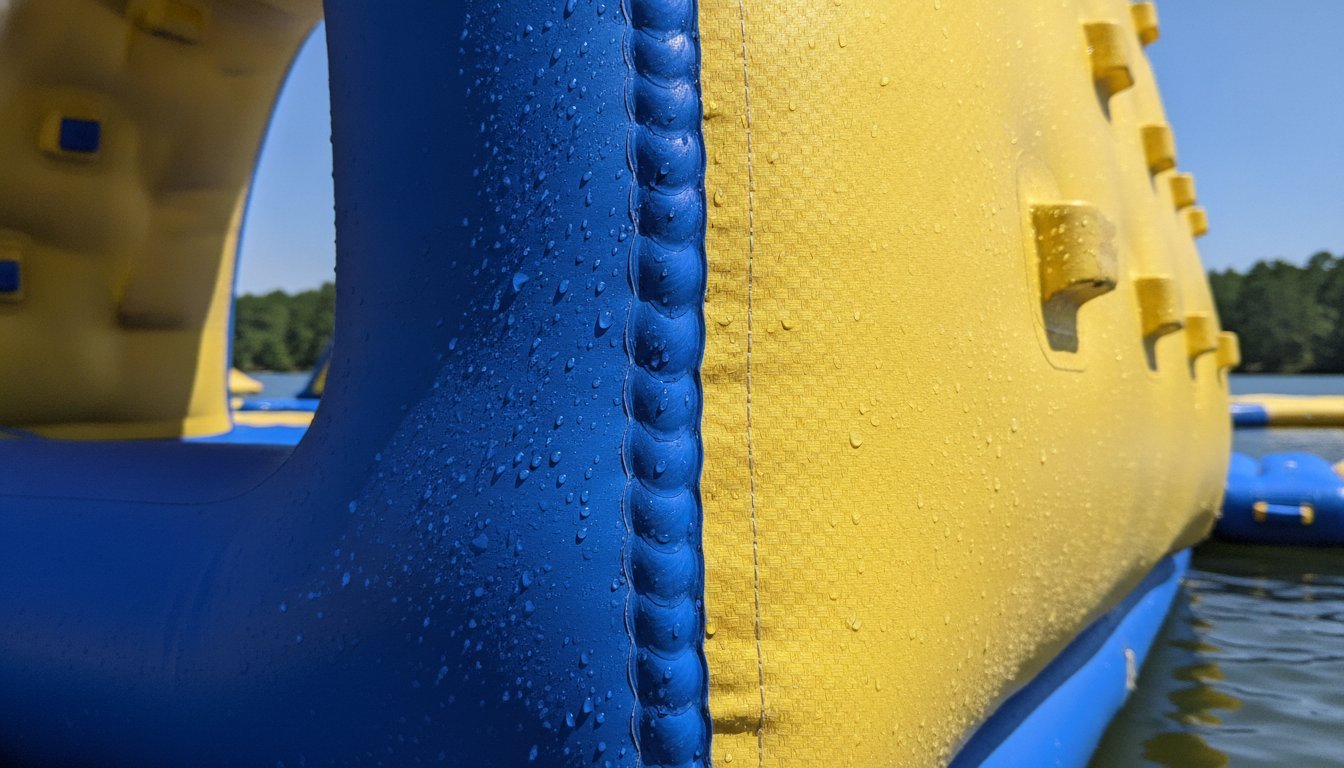
Would you bet your entire summer revenue on a material no thicker than a credit card? In the high-stakes world of waterfront attractions, the difference between a Monster Slide that anchors your resort and a deflated heap of plastic comes down to the technical rigour of your commercial-grade inflatable material specifications. These are not beach toys. They are revenue-generating assets. You shouldn’t have to spend your peak season patching holes or worrying if your equipment meets US insurance requirements. We understand the anxiety that comes with technical jargon like denier and GSM, especially when guest safety is on the line.
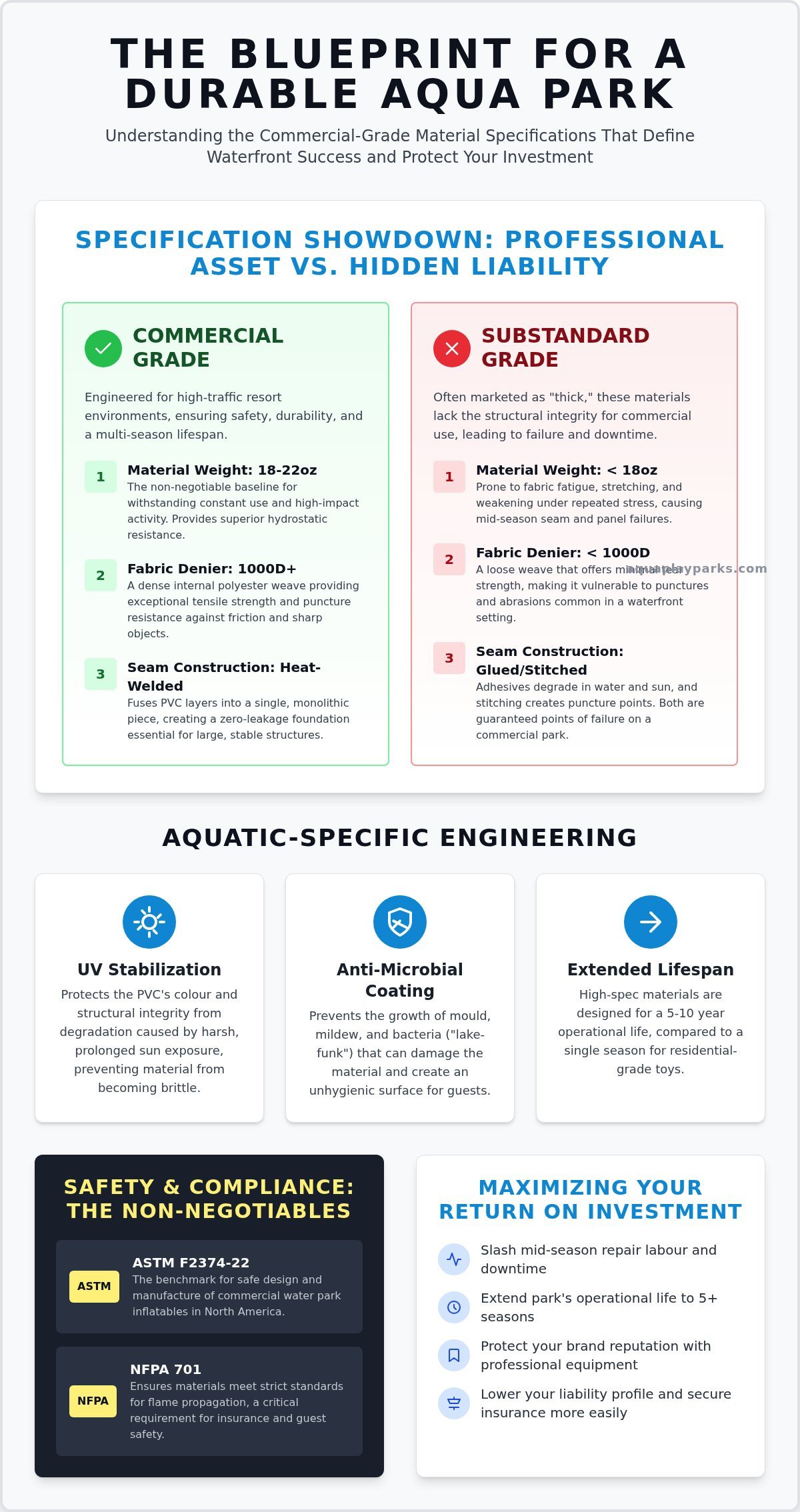
You want a park that performs without constant maintenance. This guide will demystify the high-performance aquatic PVC standards that protect your investment, from ASTM F2374-22 compliance to UV stabilization. We are going to break down exactly why 18oz to 22oz material weight is the non-negotiable baseline for durability. You will gain a clear understanding of the hydrostatic resistance and reinforced seams required to transform your US lakefront into a high-impact, professional installation that stands up to five or more seasons of heavy use.
- 18-22oz material is the baseline.
- PVC must be UV stabilized.
- ASTM F2374-22 compliance is critical.
Key Takeaways
- Stop treating your waterfront like a backyard pool. Learn why commercial-grade integrity is the only way to protect your liability and guest safety.
- Master the technical side of your investment by decoding 1000D+ denier and specific commercial grade inflatable material specifications that ensure puncture resistance.
- Protect your park from the harsh Canadian sun and “lake-funk” with UV-stabilized, anti-microbial PVC engineered for multi-season performance.
- Discover why heat-welded seams are non-negotiable for floating parks, providing the zero-leakage foundation needed for massive structures.
- Realize a faster payback period by choosing high-spec materials that slash mid-season repair labour and extend your park’s operational life.
Defining Commercial Grade: Why Material Integrity Dictates Waterfront Success
Imagine your waterfront on a busy July long weekend. Your Monster Slide is packed, the energy is electric, and the revenue is flowing. Now, imagine a seam failure. If you’ve invested in a glorified beach toy instead of a professional asset, that scenario isn’t just a possibility; it’s an inevitability. There is a hard truth in this industry: residential-grade inflatables are a massive liability on a commercial lakefront. True success starts with understanding that commercial grade inflatable material specifications are about more than just thickness. They are about the technical rigour required to withstand thousands of guests and the relentless pressure of open water.
Don’t be fooled by “thick” materials that lack structural integrity. A material can be bulky without being strong. High-traffic resorts require an engineered vinyl coated polyester composition that balances tensile strength with flexibility. This internal polyester scrim provides the “skeleton” of the inflatable, while the PVC coating protects against the elements. When you prioritize these technical standards, you aren’t just buying equipment. You are validating a vision to turn a quiet lake into a high-ROI destination. High-spec materials directly lower your liability profile, making it easier to secure insurance and protect your bottom line.
The Hidden Costs of Substandard Inflatables
Choosing “cheap” materials is the fastest way to kill your momentum. Substandard fabrics suffer from fabric fatigue, where the material stretches and weakens under repeated use. This leads to catastrophic mid-season downtime that costs you far more in lost revenue than you saved on the initial purchase. A commercial-grade asset is designed for a 5 to 10-year lifespan, whereas a residential toy might not survive its first August. Protecting your brand reputation means ensuring your park looks and performs as well on day 500 as it did on day one.
Meeting Canadian Safety Standards
Operating a waterfront in Canada means adhering to strict safety protocols. Your equipment must meet ASTM F2374-22 standards for design and manufacture, alongside NFPA 701 for flame propagation. These aren’t just suggestions; they are the benchmarks for guest safety. We pair these high-end commercial grade inflatable material specifications with on-site technician training to ensure your team understands the operational limits of the PVC. By aligning your material selection with rigorous safety standards, you realize a safer environment for your guests and a more stable, predictable business model for yourself.
The Technical Blueprint: PVC Weight, Denier, and Thickness Standards
Building a world-class waterfront requires more than a vision; it requires a mastery of the technical blueprint. When you evaluate commercial grade inflatable material specifications, you are looking at the DNA of your investment. These numbers determine if your park will stand tall against a crowd of eager tourists or buckle under the first weekend of heavy traffic. We don’t settle for “good enough” because your ROI depends on equipment that stays inflated and remains stable in open water environments. It’s time to decode the jargon and look at what actually keeps a Monster Slide operational.
The foundation of puncture resistance starts with the denier. In the commercial world, a 1000D+ denier is the non-negotiable standard. This refers to the density of the internal polyester fibers. A higher denier means a tighter, more resilient weave that prevents sharp objects or heavy friction from breaching the air chamber. While some competitors might mention material weight, they often skip the science of tear strength. We look at the Standard Test Methods for Coated Fabrics to ensure every modular piece can handle the chaotic energy of a resort environment. If you want to see how these specs translate into a high-earning park, explore our floating aqua park designs to see the technical blueprint in action.
Breaking Down the 0.9mm PVC Standard
Thickness is your first line of defence. For commercial floating aqua parks, 0.9mm PVC is the undisputed gold standard. Why? Because thickness dictates air-tightness. A 0.6mm residential material might look similar to the naked eye, but it lacks the structural density to maintain high pressure over long periods. In real-world scenarios, a 0.9mm modular track remains rigid underfoot, providing a premium experience for guests. This thickness also provides the necessary bulk to support heat-welded seams, ensuring your park doesn’t become a maintenance nightmare by August.
Tear Strength and Tensile Capacity
Every inflatable has a “skeleton” known as the inner polyester scrim. This fabric is what actually holds the shape of your park. When reading a spec sheet, look for Warp and Weft strength. Warp refers to the vertical fibers, while Weft refers to the horizontal ones. Tensile strength is the material’s ability to resist snapping under the weight of multiple guests. By using industry-leading PVC brands like Plato, we ensure the material exceeds baseline tear resistance. This means even if a small puncture occurs, the scrim prevents the hole from “zippering” open, allowing for a quick, mid-season repair rather than a total equipment loss.
Aquatic-Specific Engineering: Resisting UV, Mould, and Chemical Degradation
A floating water park faces a brutal environment that land-based bounce houses never encounter. Constant submersion, fluctuating water temperatures, and relentless solar radiation create a chemical battleground for your equipment. If your commercial grade inflatable material specifications don’t account for these aquatic-specific stressors, your investment will degrade before you’ve even cleared your first season’s expenses. This is about more than just surviving the water; it’s about thriving in it. We build for the rigours of the lakefront, ensuring your park remains a vibrant, hygienic destination for every guest.
Longevity also depends on chemical resistance. Whether you are operating in a chlorinated resort pool or brackish coastal waters, your PVC must withstand chemical breakdown. Standard vinyl will soften or delaminate when exposed to salt and chlorine over time. Additionally, floating parks must handle hydrostatic pressure, the constant force of water pushing against the submerged portions of the modules. This requires advanced seam technology that goes beyond simple stitching to create a truly hermetic seal, preventing slow leaks that common land-based slides simply aren’t built to handle.
UV Stabilization and Colour Longevity
Don’t underestimate the Canadian sun. While our summers are shorter, the intensity of UV radiation on open water is magnified by reflection, leading to rapid UV degradation in PVC films if they aren’t properly stabilized. Without high-end UV inhibitors baked directly into the PVC, the material becomes brittle, loses its elasticity, and eventually cracks. A faded, chalky attraction sends a message of neglect to your guests. Maintaining that day-one “wow factor” requires a material engineered to resist photodegradation, keeping your high-visibility Monster Slides looking professional and inviting year after year.
Anti-Microbial Protection for Water-Based Assets
Internal mould is the silent killer of modular water parks. When moisture gets trapped inside the air chambers, it creates the perfect breeding ground for “lake-funk.” This isn’t just a smell issue; it’s a structural and health concern. Our commercial grade inflatable material specifications include anti-fungal and anti-microbial treatments that prevent colonies from forming within the fabric layers. This is a critical reason why B2B commercial quality matters for your aqua park. Without these coatings, you risk a hygiene crisis that could shutter your operations mid-season.
Structural Reinforcement: Heat-Welding and Modular Connection Strength
Structural integrity on the water is a game of physics. Your park isn’t just sitting there; it’s fighting waves, wind, and the collective weight of hundreds of guests. If your commercial grade inflatable material specifications rely on traditional sewing, you’ve already lost. Sewing creates thousands of tiny perforations that become points of failure under pressure. We utilize heat-welding. This process fuses the PVC layers into a single, unbreakable bond. It’s the difference between a leaky patchwork and a zero-leakage fortress. For massive installations like our Monster Slides, this engineering is what prevents a fun day from turning into a maintenance disaster.
Stress points require a different level of rigour. We don’t just weld; we reinforce. High-impact zones, such as the landing areas of bag jumps or the joints of a 10m running track, are fortified with extra layers of material. This ensures that the energy from a guest’s leap is distributed across the structure rather than concentrated on a single seam. To ensure your park is built to these exacting standards, you can start by exploring our B2B commercial resort quality designs. We focus on the hardware that keeps your vision together, from the fabric to the 316 Stainless Steel D-rings.
Multi-Layer Seam Reinforcement
High-impact areas require more than a single layer of protection. We use triple-layer PVC reinforcement on bag jumps and entry points where guest traffic is most intense. This is paired with an overlapping technique on our 10m modular obstacle pieces. By overlapping the material by several centimetres before welding, we create a seam that is actually stronger than the surrounding fabric. This level of structural reinforcement contributes directly to your ROI by slashing daily maintenance tasks. You spend less time checking for slow leaks and more time managing a profitable operation.
The Hardware of Connection
The hardware is often the most overlooked part of a park layout. We specify 316 Stainless Steel as our baseline for all D-rings and toggles. Why? Because rust is a silent killer of structural integrity. Standard steel or lower-grade alloys will corrode in weeks when exposed to the mineral-heavy water of inland Canadian lakes or brackish coastal estuaries. The “pull-out” strength of a D-ring is a critical safety spec; if a connection point fails during a storm or high-capacity event, the results can be catastrophic. We organize our park layouts based on connection point durability, ensuring every piece of the interactive track stays exactly where it belongs. This is why our on-site technician training includes specific modules on hardware inspection and modular connection security.
Maximizing Your ROI: How Premium Specifications Reduce Operational Costs
Stop viewing your waterfront as a collection of PVC modules. Start viewing it as a high-performance financial engine. In the B2B resort world, the true value of commercial grade inflatable material specifications isn’t found in the initial purchase price; it’s found in the operational savings across the next five years. High-spec gear pays for itself within two seasons. While competitors struggle with mid-season repairs and deflated assets, you realize consistent, uninterrupted revenue. Build it once. Build it right. Profit for years. This is the pragmatic reality of choosing engineering over “cheap” alternatives.
Labour is your largest hidden expense. UV-stable and anti-mould PVC isn’t just about aesthetics; it’s about your payroll. When your material resists the “lake-funk” and doesn’t become brittle under the Canadian sun, your team spends less time scrubbing and patching and more time managing guest experiences. Furthermore, these assets hold incredible resale value. Because our Monster Slides and modular tracks are built to B2B commercial resort quality, they remain valuable assets on the secondary market if you ever decide to upgrade or expand. You aren’t just buying a product; you are acquiring a liquid business asset.
Calculating the Total Cost of Ownership (TCO)
Calculating your Total Cost of Ownership (TCO) requires looking past the invoice. You must factor in the cost of repair kits, the nightmare of mid-July downtime, and the shortened replacement cycles of inferior brands. Our on-site technician training is a critical component here. It ensures your team knows exactly how to preserve the material’s lifespan through proper inflation and anchoring. To see the full breakdown of how quality influences your bottom line, read our guide on Maximizing ROI: How to Calculate the Payback Period. Understanding these metrics is the difference between a struggling attraction and a thriving destination.
The Aqua Play Parks Advantage
We don’t just sell inflatables. We design revenue-generating ecosystems tailored to the specific rigours of your waterfront. By partnering with a direct-to-client Canadian designer, you eliminate the middleman complexity and high markups that plague the industry. We understand the business of play, ensuring every custom design maximizes your lakefront’s potential while adhering to the strictest commercial grade inflatable material specifications. Whether you are starting with a Campers Starter Park or the world’s largest floating slide, we provide the technical rigour to ensure your success. Contact Aqua Play Parks today to start your custom design journey and transform your waterfront into a visionary, high-ROI destination.
Secure Your Waterfront Legacy with Professional-Grade Engineering
You’ve seen the technical blueprint. You know that success on the water isn’t about luck; it’s about the technical rigour of your commercial grade inflatable material specifications. From the heat-welded seams that prevent leaks to the UV inhibitors that protect against the Canadian sun, every detail dictates your long-term ROI. Don’t settle for beach toys when you can own a revenue-generating asset built for the rigours of resort life.
With 35 years of industry-leading design experience, we specialize in creating the world’s largest money-earning monster slides that stand the test of time. We don’t just deliver equipment; we provide comprehensive on-site technician training to ensure your park operates at peak efficiency from day one. It’s time to stop worrying about mid-season repairs and start focusing on growth. Design your revenue-generating waterfront with Aqua Play Parks and turn your lakefront into a high-impact destination. Your vision deserves the strength of true commercial quality. Let’s build something legendary together.
Frequently Asked Questions
What is the difference between 0.6mm and 0.9mm PVC for water parks?
0.9mm PVC is the commercial gold standard, offering significantly higher air-tightness and structural rigidity than 0.6mm residential material. While 0.6mm is suitable for backyard toys, it lacks the density to survive the constant hydrostatic pressure and heavy guest traffic of a resort environment. Choosing 0.9mm ensures your modular track remains firm underfoot, providing a premium experience that won’t buckle or lose pressure during peak hours.
Can commercial inflatable materials withstand saltwater environments?
Yes, provided the commercial grade inflatable material specifications explicitly include high-grade PVC and 316 Stainless Steel hardware. Saltwater is highly corrosive to standard metals and can lead to delamination in inferior vinyl. We use marine-grade components and chemically resistant coatings to ensure your park thrives in coastal estuaries without structural degradation. Regular freshwater rinsing is still recommended to maintain the material’s vibrant finish over multiple seasons.
How do I check if an inflatable water slide meets Canadian safety standards?
Verify that the manufacturer complies with ASTM F2374-22 and NFPA 701 standards, which are the benchmarks for design and flame propagation in Canada. Look for documentation confirming these certifications before you finalize your purchase. Meeting these standards is essential for securing liability insurance and ensuring guest safety. Our on-site technician training further aligns your operational practices with these rigorous safety requirements to protect your waterfront investment.
What is UV stabilization and why is it critical for my resort’s ROI?
UV stabilization involves baking chemical inhibitors into the PVC to prevent the material from becoming brittle and cracking under solar radiation. In the Canadian summer, reflection off the water magnifies UV intensity, making this feature vital for longevity. Without it, your park will fade and fail within two seasons. Stabilized material preserves the “wow factor” and extends the asset’s life, directly lowering your total cost of ownership.
How often do commercial-grade inflatable seams need to be inspected?
Perform a visual inspection daily and a deep-dive technical check every week during the operational season. Focus on high-stress connection points like D-rings and modular toggles where tension is highest. Early detection of minor wear allows for quick mid-season repairs, preventing catastrophic downtime. Our training programs teach your staff exactly what to look for, ensuring your Monster Slides remain safe and profitable throughout the busiest summer months.
What does ‘1000D’ mean in inflatable material specifications?
‘1000D’ refers to 1000 Denier, a measurement of the density of the internal polyester fibers that form the “skeleton” of the material. In commercial grade inflatable material specifications, this high-denier count provides the essential tear strength and puncture resistance needed for heavy use. A higher denier weave prevents small nicks from “zippering” into large tears. It’s the hidden structural force that allows your park to handle thousands of guests.
Is heat-welding better than stitching for floating aqua park equipment?
Heat-welding is the only acceptable method for floating parks because it creates a completely hermetic, zero-leakage bond between PVC layers. Stitching creates thousands of tiny holes that inevitably leak air and allow water to seep into the internal scrim. Fusing the material through heat-welding ensures structural integrity and significantly reduces daily maintenance. This technology is what allows for the massive scale and stability of modern modular water parks.
How do anti-fungal treatments extend the life of a modular water park?
Anti-fungal treatments prevent the growth of mould and “lake-funk” inside the air chambers, which can rot the internal polyester scrim. When moisture is trapped during storage or daily use, these coatings act as a defensive barrier to keep the asset hygienic and structurally sound. By preventing internal biodegradation, these treatments ensure your park remains a clean, professional attraction that guests want to return to year after year.
Leave a Reply