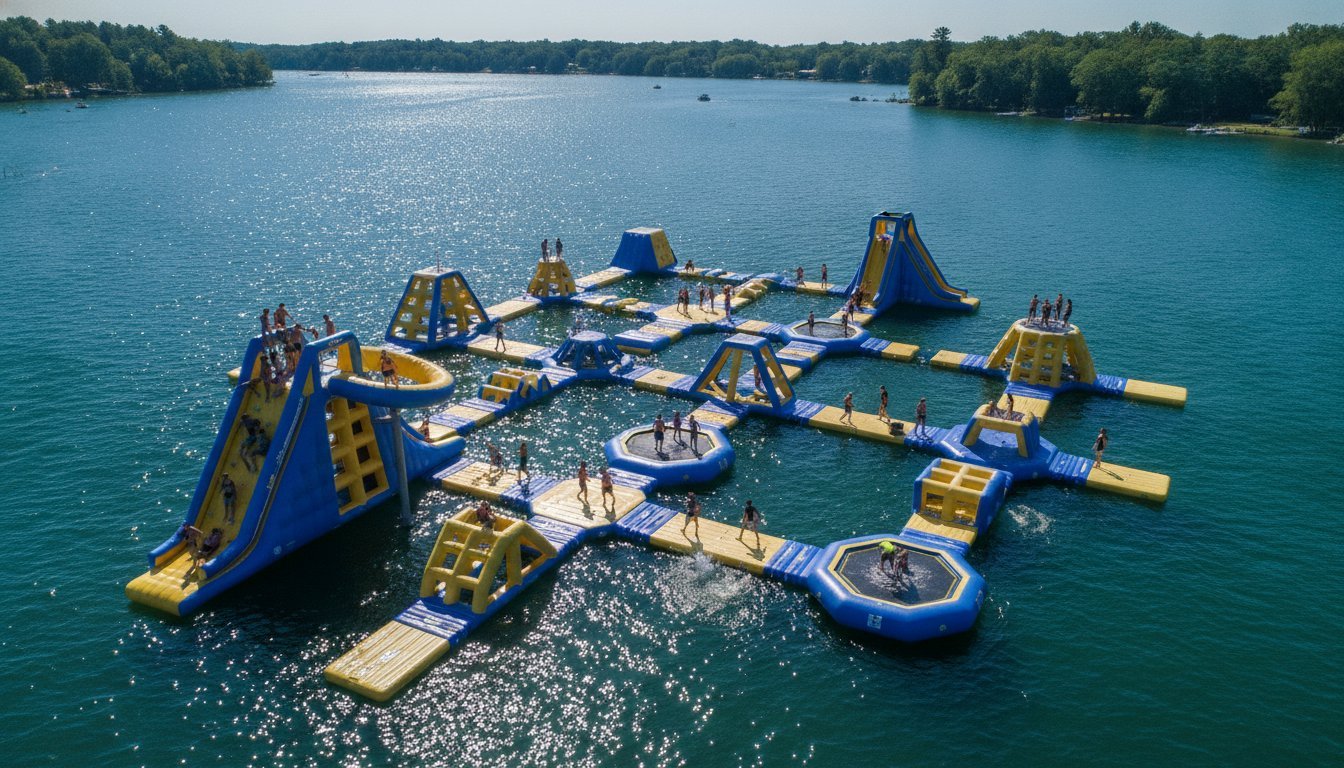
Stop looking at your waterfront as a maintenance headache and start seeing it as your most aggressive revenue driver. It’s a common frustration; you have the space, but the fear of high seasonal labour and the risk of buying gear that loses its vibrant colour or fails to meet 2026 standards keeps your expansion plans grounded. You need a solution that works as hard as you do. This is why modular floating water park systems have become the gold standard for resorts looking to maximize their return on investment.
Key Takeaways
- Understand how modularity transforms your waterfront into a scalable asset, allowing you to expand your footprint in alignment with your growing revenue.
- Discover the engineering secrets behind modular floating water park systems that ensure stable, high-capacity running tracks through advanced air-pressure management.
- Learn why commercial-grade durability and “Monster Slides” are essential to maximizing guest throughput while minimizing long-term maintenance costs.
- Master the art of high-ROI layout design to achieve a full investment payback within a single four-to-eight-month operational season.
- Realize the competitive edge of true custom designing and on-site technician training to eliminate operational friction and enhance guest safety.
What are Modular Floating Water Park Systems?
Imagine a high-revenue asset that evolves alongside your business success. Modular floating water park systems are not simple inflatables; they are sophisticated, interconnected aquatic obstacle courses engineered for commercial intensity. At its core, a modular system is a collection of independent units designed to lock together into a cohesive, high-energy environment. Instead of a single, monolithic structure that limits movement, these systems create dynamic “running tracks” where guests can race, climb, and leap without interruption. This is the future of waterfront recreation.
The shift from static, fixed-point attractions to interchangeable modules has redefined the industry. For commercial resorts and campgrounds, modularity is the ultimate strategy for scaling. You don’t need to commit to a massive footprint on day one. You can start with a focused setup, like the Campers Starter Park, and then bolt on more complex modules as your ticket sales surge. It’s about flexibility. You can reconfigure your layout every season to keep the experience fresh for returning guests, ensuring your destination never feels stale or outdated.
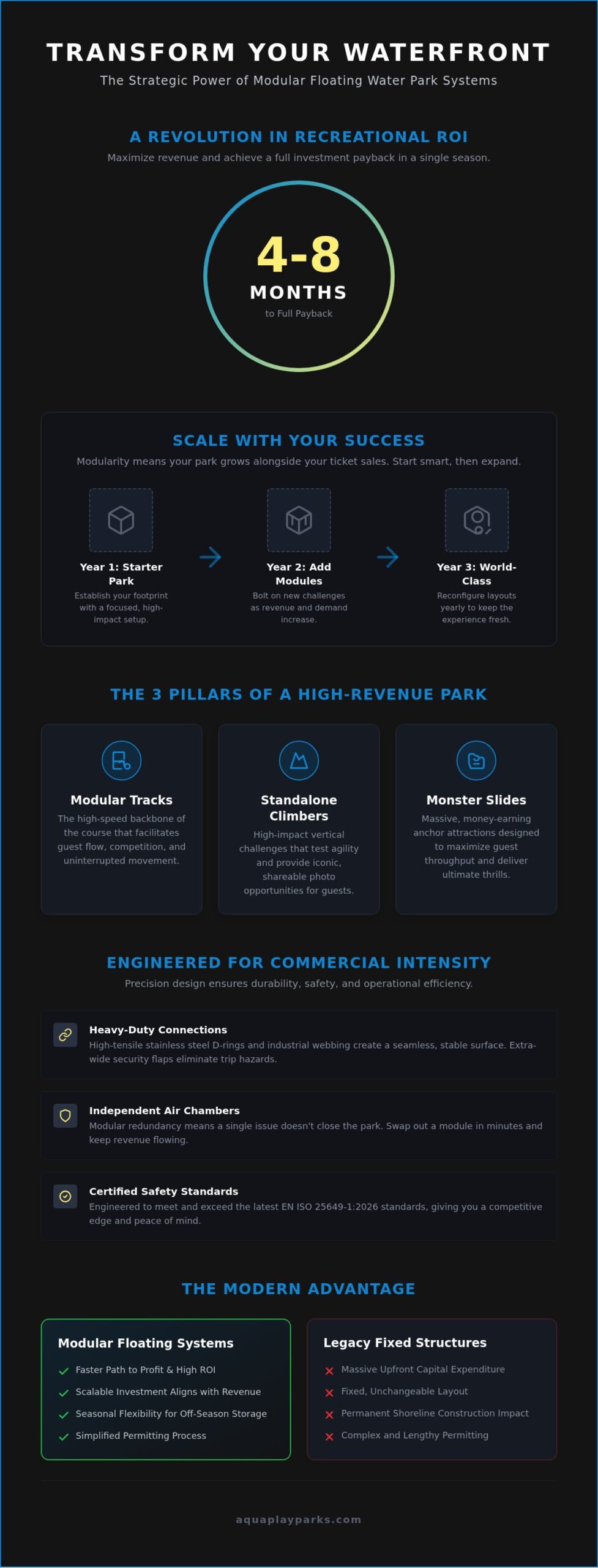
Every world-class park relies on three foundational components to drive revenue:
- Modular Tracks: The high-speed backbone of the course that facilitates guest flow and competition.
- Standalone Climbers: High-impact vertical challenges that test agility and provide iconic photo opportunities.
- Monster Slides: Massive, money-earning anchor attractions designed to maximize throughput and deliver the ultimate adrenaline rush.
The Anatomy of a Modular Inflatable
Precision is everything in a commercial aquatic environment. These systems utilize standardized lengths of 3m, 5m, and 10m, allowing you to organize your layout with surgical accuracy. These aren’t flimsy pool toys. They feature heavy-duty connection systems designed to maintain stability even when lake conditions get choppy. By utilizing vibrant, colour-coded modules, you create a visual spectacle that serves as its own marketing tool, drawing eyes from across the water and across social media.
Why Waterfronts are Moving Away from Fixed Structures
Fixed structures are becoming a legacy liability. Permanent concrete or metal slides require massive initial capital expenditure and invasive shoreline construction that can take years to approve. Floating systems offer a faster path to profit. They provide incredible seasonal flexibility; you can easily remove and store the equipment during the winter months to protect your investment. Additionally, permit processes for removable modular floating water park systems are typically far more straightforward than permanent construction, allowing you to realize your vision and start earning faster.
The Engineering Behind Modular Waterfront Attractions
Precision engineering is the heartbeat of a profitable aquatic destination. When you invest in modular floating water park systems, you aren’t just buying inflatables; you are acquiring a high-performance machine designed for maximum guest throughput. The magic happens at the connection points. Utilizing standardized 3m, 5m, and 10m segments, these systems use high-tensile stainless steel D-rings and industrial-grade webbing to create a seamless surface. Each connection is covered by an extra-wide security flap, eliminating the trip hazards and “soft spots” found in lower-quality alternatives. This ensures your tracks remain stable even when dozens of guests are racing at full speed.
Stability relies on sophisticated air-pressure management. High-capacity commercial parks use independent air chambers within each module. If one section encounters a minor issue, the rest of the course remains buoyant and safe. This modular redundancy is a massive maintenance advantage. Instead of closing your entire park for a repair, you simply swap out a single 3m module and keep the revenue flowing. It’s about operational efficiency and protecting your bottom line. You can even explore custom designing options to ensure your engineering matches the specific depth and current of your unique waterfront.
Building Interactive Running Tracks
Design your layout to encourage repeat ticket sales. By organizing straight-aways for speed and loops for competition, you create a narrative for the guest experience. It’s vital to integrate wider modules as “rest zones” to manage guest fatigue and prevent bottlenecks at high-thrill stations. Modularity allows you to create branching paths with varying difficulty levels. You can keep the younger kids on a stable perimeter track while the thrill-seekers tackle the high-intensity obstacles in the centre of the park. Build for impact. Build for flow.
Material Science: Commercial Grade vs. Retail Toys
Don’t be fooled by the vibrant colours of retail-grade toys. Commercial success requires 0.9mm reinforced PVC tarpaulin that is UV-resistant, waterproof, and flame-retardant. While retail seams often fail under intense heat, commercial systems utilize heat-welded seams that are double-reinforced to withstand constant solar exposure and the rhythmic stress of thousands of jumps. The commercial-grade standard for 2026 durability requires 0.9mm reinforced PVC tarpaulin that is double-welded and UV-stabilized to withstand the rigours of high-traffic resort environments. This material is the foundation of a park that lasts for years rather than a single season.
Commercial-Grade Durability vs. Residential Inflatables
Choosing residential-grade gear for a commercial resort isn’t just a mistake; it’s a liability waiting to happen. While a retail inflatable might look similar in a brochure, it’s engineered for a handful of children in a backyard pool, not the relentless traffic of a high-revenue destination. In a professional setting, modular floating water park systems must withstand the rhythmic stress of hundreds of guests every single day. If you opt for “budget” alternatives, you aren’t saving money. You’re simply delaying a catastrophic failure that could shutter your operations mid-season.
The “Monster Slide” factor is where the distinction becomes undeniable. These massive, money-earning structures are engineered for scale that residential products can’t even touch. They require reinforced anchor points, which are the unsung heroes of any stable installation. These points distribute the massive force of wind and waves across the entire structure, ensuring the park stays exactly where you placed it. Without this commercial-grade anchoring, your park becomes a drifting hazard the moment the weather turns. Investing in quality protects your long-term ROI by ensuring your equipment lasts for years, not just a few weeks of heavy use.
The Hidden Costs of Cheap Inflatables
Low-cost inflatables come with a heavy price tag in the form of frequent repairs and operational downtime. Every hour your park is closed for a patch job is an hour of lost ticket revenue and growing guest frustration. Beyond the financial hit, there is a significant liability risk. Using equipment that isn’t rated for commercial guest loads can lead to seam failures and injury. Finally, consider the environmental impact. Cheap materials often end up in a landfill after only one season, whereas a commercial system is built to be a permanent, sustainable part of your waterfront strategy.
Safety Protocols and Technician Training
Safety isn’t just about the equipment; it’s about the people running the show. This is why on-site water park technician training is a non-negotiable requirement for any serious operator. You need a team that understands guest ratios and weight limits for every module on the course. A properly trained technician knows how to execute daily inspection checklists to ensure all modular connections remain secure and air pressures are optimized for the day’s temperature. By prioritizing expert training, you reduce your liability and create a professional environment that guests trust, which is the ultimate driver of repeat visits and brand loyalty.
Strategic Layout Design for Maximum Capacity and ROI
A successful waterfront isn’t built on luck; it’s designed for profit. When you utilize modular floating water park systems, you aren’t just buying equipment. You are building a phased financial strategy. Start by calculating your payback period. Industry data suggests a well-run commercial park can realize a full investment payback within four to eight months of seasonal operation. This rapid return is possible because modularity allows for a phased investment approach. You don’t need to build the world’s largest park in year one. You start with a high-impact core and reinvest your initial profits to scale your attraction as demand grows.
Design your layout around “money-earning” anchors. Massive monster slides should be your North Star. These pieces create the visual gravity that pulls guests in from the shore. However, the secret to sustained revenue is guest flow management. You must prevent “dead ends” where guests get bunched up or frustrated. Organize your tracks in loops or branching circuits that keep people moving. If you can eliminate bottlenecks, you increase your total capacity and your bottom line. You can explore our custom designing services to map out a high-throughput layout tailored to your specific water depth.
The Campers Starter Park Strategy
For new operators, the entry point needs to be strategic. This is why a water park starter package for campgrounds is the ideal solution. It balances a manageable initial budget with high-intensity excitement. In your first year, prioritize modules that offer high visibility and multiple play styles. Start small. Realize a high ROI. Then, reinvest those earnings into larger, more complex monster pieces for year two. This “earn-as-you-grow” model minimizes your risk while maximizing your long-term growth potential.
Maximizing Ticket Sales with High-Capacity Modules
To push your revenue to the limit, you need to focus on “Users Per Hour” (UPH). Integrate high-capacity modules like iceberg climbers and pyramid bag jumps. These pieces increase the “wow” factor and allow more guests to play simultaneously. Calculating your capacity is straightforward: total the guest ratings of each modular piece and design for a 15 percent buffer to ensure safety. You can even use your modularity to organize special events. Timed obstacle course races or corporate team-building days create new revenue streams that go beyond standard ticket sales. Keep it fresh. Keep them returning.
Realizing Your Vision with Aqua Play Parks Custom Solutions
Your waterfront is a unique asset. It deserves more than a generic, one-size-fits-all solution. While competitors offer rigid kits that ignore the nuances of your shoreline, Aqua Play Parks thrives on the challenge of true custom designing. We don’t just ship boxes; we build destinations. By working directly with a designer boasting 35 years of industry-leading experience, you gain an advocate who understands the intersection of aquatic fun and commercial reality. From the initial concept to the first splash, we guide you through a precision-engineered process that turns your underutilized space into a high-revenue landmark.
The journey from an empty stretch of water to a thriving modular floating water park system requires a partner who is intimately involved in every detail. We eliminate the middleman, providing a direct line to expertise that ensures your installation is optimized for your specific environment. This isn’t just about aesthetics. It’s about engineering a system that manages guest flow, maximizes safety, and drives consistent ticket sales. We take the complexity out of the equation, allowing you to focus on what you do best: running a world-class resort or campground.
True Custom Designing vs. Off-the-Shelf Kits
Off-the-shelf kits are built for an “average” lake that doesn’t exist. They often fail to account for specific lake depths, fluctuating water levels, or the unique demographics of your guest base. Our approach to custom inflatable water park design allows you to tailor your layout to the exact specifications of your site. This ensures every anchor point is secure and every transition is seamless. By incorporating money-earning monster water slides into a bespoke layout, you create a brand identity that is impossible for competitors to replicate. Your park becomes a landmark, not just another attraction.
Your Partner in Operational Success
Success in the water park industry involves more than just great equipment. It requires operational excellence. We reduce operational friction by offering specialized starter packages and comprehensive on-site technician training. This training is the foundation of a safe, efficient park, teaching your team how to manage modular floating water park systems with professional precision. Our systems are built to withstand the rigours of high-traffic resorts across the United States, from intense UV exposure to peak holiday weekends. We are invested in your longevity. Concept. Design. Implementation. Success. Contact Aqua Play Parks for a custom design consultation today!
Dominate Your Waterfront and Scale Your Revenue
You now have the blueprint to transform an underutilized shoreline into a high-performance destination. By prioritizing commercial-grade durability and strategic guest flow, you protect your investment and maximize your ticket sales. Modular floating water park systems offer the unique ability to start with a focused footprint and expand as your revenue grows. It’s about vision and precision. Don’t settle for off-the-shelf kits that ignore your unique challenges.
We bring 35 years of custom design expertise to your project, ensuring your layout is optimized for your specific site. You can anchor your attraction with the world’s largest revenue-generating monster slides and operate with total confidence thanks to our professional on-site technician training. The 2026 season is your opportunity to lead the market and realize the full potential of your property. Let’s build something massive together.
Build your high-ROI waterfront with a custom modular system from Aqua Play Parks!
Frequently Asked Questions
What is a modular floating water park system?
A modular floating water park system is an interconnected series of independent inflatable units, such as tracks, climbers, and slides, designed to form a cohesive aquatic obstacle course. Unlike fixed structures, these systems allow for complete customization and easy seasonal storage. This flexibility lets you reconfigure your layout to keep the guest experience fresh and exciting year after year.
How do modular inflatable pieces connect to each other?
Modules connect using industrial-grade webbing and high-tensile stainless steel D-rings. These connection points are protected by extra-wide safety flaps to create a seamless, trip-free running track for your guests. This engineering ensures the entire park remains stable and secure, even when multiple people are racing across the surface at full speed.
Can I add more modules to my water park later?
Yes, scalability is the primary advantage of modular floating water park systems. You can start with a focused setup like the Campers Starter Park and bolt on 3m, 5m, or 10m segments as your ticket sales grow. This phased investment approach allows you to minimize initial capital expenditure while maximizing your long-term revenue potential.
What is the difference between commercial and residential inflatable water parks?
Commercial systems utilize 0.9mm reinforced PVC tarpaulin with heat-welded seams, while residential toys use much thinner, less durable materials. Commercial-grade parks are engineered for the relentless traffic of a resort environment and include redundant air chambers for guest safety. Using residential gear in a B2B setting is a massive liability that can lead to frequent downtime and equipment failure.
How long does it take to set up a modular floating water park?
A mid-sized commercial park can typically be installed in one to three days with a properly trained team. The exact timeline depends on your specific layout and the complexity of your anchoring environment. We provide on-site technician training to ensure your setup is fast, efficient, and meets all safety protocols before your first guest arrives.
Are modular water parks safe for all ages?
How much maintenance does a modular floating system require?
Maintenance involves daily inspections of air pressure levels and connection security. Because the system is modular, you can easily remove a single 3m or 5m piece for cleaning or minor repairs without closing the entire attraction. This ensures your modular floating water park systems stay operational and profitable throughout the entire peak season.
What are the anchor requirements for a modular water park on a lake?
Anchoring requires heavy-duty concrete blocks or specialized earth anchors connected to the park with elastic bungee lines. These lines allow the structure to rise and fall with water levels while absorbing the shock from wind and waves. The specific number of anchor points is determined by your total surface area and the environmental conditions of your unique waterfront.
Leave a Reply