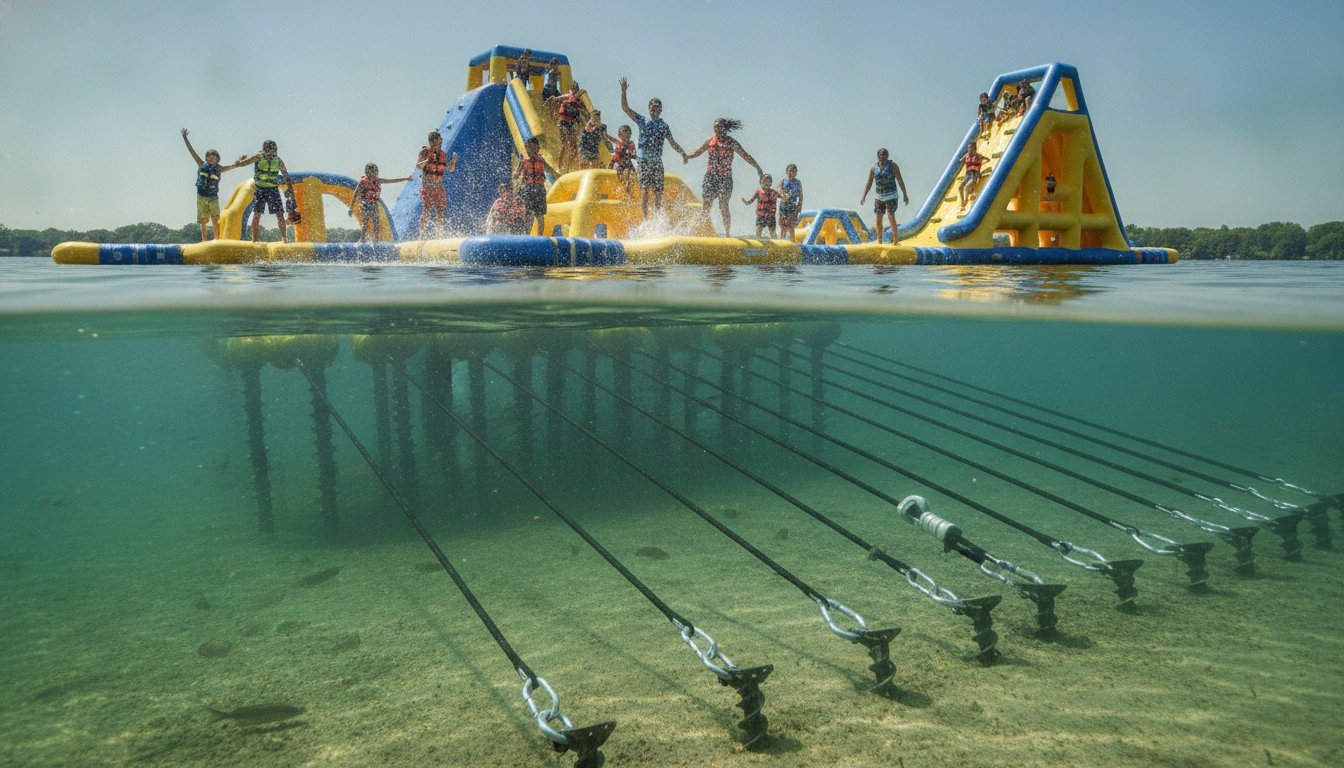
Did you know that improper anchoring is responsible for 35% of all inflatable rental lawsuits? It is a staggering figure that highlights the thin line between a high-revenue season and a legal nightmare. You have poured capital into a world-class waterfront experience. The sight of a darkening horizon should never send your stomach into a knot. To sleep soundly, you must master the engineering of commercial inflatable water park anchoring. You need to know your massive monster slides will stay exactly where you put them, regardless of what the weather throws at your shoreline.
Correct anchoring is about more than just staying put; it is about maximizing your long-term ROI. Protect your guests. Secure your equipment. Guard your bottom line. We promise to help you master the tactical execution required to defend your commercial investment. You will gain a clear understanding of the hardware needed for high-capacity pieces and the protocols that reduce insurance premiums. We are diving deep into the latest safety standards, site assessment rigour, and the specific hardware that transforms inflatables into a secure, permanent business asset.
Key Takeaways
- Understand why secure tethering is the invisible foundation of your waterfront ROI, preventing equipment fatigue and significantly extending the lifespan of your custom installation.
- Compare the mechanical advantages of deadweight concrete systems versus helical earth anchors to determine the most secure fit for your specific seabed and water depth.
- Learn to calculate environmental variables like “fetch” and the “Sail Effect” to ensure your massive slides and modular pieces remain stable during high-wind events.
- Master the tactical execution of commercial inflatable water park anchoring by mapping out precise centre points and utilizing the essential “Pre-Stretch” technique.
- Mitigate liability and operational risks by prioritizing on-site technician training that empowers your staff to manage professional-grade marine hardware with confidence.
The Critical Role of Commercial Inflatable Water Park Anchoring
Think of your waterfront as a high-stakes engine. If one gear slips, the entire system grinds to a halt. In this industry, commercial inflatable water park anchoring is that essential gear. It is the invisible infrastructure that transforms a collection of floating PVC modules into a stable, revenue-generating destination. When you invest in B2B commercial resort quality equipment, you aren’t just buying inflatables. You’re building a brand. That brand requires a rock-solid connection to the lakebed to survive the season. Without it, you aren’t running a park; you’re managing a liability.
A park that moves is a park that loses money. We call it the “drifting disaster.” If your equipment shifts even a few metres due to a sudden storm, you face immediate operational downtime. You might need professional divers or heavy machinery to reset the grid, costing you thousands in unscheduled labour. Worse, the reputational hit is often permanent. Word spreads fast when a park is closed for “technical issues.” Don’t confuse residential-style weights with commercial-grade marine systems. While a backyard setup might rely on simple concrete blocks, a professional operation utilizes the fundamental principles of mooring to withstand massive environmental forces.
Safety, Liability, and Guest Confidence
Safety isn’t just a checklist; it’s the core of your business model. A stable park drastically reduces the risk of entrapment or collisions between modules. If a tether snaps and a gap opens up, you’ve created a hazard that no lifeguard can fully monitor in real-time. Beyond the physical risks, there is a massive psychological component. Guests who feel the park shifting or wobbling beneath them won’t push their limits or stay as long. A secure park invites bold play, leading to longer stay times and repeat ticket sales. You can also realize lower insurance premiums by documenting professional commercial inflatable water park anchoring protocols, proving to your provider that you’ve eliminated the most common cause of rental lawsuits.
Protecting Your High-ROI Investment
Protect your gear from the elements and from itself. Improperly tethered pieces often suffer from “abrasion damage” caused by the underside of the inflatable rubbing against the lakebed or underwater debris. This friction can eat through high-grade 0.9mm PVC far faster than standard UV wear. Proper anchoring ensures your modular pieces stay perfectly aligned, which is critical for maintaining the integrity of interactive running tracks and obstacle courses. This strategic planning is the very first step in any successful custom inflatable water park design. It ensures your massive slides stay in the deep water where they belong, keeping your investment safe and your guests coming back for more.
Choosing the Right System: Deadweights vs. Earth Anchors
Your lakebed is not a generic floor. It is a dynamic environment that dictates your entire operational strategy. Across diverse landscapes, you might be battling the jagged granite of ancient rock formations or the shifting silt of a riverine reservoir. Choosing the correct commercial inflatable water park anchoring system starts with a physical probe of that terrain. If you cannot bite into the bottom, you must weigh it down. If the ground is soft, you screw into it for maximum leverage. This is not just about keeping things in place; it is about engineering a system that survives a sudden squall without dragging your investment into the reeds.
To ensure your setup meets rigorous safety standards, many operators look toward established municipal regulations for floating structures as a benchmark for mooring tension. Whether you use blocks or screws, integrating bungee tethers is non-negotiable. These heavy-duty shock absorbers take the “snap” out of wave action and guest impact, preventing the violent jerks that tear D-rings right out of the PVC. For a system tailored to your specific GPS coordinates, consider a custom plan from Aqua Play Parks to ensure every module stays exactly where it belongs.
Concrete Deadweights and Block Systems
Deadweights are the workhorses of rocky or uneven lakebeds. You must calculate the required mass based on the total surface area of your inflatables. A massive 10-metre slide acts like a sail. It requires significantly more ballast than a flat connecting runway. When pouring your own blocks, ensure they have smooth, rounded edges. Sharp corners are the enemy of marine-grade rope and will fray your cables in a single weekend of heavy chop. Organize your grid so that tension is distributed equally. If one block is too light, the entire modular park will begin to “walk” across the lake floor, putting immense stress on your connecting hinges.
Helical Screw-in Anchors for High-Tension
For permanent resort installations or sandy bottoms, helical earth anchors offer the ultimate mechanical advantage. These are not simple stakes. They are heavy-duty screws that bore deep into the substrate, providing massive holding power that deadweights simply cannot match. In high-wind zones, these are often the only way to guarantee your park will not flip or drift. Installation requires specialized hydraulic equipment or manual torque bars, depending on the water depth. While the initial setup is more labour-intensive, the peace of mind during a storm is worth the effort. It transforms your park from a temporary attraction into a permanent, rock-solid waterfront fixture.
Engineering for Environmental Variables: Wind, Tides, and Depth
Nature doesn’t respect your business hours. It only respects physics. When you deploy a park, you are essentially launching a giant, multi-component sail onto the water. This is the “Sail Effect” in action. A single gust can transform a 10-metre slide into a high-tension kite, putting immense strain on your commercial inflatable water park anchoring system. To defend your investment, you must calculate the “fetch.” This is the unobstructed distance wind travels over the water before hitting your installation. A long fetch allows waves to build significant energy, requiring a robust, engineered response to keep your park from migrating toward the shoreline.
Managing these forces requires more than just heavy weights. It requires strategic slack management. In tidal zones or reservoirs where water levels fluctuate, your tethering lines must account for the rise and fall without becoming tangled or dangerously tight. If your lines are too short, a rising tide will lift your anchors. If they are too long, the park will drift and modular connections will fail. Adhering to state-level installation and design standards provides a proven framework for managing these mooring loads while protecting the delicate aquatic substrate beneath your park.
Managing Wind Loads on Monster Slides
Revenue follows the scale. This is why inflatable monster water slides are the centerpiece of high-ROI parks. However, their height makes them primary targets for wind resistance. These high-profile attractions require specialized multi-point tethering that anchors the piece from several angles simultaneously. Position these massive units so their narrowest profile faces the prevailing winds. This simple orientation reduces the total force exerted on your hardware, ensuring your star attraction stays upright and operational even when the breeze picks up.
Depth and Thermocline Considerations
The “scope” of your anchor line, the ratio of line length to water depth, is a critical safety metric. A steep angle puts vertical pressure on the anchor, potentially pulling it loose. A wider angle provides better holding power but increases the footprint of your underwater grid. You must also account for thermoclines. Sudden drops in water temperature can affect the elasticity of your bungee systems, making them stiffer and less effective at absorbing shock. Always ensure your lines are deep enough to avoid boat propeller interference. A single stray vessel can sever a primary line, compromising the integrity of your entire commercial inflatable water park anchoring setup in seconds.
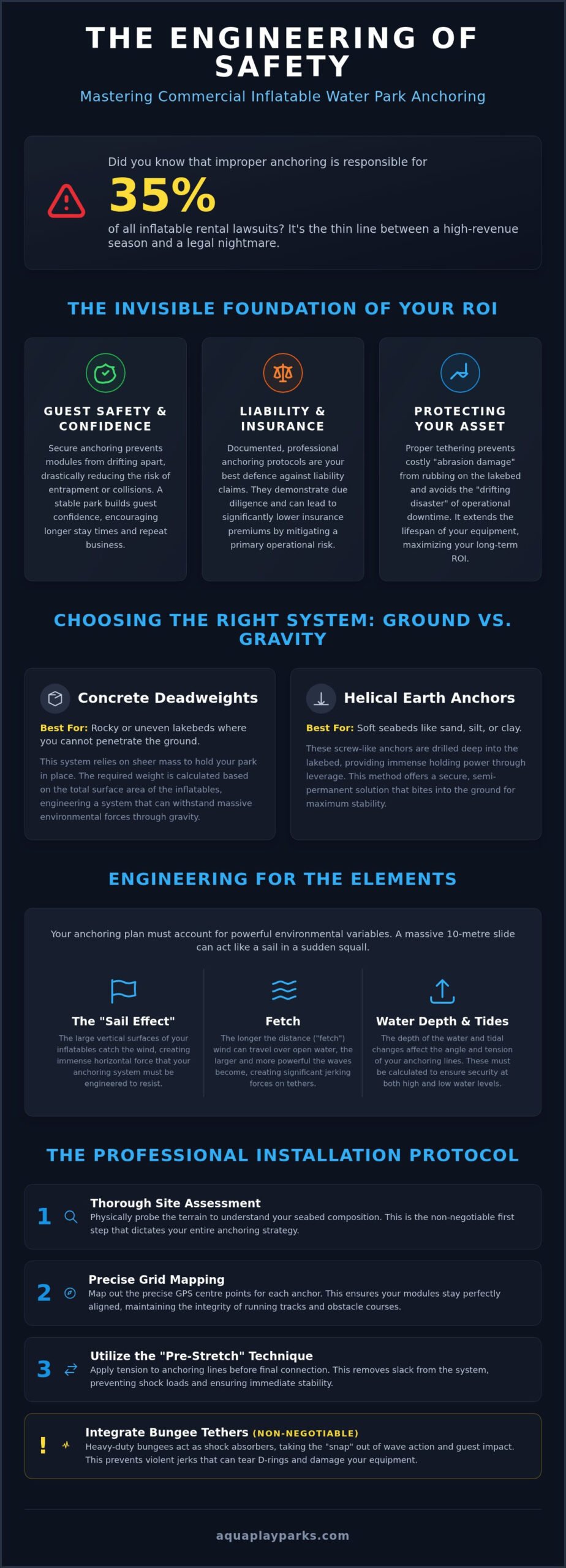
Installation Best Practices and Seasonal Maintenance
Excellence lives in the execution. You have selected your hardware and analyzed your lakebed; now you must deploy your grid with surgical precision. Successful commercial inflatable water park anchoring is not a “drop and forget” task. It is a systematic process of mapping centre points to ensure your modular obstacle course remains a perfectly flat, high-speed running track. If your grid is even a few centimetres off, the connecting hinges will bind, and your park will look amateurish. Worse, it will wear out faster. Precision in the setup phase is the difference between a park that lasts five seasons and one that requires constant repairs.
The “Pre-Stretch” technique is your secret weapon. Before the first guest steps on the park, apply tension to your lines and let them sit for 24 hours. This allows the ropes and bungees to settle and find their natural seat. Slack is the enemy of safety. A loose park is a dangerous park. Once the lines have settled, perform a final tensioning pass to ensure the entire structure is rigid and responsive. Ready to secure your waterfront with a professional-grade setup? Partner with Aqua Play Parks for custom designs and expert anchoring guidance.
The Grid Layout: Organizing Your Waterfront
Organization is the backbone of a high-ROI park. Follow these steps to realize a professional installation:
- Step 1: Mark the perimeter using GPS coordinates or temporary buoys to define your operational zone.
- Step 2: Drop your main corner anchors first. These are your “master points” that establish the park’s footprint and resist the heaviest lateral loads.
- Step 3: Connect modular pieces using a systematic, centre-out approach. This prevents tension from bunching up on one side of the grid.
- Step 4: Perform final tensioning. Ensure every line is taut to create a flat, safe running surface that guests can navigate with confidence.
Mid-Season Inspection Protocols
The work doesn’t end on opening day. You must implement a rigorous inspection schedule to identify signs of anchor “creep” or cable fatigue before they lead to a failure. Every week, check for bio-growth like algae or barnacles. This underwater accumulation can add significant weight to your tether lines, dragging them down and reducing their shock-absorbing capacity. Inspect every D-ring and carabiner for signs of metal stress or salt corrosion. These small components are the most common points of failure. After every major storm or peak-occupancy weekend, dive the lines to adjust tension. Constant use will naturally loosen the system, and a quick adjustment can prevent thousands of dollars in long-term abrasion damage.
Professional Support: Training Your On-Site Technicians
DIY anchoring is the single greatest risk to your long-term ROI. If you treat a high-capacity waterfront installation like a backyard pool toy, you are inviting disaster. Professional commercial inflatable water park anchoring is an exercise in marine engineering, not a weekend project for the maintenance crew. Guessing at weight requirements or tether angles leads to anchor creep, equipment damage, and unmanageable liability. This is the critical distinction in the commercial vs residential inflatable water park debate. True B2B commercial resort quality requires a bespoke engineering strategy that accounts for your specific GPS coordinates and lakebed composition.
Empowering your staff is the most effective way to protect your investment. When your team understands the mechanics of tension and the physics of the “Sail Effect,” they become the first line of defence against equipment failure. On-site technician training transforms your employees from lifeguards into savvy operational managers. They learn to identify the subtle signs of cable fatigue and realize when a bungee needs immediate replacement. This proactive approach doesn’t just save your equipment; it reduces your insurance risk by proving a commitment to professional safety protocols.
The Aqua Play Parks Advantage
We don’t just ship boxes; we build businesses. Choosing us means gaining direct access to a Canadian designer with 35 years of hands-on expertise in the industry. We understand that every shoreline is different. Our water park starter package for campgrounds simplifies the complex commercial inflatable water park anchoring process, providing a clear path for new operators. We bridge the gap between a simple “beach toy” and a professional-grade attraction that generates massive revenue. Every custom park we design comes with a tailored anchoring plan, ensuring your massive monster slides stay at the centre of their designated tension zones.
Booking Your On-Site Training
What can your team expect during a professional training session? We dive into the tactical execution of your specific grid layout. We walk your staff through the seasonal setup and teardown processes, ensuring they can handle the hardware with speed and confidence. This training ensures your park is always optimized for guest safety and operational continuity. Don’t leave your waterfront to chance. Secure your park’s future. Contact us for a custom anchoring and design consultation to get your project moving.
Secure Your Waterfront Legacy
Your aqua park is more than a collection of modules; it is a high-performance revenue engine. To keep that engine running, you must respect the invisible engineering that holds it all together. Master the tactical execution of commercial inflatable water park anchoring to eliminate the “drifting disasters” that sink competitors. You now understand that every lakebed requires a bespoke strategy and that your team’s training is the ultimate safeguard for your equipment. Don’t leave your investment to the mercy of the next storm.
We bring 35 years of industry-leading expertise to every project, delivering custom engineered plans that match your unique waterfront. From massive monster slides to modular obstacle courses, we ensure your park stays exactly where you put it. Contact our visionary designers to realize your custom, secure waterfront today. We include on-site technician training for every commercial installation, giving your staff the confidence to manage a professional attraction. Build it right. Build it to last. Your future success is anchored in the decisions you make today.
Frequently Asked Questions
How much weight is required to anchor a commercial inflatable water park?
Weight requirements vary based on the surface area of your modules and local wind conditions. For a standard commercial inflatable water park anchoring setup, deadweight anchors typically range from 500kg to 2000kg per block. Larger pieces like monster slides act as sails and require the higher end of that scale. Each anchor point must resist a minimum force of 1600 N (360 lbf) to ensure the park remains stationary.
Can I use cinder blocks to anchor my floating aqua park?
No, you should never use cinder blocks for a professional B2B installation. Cinder blocks lack the necessary mass and have sharp, porous edges that will quickly fray your marine-grade ropes. They are intended for residential use and won’t withstand the lateral forces exerted by a large-scale park. Instead, use smooth-edged, high-density concrete blocks or helical earth anchors to protect your investment and ensure guest safety.
How often should I check my water park anchors?
Perform a visual surface check every morning before the first ticket is sold. Conduct a comprehensive underwater inspection once a week to identify any anchor “creep” or bio-growth on the lines. It is also essential to re-evaluate the entire commercial inflatable water park anchoring grid after any major storm or high-wind event. Regular maintenance prevents small issues from turning into catastrophic failures during peak operational hours.
What is the best way to anchor an inflatable in a sandy lake bottom?
Helical screw-in anchors are the superior choice for sandy or clay substrates. These anchors bore deep into the ground, utilizing the mechanical advantage of the soil to provide massive holding power. While deadweights can slide across a sandy floor, helical anchors remain fixed even under high tension. They are particularly effective for securing high-profile modules that face significant wind resistance throughout the season.
Do I need a professional diver to install my water park anchors?
A professional diver is highly recommended for the initial placement of heavy deadweights in deep water. However, our on-site technician training empowers your staff to handle routine adjustments and seasonal maintenance. Having a team that understands the underwater grid reduces your reliance on external contractors. For complex custom designs, professional installation ensures every anchor is placed with GPS precision to maintain the park’s structural integrity.
How do I prevent my water park from flipping in high winds?
Prevention starts with maintaining taut lines and orienting your tallest pieces to face the prevailing winds. If your tethers are loose, the wind can get underneath the modules, creating lift that leads to flipping. Always follow the industry standard of shutting down operations when wind speeds reach 24 to 32 kilometres per hour (15 to 20 mph). Proper anchoring is your first line of defence against these environmental forces.
What is a bungee tether and why is it used in anchoring?
A bungee tether is a heavy-duty shock absorber that sits between your anchor line and the inflatable. It is used to dissipate the energy from waves and guest movement, preventing sudden “snaps” that can tear D-rings. Without these elastic components, the constant jerking motion would cause rapid equipment fatigue. Bungees keep the park feeling stable for guests while significantly extending the lifespan of your commercial-grade PVC.
Does a custom aqua park design include an anchoring plan?
Yes, every custom design we provide includes a detailed anchoring strategy tailored to your specific waterfront. We analyze your lakebed, water depth, and local weather patterns to create a grid that ensures maximum stability. This engineered approach is part of our commitment to your long-term ROI. We don’t just provide the inflatables; we provide the foundation for a secure and profitable commercial operation that is built to last.
Leave a Reply