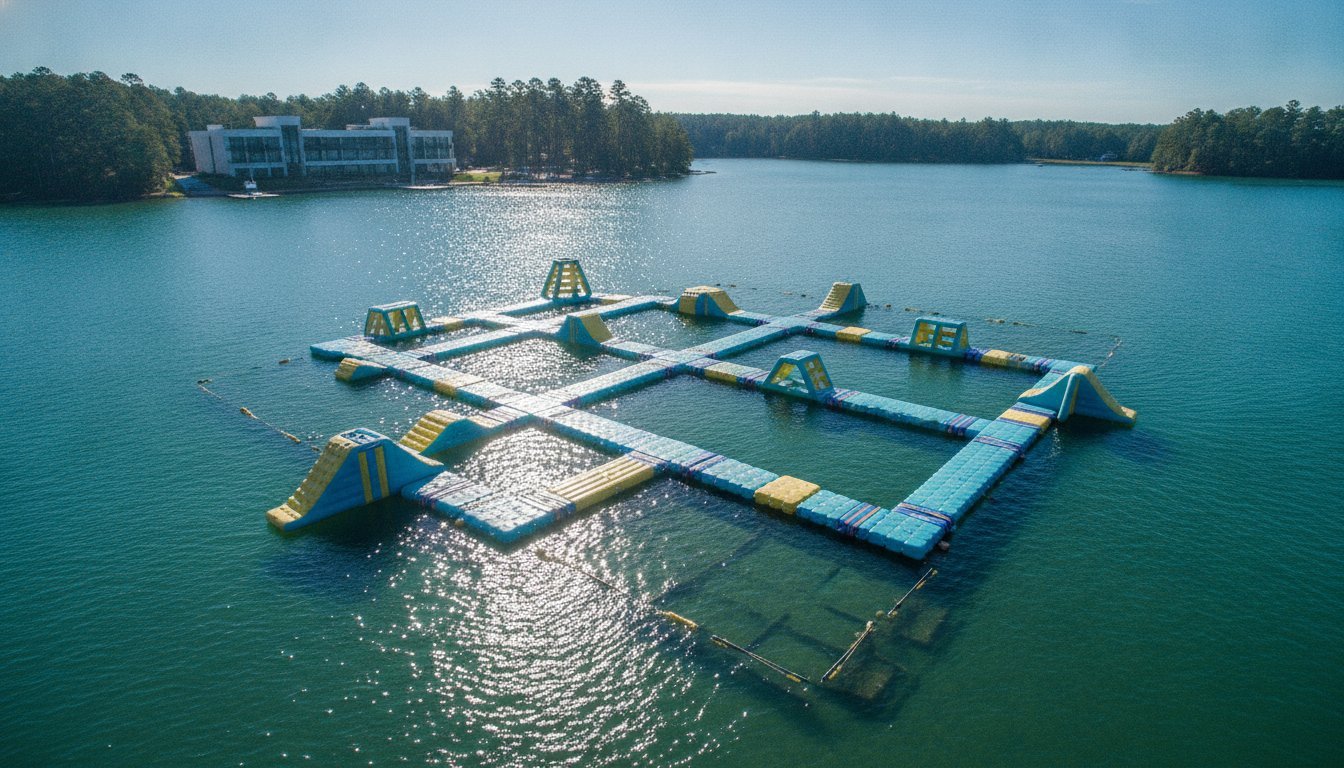
Did you know that improper anchoring accounts for 35% of all inflatable rental lawsuits? It is a staggering figure that proves getting your setup right isn’t just about fun; it’s about protecting your commercial bottom line. You want to transform your waterfront into a high-revenue destination, but the fog of permit red tape and safety concerns can feel paralyzing. It’s natural to worry about lakebed suitability or whether your site meets the specific floating water park installation requirements needed to secure insurance and total peace of mind.
You are in the right place to clear the air. We’ve designed this guide to help you master the technical, environmental, and operational standards required to realize a world-class aquatic attraction. You will gain a clear checklist of site specifications, learn how to organize a modular layout for maximum guest flow, and build the confidence to select a professional anchoring strategy. Let’s move past the uncertainty and turn that empty water into a high-impact commercial engine.
Key Takeaways
- Learn how modularity acts as a commercial engine, allowing you to scale your waterfront revenue by expanding your park piece by piece over time.
- Gain a clear understanding of the floating water park installation requirements regarding water depth and clearance to safely accommodate high-impact monster slides.
- Master the technical nuances of anchoring systems and hydrodynamic layouts to ensure your installation remains secure and stable in varying conditions.
- Identify the essential insurance and provincial regulatory standards needed to protect your resort from liability and ensure a smooth operational launch.
- Discover the “Direct Designer” advantage to realize your custom vision faster while avoiding the unnecessary costs and delays of intermediaries.
Understanding the Blueprint for a High-ROI Floating Water Park
Stop thinking about beach toys. If you want to transform your waterfront into a high-yield commercial asset, you must shift your perspective from simple inflatables to professional aquatic infrastructure. A high-ROI park isn’t just about floating; it’s about engineering a guest experience that scales. Meeting strict floating water park installation requirements is the bridge between a backyard hobby and a durable, money-earning destination. While the basic concept of What is a Water Park? remains consistent, the execution at a B2B commercial level requires a blueprint focused on bathymetric precision and modular growth.
Modularity is your secret weapon for long-term profitability. By utilizing 3m, 5m, and 10m modular obstacle pieces, you can start with a focused footprint and expand as your guest numbers climb. This “vision-first” approach allows you to reinvest profits into larger, high-impact features like the world’s largest monster slides without redesigning your entire site from scratch. True Custom Designing ensures that your park fits your specific waterfront like a glove, turning even the most challenging shoreline into a seamless playground.
Commercial-Grade Standards: Why Material Matters
In the harsh Canadian climate, durability is the difference between a one-season wonder and a decade-long investment. We utilize high-density, UV-resistant 0.9mm PVC tarpaulin specifically designed to withstand temperature fluctuations and intense sun exposure. Unlike residential products, B2B Commercial Resort Quality equipment features heat-welded seams. These are non-negotiable for high-traffic environments because they create a bond stronger than the fabric itself. If you aren’t prioritizing these material standards, you are inviting premature failure and massive liability. For a deeper breakdown of these technical differences, explore our guide on Commercial vs Residential Inflatable Water Park.
The ROI of Proper Site Assessment
A well-planned layout does more than just look good; it protects your investment. When you align your modular connectors with the natural movement of the water, you minimize the mechanical stress on every joint. This strategic planning prevents the “whiplash” effect during windy days, significantly extending the life of your park. Consider these layout essentials:
- Guest Flow: Use 10m interactive running tracks to connect major features, preventing bottlenecks and keeping the energy high.
- Revenue Magnets: Position standalone attractions, like an inflatable iceberg climber, in deep-water zones to create secondary “hubs” of activity.
- Custom Footprints: Tailor the installation to your specific lakebed to ensure anchors stay submerged and out of the way of swimmers.
Ultimately, your installation standards dictate your insurance and liability profile. Insurance providers need to see a professional, engineered layout that adheres to international safety standards like ISO 25649. When you build to these floating water park installation requirements, you aren’t just buying equipment; you’re buying the confidence to operate a world-class resort attraction.
Critical Environmental Requirements for Your Waterfront
Your waterfront is more than just a scenic backdrop; it’s the literal foundation of your business. Before you drop a single anchor, you must understand the invisible forces at play beneath the surface. Site suitability isn’t a guessing game. It’s a precise calculation of bathymetry, water movement, and geological composition. Ignoring these floating water park installation requirements doesn’t just risk your equipment; it risks your reputation. You need a site that works with your park, not against it.
Depth and Clearance: The Safety Margin
Safety is your primary currency. For standard modular obstacle pieces, you need a consistent minimum depth of 2.5 to 3 metres. However, when you introduce high-adrenaline features like our world’s largest monster slides or the Pyramid Bag Jump, the stakes get higher. These high-impact zones require a guaranteed 3-metre safety clearance to prevent injuries during deep entries. You must also establish a strict “no-go” zone. Any underwater hazards, such as jagged rocks, old tree stumps, or discarded debris, must be cleared or bypassed entirely. If your lakebed is unpredictable, our True Custom Designing service can help you navigate these obstacles by tailoring the layout to your specific bathymetric map.
Hydrodynamics and Water Movement
Wind and waves are the primary drivers of wear and tear. You must analyze the “fetch” of your waterfront to ensure long-term stability. Hydrodynamic fetch is the unobstructed distance of open water over which wind blows to create waves; the longer the fetch, the larger the potential wave energy hitting your park. High-energy waves put immense stress on modular connection points. If your site is exposed to heavy winds, you should look for natural landforms or consider installing breakwaters to protect your investment. A protected cove is always superior to an open shoreline for park longevity.
Water clarity is another non-negotiable factor for operational safety. Your lifeguards need to see the bottom to effectively monitor guest activity. Poor visibility increases response times and liability risks. We recommend cross-referencing your site’s conditions with the EPA Water Quality Criteria to ensure you’re maintaining a healthy, safe environment for your guests. Pathogens or high turbidity aren’t just health risks; they’re business killers.
Finally, look at what’s on the bottom. Your lakebed composition dictates your anchoring hardware. Solid rock requires specialized drills and bolt-in solutions, while soft silt or sand might demand heavy-duty earth anchors or massive concrete blocks. You don’t want your park drifting toward the shore during a summer storm because you chose the wrong hardware for your soil type. Get the ground right, and the rest will follow.
Beyond the hardware itself, ensuring the lakebed is clear of excessive organic matter is vital for a firm set. For operators in regions like Florida, Green Lakes Florida offers specialized aquatic restoration and invasive weed removal to ensure the foundation of your park remains stable and secure.
Advanced Anchoring and Hydrodynamic Layout Planning
Your park’s stability isn’t just about weight; it’s about physics. If you treat anchoring as an afterthought, you are gambling with your investment. A professional installation requires a deep understanding of how tension, drag, and buoyancy interact during a storm. Mastering these floating water park installation requirements ensures your park stays exactly where you put it, regardless of what the weather throws at your resort. It’s the difference between a secure, high-traffic attraction and a drifting liability nightmare.
Selecting the Right Anchoring System
There is no “one-size-fits-all” anchor. Your choice must be dictated by your lakebed composition. For soft silt or clay, concrete deadman anchors are often the go-to solution because their massive footprint provides the necessary friction. Conversely, if you’re dealing with firm sand, helical screw anchors offer superior holding power by literally “locking” into the ground. You must calculate your weight requirements based on the total surface area of the park and the maximum predicted wind load for your region. High-profile pieces catch more wind, meaning they need more “bite” in the lakebed.
Organization is key to guest safety. You must arrange your anchor lines to prevent guest entanglement or tripping. This means using submerged lines that drop vertically from the attachment points rather than stretching horizontally through swimming zones. While you focus on the physical setup, always ensure your operational plans align with broader safety protocols, such as the CDC Guidelines for Aquatic Venues, to maintain a gold-standard safety environment. Proper line management isn’t just about aesthetics; it’s about eliminating hidden hazards.
Shock absorption is your park’s insurance policy. We utilize heavy-duty elastic bungee cords in our anchoring subsystems to absorb the sudden shock loads caused by waves. Without these bungees, the staccato energy of a storm would snap modular connectors or pull anchors right out of the lakebed. This is especially critical for the world’s largest floating, money-earning monster slides. These massive structures act like sails; they require a dedicated, reinforced anchoring subsystem to handle the increased lateral pressure and maintain their position.
Modular Layout Strategy for Guest Flow
A smart layout turns a collection of inflatables into a high-capacity revenue machine. By connecting 3m, 5m, and 10m pieces, you can create a “running track” that keeps guests moving and prevents bottlenecks. If you’re just starting out, the Campers Starter Park provides an ideal foundation. It’s a scalable entry point that allows you to master the basics of modularity before expanding into a larger footprint. For inspiration on how to engineer these high-ROI destinations, check out our insights on Custom Inflatable Water Park Design. Every piece you add should enhance the flow, directing guests toward your high-impact “anchor” attractions while maintaining clear sightlines for your staff.
Compliance, Liability, and Operational Staffing Requirements
Transforming your waterfront into a high-revenue destination is a bold move, but the physical setup is only half the battle. You must also build a rock-solid legal and operational foundation to keep your park open and profitable. Navigating the complex web of floating water park installation requirements is where many entrepreneurs feel overwhelmed. However, mastering these standards is the only way to protect your investment and your guests. You are no longer just a resort owner; you are the operator of a sophisticated commercial aquatic facility.
Regulatory and Permit Checklist
In Canada, you will likely interface with Transport Canada regarding the Navigable Waters Act and various provincial ministries for environmental protection. You must secure commercial use permits or “Right of Way” agreements, particularly if you are operating on public water bodies. Standardization is your best friend here. Ensure your installation meets the latest ISO 25649 commercial safety requirements. This isn’t a mere suggestion. It is exactly what your insurance provider will demand to see before they authorize your coverage. They need proof of engineered layouts and B2B Commercial Resort Quality equipment that is built for high-traffic intensity.
The Necessity of On-Site Technician Training
Staffing is where most resorts make a critical error. They hire certified lifeguards and assume the operational work is complete. While lifeguards are essential for guest supervision, they aren’t equipped to maintain the physical integrity of the park. You need a trained park technician. Professional on-site training reduces your liability and significantly extends the lifespan of your modular pieces. Our specialized training packages cover everything from seam inspection to anchor line tension adjustments, ensuring your team can spot a minor issue before it becomes a major failure.
Inflation pressure management is a critical daily technician task because fluctuating air volumes caused by temperature shifts can lead to structural failure or guest injury if left unchecked. Leaving your multi-thousand dollar investment in the hands of someone who doesn’t understand the mechanics of PVC tension is a risk you can’t afford. To ensure your team is ready for the rigours of a busy summer season, you should invest in our On-Site Technician Training.
Developing a rigorous daily inspection and maintenance schedule is your final line of defence. Every morning, before the first guest steps onto the running track, your technician must verify every modular connector and anchor line. This proactive approach does more than just prevent accidents. It builds a documented record of due diligence that is invaluable if a liability claim ever arises. Success in this industry is built on a culture of safety and precision that starts long before the guests arrive.
Scaling Your Vision with Aqua Play Parks’ Custom Solutions
You don’t have time for intermediaries or diluted visions. When you partner with Aqua Play Parks, you work directly with the source. This “Direct Designer” advantage means your project moves from concept to reality with unmatched speed and transparency. By eliminating the middleman, we ensure that every specific detail of your floating water park installation requirements is addressed by the people actually engineering the equipment. We don’t just provide a catalog; we provide a direct line to 35 years of industry-leading Canadian design expertise.
Every resort waterfront has a unique personality and a specific bathymetric profile. Our True Custom Designing service ensures your park isn’t a generic “off-the-shelf” solution that struggles to fit your shoreline. We map your specific depths and lakebed conditions to create a layout that maximizes every square metre of your water. This bespoke approach allows us to integrate high-impact revenue drivers, such as the world’s largest floating monster slides, into environments that others would deem too challenging. We turn your site’s unique constraints into its greatest commercial strengths.
From Starter Packages to World-Class Destinations
Success often starts with a focused, high-impact launch. The Campers Starter Park is specifically engineered for rapid deployment in smaller campgrounds or resorts looking to test the waters. It simplifies the initial setup by providing a curated selection of B2B Commercial Resort Quality pieces that are easy to manage and quick to install. It’s the ultimate entry-level requirement for venues that want to prove the ROI of an aquatic attraction before scaling up.
Growth is built into our modular DNA. Once your initial installation begins driving traffic, you can scale your vision by adding 3m, 5m, or 10m modular obstacle pieces. This allows you to increase seasonal ticket sales and keep your guest experience fresh year after year. For those looking to dominate their local market, explore our insights on Inflatable Monster Water Slides to see how a single massive attraction can redefine your entire resort’s brand.
The Aqua Play Parks Installation Partnership
We are more than a manufacturer; we are your long-term operational partner. Our 35 years of design experience allows us to solve complex site challenges that leave others guessing. We provide professional on-site support to ensure your first splash is a success, guiding your team through the nuances of the floating water park installation requirements from the first anchor drop to the final safety check. This hands-on involvement ensures your park is stable, secure, and ready for high-traffic intensity from day one.
Your waterfront has the potential to be a world-class destination. Stop settling for generic inflatables and start building a commercial legacy. Our team is ready to help you navigate the technical, environmental, and regulatory landscape to realize a high-ROI park that sets your resort apart. Book your custom design consultation today and let’s start engineering the future of your waterfront.
Turn Your Waterfront into a High-Impact Revenue Engine
Your waterfront is a dormant commercial asset waiting for a visionary spark. You’ve seen how bathymetric precision, advanced anchoring, and a modular layout strategy can transform a simple lake into a high-ROI destination. Mastering the floating water park installation requirements isn’t just a technical hurdle; it’s the foundation of your commercial success. From securing the right permits to ensuring your team is trained for daily pressure management, every detail counts toward building guest trust and maximizing seasonal revenue.
Don’t settle for middleman markups or generic designs that ignore your site’s unique challenges. You deserve a partner who brings 35 years of industry-leading design experience directly to your shoreline. With our commercial-grade modular systems and included on-site technician training for major installations, you can launch with absolute confidence. The path from a quiet waterfront to a world-class attraction is shorter than you think. Realize your waterfront potential with a custom Aqua Play Parks design and start building your legacy today. Your guests are ready for the splash of a lifetime.
Frequently Asked Questions
What is the minimum water depth required for a floating water park?
You need a consistent minimum depth of 2.5 to 3 metres for standard modular pieces. For high-adrenaline attractions like our monster slides, a guaranteed 3-metre safety clearance is a non-negotiable requirement. Always calculate your site’s lowest seasonal water levels to ensure you stay within these floating water park installation requirements all summer long.
Do I need a permit to install an inflatable water park on a private lake in Canada?
Yes, you typically require permits even on private property if the water body is connected to navigable systems or public watersheds. You must interface with Transport Canada and your specific provincial ministry of environment to secure the necessary commercial use clearances. We recommend starting this process at least 90 to 120 days before your planned opening date.
How many anchors do I need for a modular floating aqua park?
The number of anchors depends entirely on your park’s total surface area, the local wind load, and the lakebed composition. A medium-sized layout often requires between 15 and 30 specialized anchor points to ensure stability during high-traffic periods. We calculate these precise requirements during the custom design phase to ensure your investment stays exactly where it belongs.
Can I install a floating water park in an area with high winds or waves?
You can certainly operate in exposed areas, provided you utilize a professional anchoring strategy with heavy-duty bungee cords. These bungees act as shock absorbers, preventing modular connectors from snapping under the staccato energy of waves. If your waterfront has a long fetch, we will customize your layout to minimize drag and protect the structural integrity of the park.
What kind of staff do I need to operate a commercial inflatable park safely?
Safe operation requires a combination of certified lifeguards and a dedicated park technician. While lifeguards focus on guest supervision, the technician manages the physical floating water park installation requirements, such as daily inflation checks and anchor tensioning. Our specialized on-site training equips your team to maintain structural integrity and minimize liability risks from day one.
How long does the installation process typically take from delivery to opening?
Physical installation usually takes between 1 and 3 days once the equipment is on-site and your anchors are set. This timeline includes the assembly of modular pieces and the completion of our professional on-site technician training. We focus on an efficient, direct implementation so you can move from delivery to revenue generation without unnecessary delays.
Are there specific insurance requirements for floating water attractions?
Insurance providers demand proof that your park adheres to international safety standards like ISO 25649. They will typically require an engineered site layout, proof of commercial-grade materials, and a documented daily inspection log. Meeting these technical standards upfront positions you as a professional operator and is essential for securing comprehensive liability coverage.
How do I maintain the park during the off-season in colder Canadian climates?
You must remove the park from the water, clean every module with fresh water, and ensure all pieces are completely dry before storage. Store your equipment in a climate-controlled, rodent-proof facility to protect the PVC material from extreme temperature fluctuations. Proper off-season care is a pragmatic business move that significantly extends the lifespan of your commercial assets.
Leave a Reply