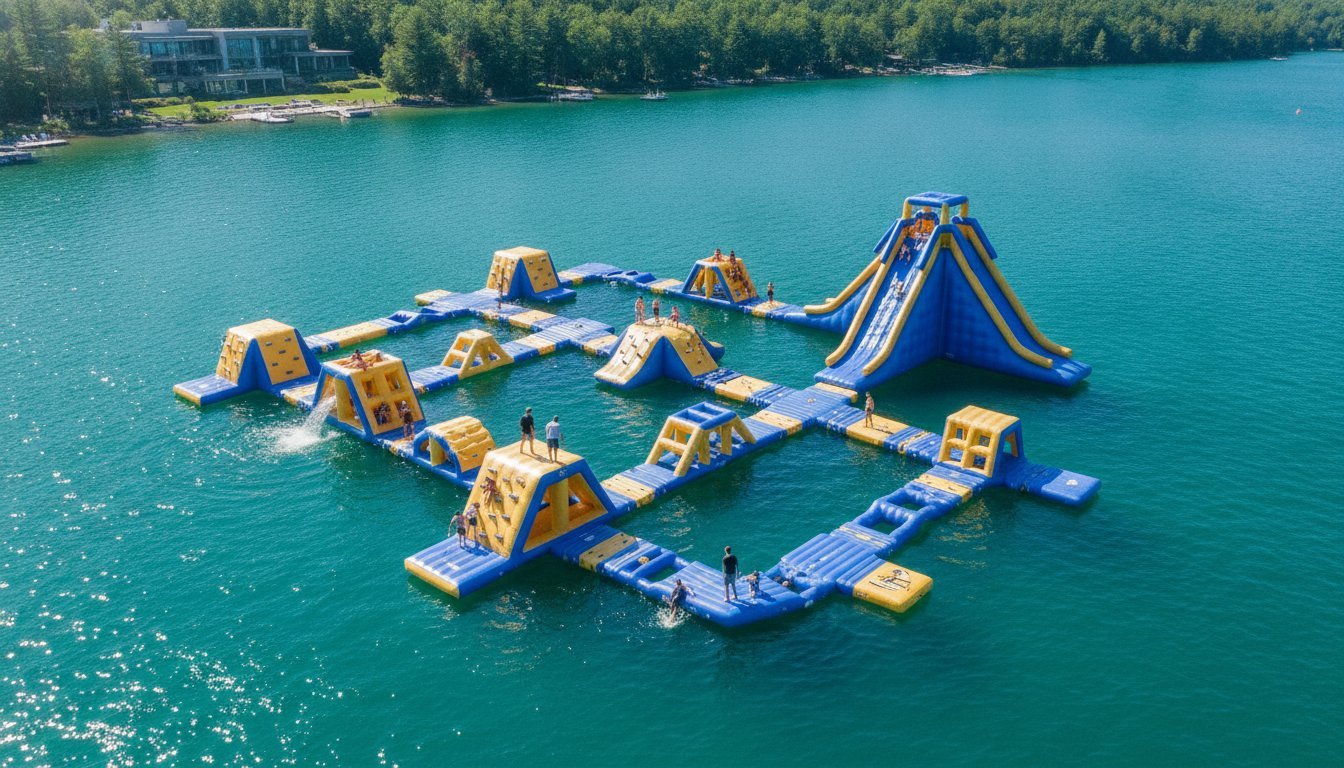
Why do some waterfront operators realize a full return on investment in a single week while others struggle to break even after three years? The difference often comes down to how you calculate and execute your commercial inflatable water park ROI from day one. You already know that your waterfront is an underutilized asset, but the fear of seasonal slumps and the nightmare of high labour costs for setup can make any owner hesitate. It is frustrating to watch potential revenue drift away because you are worried about liability or stuck comparing commercial-grade assets to cheap residential toys that simply won’t last.
Success in this industry isn’t about finding the lowest price point; it is about engineering a high-capacity destination that processes guests efficiently. We will show you exactly how to calculate your payback period, slash your operational headaches, and leverage custom designs to build a park that scales as fast as your demand. From understanding the 2026 safety standards to choosing money-earning monster slides, this guide provides the blueprint for turning your lake or resort into a premier profit centre.
Key Takeaways
- Master the pragmatic formula to calculate your commercial inflatable water park ROI by balancing initial investment against hourly guest throughput and seasonal revenue.
- Uncover the power of “Anchor Attractions” like the world’s largest monster slides to drive massive ticket demand and turn passive waterfronts into high-energy destinations.
- Safeguard your profit margins by implementing professional setup protocols and on-site technician training that minimize liability and maximize equipment lifespan.
- Start smart with turnkey solutions like the Campers Starter Park to ensure a rapid payback period while maintaining a clear path for future modular expansion.
- Eliminate the middleman and leverage direct access to world-class custom design to build a park that dominates your local market from day one.
The Revenue Potential of Commercial Floating Water Parks
Imagine your waterfront not as a scenic backdrop, but as a high-velocity engine for capital growth. Maximizing your commercial inflatable water park ROI starts with recognizing that these installations are sophisticated B2B assets, not just colourful summer attractions. In 2026, the market has shifted decisively. Guests no longer want to simply look at the water from a distance; they want to conquer it. This transition from passive viewing to active engagement is the foundation of a robust business model. When you install a professional floating park, you aren’t just buying PVC. You are acquiring a dedicated revenue centre that drives primary ticket sales and triggers massive secondary spend on food, beverages, and merchandise. Many operators maximize this by installing professional outdoor kitchen islands from The Pinnacle Patio to serve hungry guests right at the water’s edge.
The “Amenity Effect” is a powerful force for resort and campground owners. Professional aqua parks often see a direct correlation with increased nightly rates and higher occupancy during shoulder seasons. It transforms a standard stay into a destination experience that families prioritize. When children are engaged and safe, parents book longer stays. This increases the lifetime value of every guest who walks through your gates, turning a single visit into an annual tradition.
The Shift from Lakefront to Profit Centre
The demand for interactive outdoor recreation is surging. Across North America, the “staycation” and RV park trends have created a captive audience looking for premium thrills close to home. Unlike fixed wooden or concrete structures, floating attractions offer unparalleled flexibility and speed to market. They bypass many of the permanent construction permitting hurdles that can stall development for years. You can scale your park as demand grows, adding modular pieces in 3m, 5m, or 10m lengths to keep the experience fresh every season. Since the history of the inflatable attractions industry began, the technology has evolved from simple backyard bounce houses into massive, engineered floating obstacle courses capable of processing hundreds of users per hour. This throughput is the heartbeat of your profitability.
Commercial Resort Quality vs. Residential Toys
Don’t let a low price tag fool you. In the world of commercial recreation, “cheap” is the most expensive mistake you can make. Material thickness and seam reinforcement are not just technical specs; they are critical financial metrics. A thin, residential-grade float will fail under the pressure of 200 daily visitors, leading to catastrophic downtime and lost ticket sales. “Commercial grade” is the intersection of rigorous safety standards, such as the EN ISO 25649-6:2026 requirements, and long-term structural durability designed for high-intensity use. When your park stays inflated and operational, your revenue remains consistent. Every hour of maintenance-related downtime is a direct hit to your bottom line. Investing in B2B resort-quality assets ensures your investment works as hard as you do.
Calculating Your ROI: The Payback Period Formula
Numbers don’t lie, and in the world of waterfront development, your commercial inflatable water park ROI is a cold, hard calculation of throughput versus overhead. To realise a full return on your investment, you must look past the initial purchase price and analyse the total capital outlay. This includes the equipment itself, international shipping logistics, and the professional installation of anchoring systems. For a medium-sized park with a capacity of 80 to 150 people, equipment costs typically range from $40,000 to $80,000. While this sounds like a significant commitment, the revenue potential is staggering. With an average North American ticket price of $20 per hour, a 100-person capacity park attracting 300 visitors daily can generate upwards of $540,000 in gross revenue over a standard 90-day season. This is why many disciplined operators see their entire initial investment paid back within the first 12 to 18 months of operation.
Operating expenses are the next variable in your success formula. Smart operators aim to keep these costs under 35% of gross revenue. This budget must cover seasonal staffing, routine maintenance, and liability insurance, which generally costs between $5,000 and $15,000 annually. You also need to factor in annual permit fees, which can vary from $40 to over $500 per unit depending on your specific state or territory. By keeping a tight grip on these margins, you ensure that your waterfront remains a profit powerhouse rather than a liability. To start planning your specific layout, you can explore our custom floating aqua park designs to see how we maximise every square metre of your water.
Revenue Modelling: Capacity vs. Ticket Price
Your revenue is a direct reflection of your capacity and “Users Per Hour” (UPH). Modular obstacle pieces in 3m, 5m, and 10m lengths allow you to scale your capacity precisely as your guest demand grows. By utilising high-capacity “Anchor Attractions” like our money-earning monster slides, you reduce guest wait times and increase ticket volume. High throughput means more guests through the gate without increasing your staffing footprint, which is the fastest way to accelerate your payback period. Many high-capacity attractions can actually realise a full return in as little as 3 to 6 months during a peak season.
Total Cost of Ownership (TCO) Analysis
True profitability is measured over the long term, not just the first summer. B2B commercial resort quality equipment is designed with a 5-year lifespan in mind, utilising heavy-duty 0.9mm PVC with double-welded seams. Understanding the differences between commercial vs residential inflatable water parks is essential because it dictates your long-term maintenance costs. Cheap residential toys fail under commercial stress, leading to lost ticket sales and constant repairs. By investing in professional-grade assets and utilising on-site technician training, you reduce seasonal labour costs and ensure your park stays inflated and earning for years to come.
Strategic Design: Driving ROI Through Customization
Off-the-shelf kits are for hobbyists. To truly dominate your market and maximize commercial inflatable water park ROI, your layout must be an intentional piece of revenue engineering. A generic park is a missed opportunity. Customization allows you to organize your park based on your specific shoreline length, water depth, and guest demographics. If you have a deep-water section, you can install massive vertical elements that shallower venues simply cannot touch. This site-specific strategy ensures you aren’t just another lakefront attraction; you are a destination that commands premium ticket prices.
Design is the silent salesman of your waterfront. When you tailor the experience to the unique physical characteristics of your location, you minimize safety risks and maximize the usable footprint. A park designed for a calm lake will look and perform differently than one designed for a coastal resort with tidal shifts. By working directly with a designer who understands these nuances, you eliminate the guesswork and ensure every square metre of your investment is working to generate profit.
The World’s Largest Money-Earning Monster Slides
The visual impact of inflatable monster water slides is your most powerful marketing tool. These aren’t just slides; they are visual beacons that draw guests from kilometres away. In 2026, guest experience is often measured in “Instagrammability.” A monster slide creates a viral social media moment that serves as free advertising for your resort. The psychology is simple: the bigger the thrill, the higher the perceived value of the ticket. While smaller interactive pieces like iceberg climbers provide variety, the monster slide is the engine that drives high-volume throughput and justifies your premium pricing model.
Modular Layouts for Scalable Growth
Growth should be a strategy, not a gamble. For many campground owners, the Campers Starter Park is the perfect entry point to prove the business model with a lower initial capital outlay. Once the initial revenue starts flowing, you can scale up by adding 3m, 5m, or 10m modular pieces to expand your capacity. This modularity is a massive financial advantage. It allows you to rearrange your entire park layout every season, keeping the experience fresh for repeat guests without buying a single new asset. Effective custom inflatable water park design prioritizes guest flow through interactive running tracks. By creating a continuous loop, you eliminate bottlenecks and “dead ends” that frustrate guests and slow down your hourly throughput. Happy guests stay longer, spend more on secondary services, and book their return visit before they even leave the beach.
Operational Excellence: Protecting Your Profit Margins
Efficiency is the final frontier of your commercial inflatable water park ROI. You can have the most visionary design in the world, but if your operations are sloppy, your profit will leak out through high insurance premiums and avoidable downtime. Safety isn’t just a regulatory checkbox. It is a financial strategy. Verified data shows that improper anchoring is responsible for 35% of all lawsuits in the inflatable industry. By adhering to global benchmarks like ASTM F2374-22 and EN ISO 25649-1:2024, you aren’t just protecting your guests; you are protecting your equity. Don’t leave your investment to chance. A well-engineered park layout also streamlines your labour requirements. When guest flow is intuitive and bottlenecks are eliminated, you need fewer lifeguards to monitor the same number of users, directly lowering your seasonal overhead.
On-Site Technician Training and Liability
Basic manuals are a starting point, but they don’t replace hands-on expertise. Our on-site technician training is designed to turn your seasonal staff into a high-performance team that understands the mechanics of a successful waterfront. They learn the nuances of professional anchoring and the critical importance of maintaining precise inflation levels as temperatures fluctuate throughout the day. This competence directly impacts your hourly throughput. When your staff are confident in their daily inspections and guest management, the park runs like a Swiss watch. This reduces the risk of operational hiccups that can shut down a monster slide for hours, which costs you thousands in potential ticket sales. To ensure your team is ready for opening day, book your on-site technician training as part of your implementation plan.
Seasonal Maintenance and Storage
Your assets need to perform at peak capacity for five years or more to maximize their value. This requires a disciplined approach to the off-season. Commercial grade UV resistance is mandatory for North American sun exposure to prevent material degradation and keep your colours vibrant. Beyond the sun, how you handle the teardown matters. Quick-repair techniques are vital for maintaining momentum; your team should be able to handle minor seam issues on-site without waiting for a third-party contractor. Every day your park is out of the water is a day your commercial inflatable water park ROI takes a hit. Proper cleaning, drying, and climate-controlled storage are the final steps in ensuring your equipment is ready to earn the moment the ice melts next spring. High-quality PVC is an investment that demands respect to yield its full financial potential.
The Aqua Play Parks Advantage: A Partner in Your Success
Stop guessing. Start earning. When you partner with Aqua Play Parks, you gain direct access to a Canadian designer with 35 years of boots-on-the-ground experience. We don’t just ship boxes; we build businesses. By eliminating the middleman and favouring direct B2B manufacturing, we save you thousands in markups that would otherwise drain your commercial inflatable water park ROI. This is about more than just PVC and pumps. It is about a comprehensive success package that spans from the first conceptual sketch to on-site technician training. You need a partner who understands the pragmatic reality of seasonal operations and the bold vision required to dominate a market.
We believe in transparency and impact. Our modular systems are designed to be intuitive, durable, and, above all, profitable. From the world’s largest monster slides to specialized obstacle pieces, every component we offer is a result of decades of refinement. We don’t just provide a product; we provide the blueprint for your waterfront’s transformation into a premier destination. When you work with us, you are working with experts who are as invested in your seasonal success as you are.
Why a “Starter Package” is the Smartest ROI Move
The smartest way to enter this market is with a proven model. For many RV parks and smaller lakefront resorts, a massive initial layout isn’t necessary to prove the concept. Our water park starter package for campgrounds is specifically engineered as a low-risk entry point. These configurations aren’t random. They are calculated to maximize ticket sales from day one by focusing on high-energy engagement in a compact footprint. You get the quality of a mega-resort with the agility of a local operator. It is the most efficient way to realize a rapid payback period while building the guest base necessary for future expansion.
Scaling Your Vision for 2026 and Beyond
Your first season is just the beginning. Use those initial profits to fund your expansion, adding modular pieces that keep your competition guessing. In 2026, the venues that win are the ones that evolve. You can rearrange your layout, add a monster slide, or extend your running tracks to keep the “wow factor” alive for repeat guests. This scalability ensures your commercial inflatable water park ROI continues to climb year after year. Don’t let your waterfront sit idle for another summer. Consult with our design team today and let’s turn your vision into a high-revenue reality.
Secure Your Waterfront Legacy in 2026
Your lakefront is a sleeping giant. It’s time to wake it up. We have established that the most successful operators don’t just buy equipment; they invest in high-capacity revenue centres that command attention. By prioritizing B2B commercial resort quality and implementing rigorous on-site technician training, you eliminate the operational risks that sink lesser businesses. You now have the blueprint to turn a standard waterfront into a high-energy destination where guest throughput and safety work in perfect harmony.
Success requires a partner who understands the stakes. With direct access to a veteran Canadian designer, you ensure your commercial inflatable water park ROI is built on a foundation of 35 years of industry expertise. Don’t settle for off-the-shelf solutions when your site demands a custom strategy. It’s time to stop watching from the shore and start leading the market. Calculate Your Waterfront Revenue Potential with our Design Team and prepare for your most profitable season yet. The water is waiting. Let’s build something legendary together.
Frequently Asked Questions
What is the typical payback period for a commercial inflatable water park?
Most commercial operators achieve a full return on their investment within 12 to 24 months of operation. High-capacity attractions, such as our monster slides, can see an even faster recovery, sometimes within a single 90-day peak season. Your specific commercial inflatable water park ROI depends on your local ticket pricing and guest throughput efficiency.
How much revenue can a floating aqua park generate per season?
A medium-sized park with a 100-person capacity can generate approximately $540,000 in gross seasonal revenue over 90 days. This model assumes an average ticket price of $20 per hour and a daily draw of 300 visitors. High-margin ancillary sales from food, merchandise, and party packages often add another 25% to 35% to these total gross figures.
Do I need a large lake to see a return on investment?
You don’t need a massive body of water to build a profitable destination. Strategic custom design allows us to maximize “Revenue per Square Metre” by tailoring the layout to your specific shoreline and water depth. Even smaller waterfronts at campgrounds or private resorts can drive significant profit by utilizing compact, high-energy obstacle courses and modular running tracks.
What are the main operational costs associated with running an inflatable park?
Primary expenses include seasonal staffing, liability insurance, and annual operating permits. Insurance for a commercial park typically ranges from $5,000 to $15,000 annually, while permit fees vary by province or state. Successful operators aim to keep total operating expenses under 35% of gross revenue to protect their long-term commercial inflatable water park ROI.
How does custom design impact the ROI compared to standard kits?
Custom design eliminates the bottlenecks and “dead ends” found in standard off-the-shelf kits, which directly increases your hourly throughput. By engineering a layout that includes viral “Instagrammable” moments and high-energy flow, you justify premium ticket prices and encourage repeat visits. Standard kits often fail to account for site-specific safety and depth requirements, leading to avoidable downtime.
Is on-site technician training really necessary for my staff?
Professional training is an essential business safeguard that protects both your guests and your profit margins. Since improper anchoring accounts for 35% of all industry-related lawsuits, having a team trained in ASTM and ISO standards is your best defence against liability. Competent staff also ensure the park is set up and inspected correctly every day, preventing mid-season mechanical failures.
What is the lifespan of commercial-grade inflatable water park equipment?
B2B commercial resort quality equipment is engineered to last five years or more with proper maintenance and off-season storage. This durability is achieved through the use of heavy-duty 0.9mm PVC and double-welded seams. In contrast, low-quality residential toys often fail within a single season of commercial use, resulting in a total loss of investment and lost ticket revenue.
Can I start with a small park and expand it later as revenue grows?
Yes, starting with a modular “starter park” is a very effective strategy for managing initial capital outlay. Our systems use 3m, 5m, and 10m modular pieces that allow you to scale your park annually using your first-season profits. This approach lets you prove the business model at your specific location before committing to a mega-park installation.
Leave a Reply