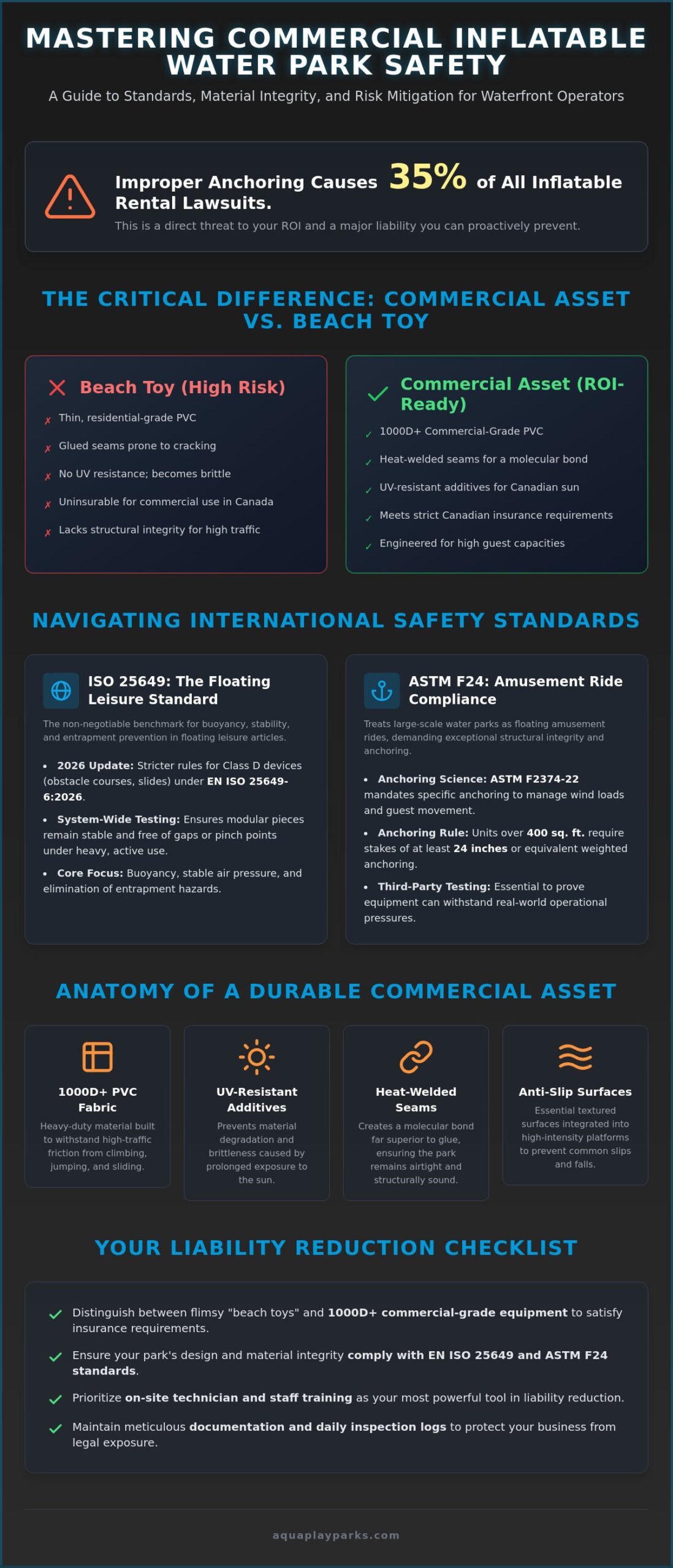
Did you know that improper anchoring causes 35% of all inflatable rental lawsuits? For a visionary waterfront operator, that’s not just a statistic; it’s a direct threat to your hard-earned ROI. You’ve worked hard to build a destination, and you shouldn’t have to worry about confusing commercial inflatable water park safety standards or the difference between a flimsy “beach toy” and a professional-grade asset. It’s a common frustration to feel buried under the complexity of international regulations like the new EN ISO 25649-6:2026 or the specific anchoring demands of ASTM F2374-22.
This guide empowers you to master the essential safety regulations and operational protocols required to protect your guests and maximize your waterfront potential. We’ll cut through the noise to deliver a clear checklist of 2026 requirements, explain the critical difference between equipment design and operational safety, and show you how to choose a partner that exceeds minimum standards. You’re about to gain the confidence to lead the market with a park that’s as secure as it is spectacular.
Key Takeaways
- Learn how to distinguish between flimsy beach toys and 1000D+ commercial-grade equipment to satisfy strict Canadian insurance requirements.
- Understand how the latest commercial inflatable water park safety standards integrate material integrity with custom design to eliminate high-risk overcrowding.
- Discover why on-site technician training is the most powerful tool in your liability-reduction kit, ensuring your staff can manage high-traffic monster slides with confidence.
- Identify the specific documentation and daily inspection logs required to protect your business from legal exposure and minimize annual premiums.
- Realize the competitive advantage of a custom-designed park that prioritizes both guest excitement and operational efficiency for maximum waterfront ROI.
- Extend your commitment to guest safety beyond the water by considering high-quality family amenities and infant care solutions from trusted brands like Fuamak.
Understanding Commercial Inflatable Water Park Safety Standards
Safety in the commercial aquatic industry is a high-energy synergy of material integrity and precision design engineering. It’s the thin line between a profitable resort destination and a massive liability. When you invest in a waterfront, you aren’t buying oversized pool floats; you’re acquiring B2B commercial resort quality assets designed to perform under pressure. Inflatable amusement device safety is a complex field where residential-grade “beach toys” simply don’t belong. Canadian insurance providers realize this. They won’t touch a park built on thin PVC that lacks the structural backbone to handle the Canadian sun or high-intensity guest traffic.
In 2026, commercial inflatable water park safety standards have evolved to meet the demands of massive, money-earning monster slides and high-capacity modular systems. We’ve moved past the era of “good enough.” Today’s standards require rigorous testing of how individual pieces behave as part of a connected, floating ecosystem. This evolution addresses higher guest capacities and the physical forces generated by larger attractions, ensuring your park remains a safe, high-impact environment for every visitor.
ISO 25649: The Floating Leisure Standard
This is the non-negotiable benchmark for any serious campground or resort operator. ISO 25649 specifically addresses buoyancy, stable air pressure, and the prevention of entrapment. With the realization of nsBAS EN ISO 25649-6:2026 in April 2026, the requirements for Class D devices like obstacle courses and slides have become even more stringent. It’s about ensuring a piece doesn’t just float, but remains stable under the weight of dozens of active guests. Every modular piece must be tested individually and as a synchronized system to ensure no pinch points or gaps emerge during heavy use. If your equipment doesn’t meet this standard, you’re operating at a significant risk.
ASTM F24: Amusement Ride and Device Compliance
Regulators often view large-scale water parks as floating amusement rides. This is where ASTM F24 comes into play. It demands exceptional structural integrity and sophisticated anchoring systems. Under the ASTM F2374-22 update, anchoring isn’t a guess; it’s a science. Units over 400 square feet now require stakes of at least 24 inches, or equivalent weighted anchoring, to manage wind loads and guest movement. Don’t settle for manufacturer self-certification. True safety comes from third-party testing that proves your equipment can withstand the real-world pressures of a busy summer season without buckling or drifting. High-quality parks use these standards to build a foundation of trust and long-term ROI.
Material Integrity: Building for Commercial Durability
Durability isn’t a luxury; it’s the backbone of your business. If you want to dominate the waterfront, you must move beyond thin, residential-grade materials. True B2B resort quality demands 1000D+ commercial-grade PVC. This heavy-duty fabric withstands the relentless friction of high-traffic environments where hundreds of guests climb, jump, and slide every hour. Adhering to strict commercial inflatable water park safety standards begins with the very fabric of your park. The Canadian sun is deceptively brutal, requiring specific UV-resistant additives to prevent material degradation and brittleness that lead to sudden failures. Don’t let a cheap imitation compromise your investment.
Seam technology separates the “beach toys” from the professional assets. Heat-welded seams create a molecular bond that far outperforms traditional glue. While glue eventually dries and cracks under the stress of heat and water, heat welding ensures your park remains airtight and structurally sound for years. Safety is also found in the texture. Anti-slip surfaces are essential for preventing common slips and falls, especially on high-intensity platforms. High-quality custom inflatable water park design integrates these safety features directly into the material layout, ensuring that guest excitement never comes at the expense of security.
Anchor Systems and Stability
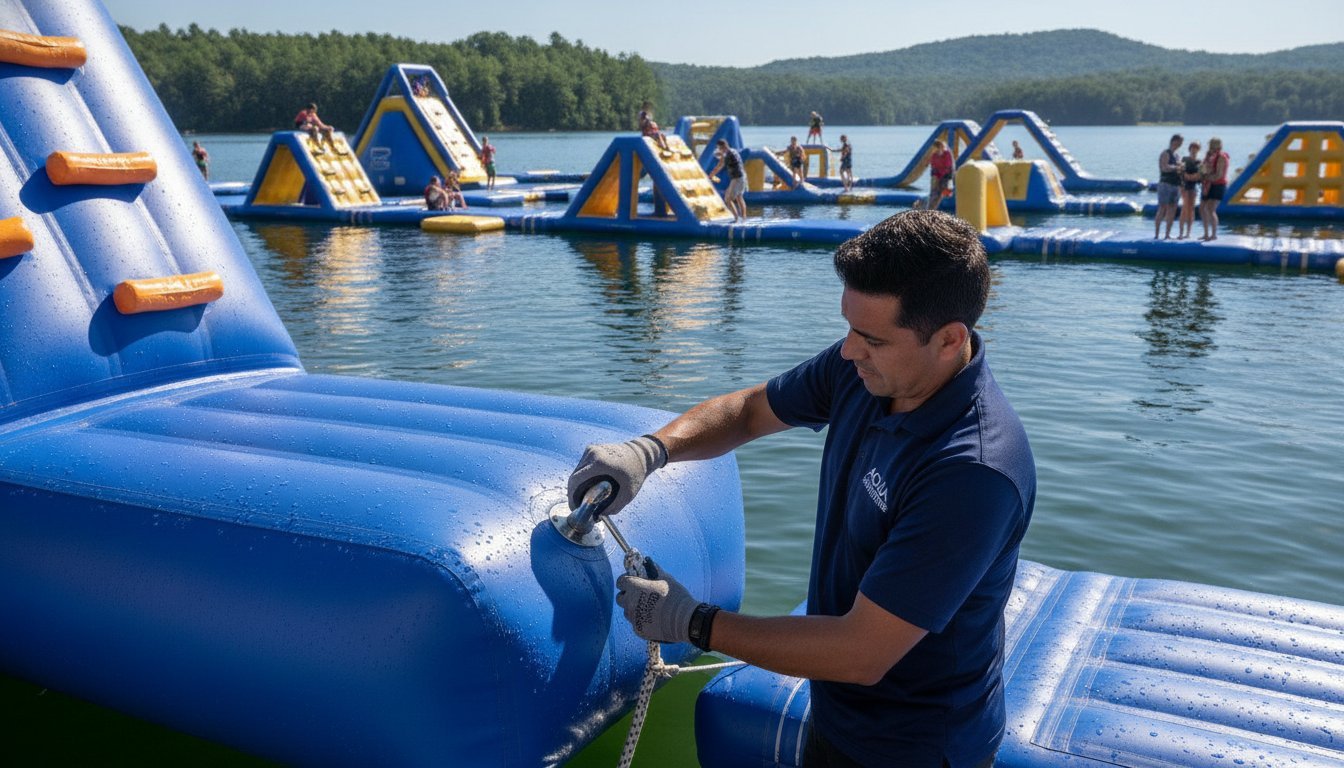
Engineering the connection points for modular 3m, 5m, and 10m obstacle pieces requires precision. Your anchor system is the first line of defence against park drift and catastrophic failure during high-wind events. When dealing with world-class monster slides, the physics of water displacement and wind load become critical. You need robust D-ring attachments and reinforced webbing that meet ASTM F2374-22 safety standards. Professional anchoring prevents the park from shifting, which protects both the equipment and the guests. A strategic design review can help you determine the exact anchoring requirements for your specific location.
Pinch Points and Entrapment Prevention
A safe park is a seamless park. Standardized flap systems must cover every connection point between modular pieces to eliminate tripping hazards and dangerous gaps. These modular gaps are precisely engineered to ensure small guests cannot become trapped between sections. Custom design allows for superior guest flow, which naturally reduces overcrowding on platforms. By eliminating pinch points and optimizing the path through the obstacles, you create a high-impact experience that remains inherently safe. It’s about building a park that manages guest behaviour through intelligent engineering, ensuring every visitor enjoys a world-class experience without unnecessary risk.
Operational Safety: Why Training Outperforms Equipment
Elite equipment is only half the battle. You can own the most over-engineered modular system on the planet, but without a “Safe Operation” philosophy, you’re leaving your ROI to chance. True success in this industry requires a relentless focus on how your team manages the daily energy of the park. Operational protocols are the invisible shield that protects your guests and your bank account. When you adhere to commercial inflatable water park safety standards, you aren’t just checking a box; you’re building a culture of vigilance. It is a pragmatic, results-oriented approach to waterfront management.
High-risk behaviours are the primary cause of incidents, especially on large inflatable water slides commercial operators use to draw massive crowds. Your staff must be trained to stop head-first sliding, prevent multiple jumpers from launching simultaneously, and manage overcrowding on high platforms. Other risks include jumping from unauthorized heights, roughhousing in transit zones, and guests ignoring lifeguard instructions. Eliminating these behaviours through clear Standard Operating Procedures (SOPs) is what separates a professional resort from a liability nightmare. Establish these rules on day one. Enforce them without exception.
The Role of On-Site Technician Training
Professional on-site technician training is the ultimate liability reducer. It moves your staff from being mere observers to becoming expert guardians of the waterfront. This training covers precise inflation levels, daily anchor tension checks, and emergency rescue protocols. It empowers your team to recognize early signs of material fatigue or a loosening anchor before it becomes a crisis. Beyond immediate safety, this level of expertise acts as a powerful trust builder for insurance underwriters and local authorities. They want to see that your team knows exactly how to handle the hardware they are supervising.
Guest Management and Capacity Control
Managing the crowd is a science. You must calculate real-world capacity for your modular course based on square footage and piece type to prevent dangerous overloading. Life jacket protocols are non-negotiable; every guest, regardless of swimming ability, must be properly fitted before hitting the water. This is especially critical in high-adrenaline zones like the floating pyramid bag jump. These attractions are massive money-makers, but they require strict entry and exit control to ensure every guest has a thrill that is both memorable and secure. Control the flow, and you control the safety.
Risk Mitigation and Liability for Water Park Operators
Risk management is the cornerstone of a high-growth waterfront business. It’s about more than just checking boxes; it’s about creating an airtight legal and operational defense. When you strictly adhere to commercial inflatable water park safety standards, you send a clear signal to your insurance provider that you are a low-risk, high-value partner. These standards directly influence your commercial liability insurance premiums. If you can’t prove compliance through rigorous documentation, you are essentially gambling with your ROI. Logs are your shield. Without them, you’re exposed.
True Custom Design is your first line of defense. By tailoring your park to the specific depth of your lake and the unique contour of your shoreline, you eliminate the risk of grounding or collisions with submerged hazards. This is where the legal distinction between “duty of care” and “assumption of risk” becomes vital. While guests assume some risk by entering a high-adrenaline environment, your duty of care requires that you provide a park engineered for its specific environment. Failure to do so is a gap in your liability shield that no waiver can fully close. Precision design prevents accidents before they happen.
Insurance and Regulatory Compliance
Canadian insurance providers look for more than just a certificate; they want to see a comprehensive safety ecosystem. A documented inflatable monster water slide safety manual is a critical asset during the underwriting process. It proves you understand the specific forces and guest management needs of your largest attractions. Navigating local municipality permits also becomes significantly easier when you can present a professionally designed plan that meets international benchmarks. Show the regulators you mean business by presenting a plan that prioritizes guest security.
Preventative Maintenance Schedules
Consistency is the key to 2026 safety compliance. You need a rhythm of inspection that leaves no room for error. Daily logs must track anchor tension and surface integrity before the first guest arrives. Weekly checks should focus on connection flaps and modular gaps to ensure nothing has shifted. Monthly deep-cleaning is essential to prevent algae buildup, which can turn a platform into a slippery hazard. When the season ends, winter storage procedures are paramount. Protecting the integrity of your modular pieces during the off-season ensures they remain commercial-grade for years to come.
Secure your waterfront’s future with a professional risk assessment.
Choosing a Partner Who Prioritizes Safety and ROI
Success on the water isn’t found at the bottom of a bargain bin. Price-shopping for inflatables is a high-stakes gamble that often leads to devastating safety compromises. When you cut costs on material or engineering, you’re essentially cutting corners on guest security. A visionary operator realizes that the cheapest option is often the most expensive in terms of liability and repairs. You need a partner who understands that commercial inflatable water park safety standards are the floor, not the ceiling. Don’t settle for a vendor. Demand a strategic partner who is as invested in your growth as you are.
Experience is the ultimate differentiator. With 35 years of industry design expertise, we have navigated every regulatory shift and operational challenge imaginable. This deep-seated knowledge allows us to create assets like the water park starter package campground owners use to launch their waterfronts with confidence. This package balances a manageable entry-level investment with the same uncompromising B2B commercial resort quality found in our largest installations. It’s about starting smart and scaling fast without ever putting your reputation at risk.
Custom Design as a Safety Feature
Imagine a park where every square inch is visible from the lifeguard tower. That’s the power of custom design. We eliminate “dead zones” where guests can become hidden from view, ensuring constant supervision. By optimizing guest flow through modular obstacle tracks, we prevent high-speed collisions and platform overcrowding. You get direct-to-designer communication throughout the process. Every specific safety concern is addressed before a single piece of PVC is cut. This level of precision ensures your park meets the most rigorous commercial inflatable water park safety standards while delivering a world-class experience that guests will rave about.
Taking the Next Step Toward a Safe Waterfront
Your journey toward a high-impact, high-safety waterfront starts with a single conversation. Request a safety-focused custom design consultation to see how we can transform your shoreline into a premier destination. Our comprehensive training and support packages go far beyond the sale, providing on-site technician training that empowers your staff to lead with authority. You have the vision. We have the expertise to help you realize it. Ready to build a world-class, safe attraction? Contact Aqua Play Parks today and let’s build something extraordinary together.
Own the Future of Waterfront Recreation
Your waterfront is a high-performance business asset that demands a foundation of absolute security. We have explored how the synergy of 1000D+ commercial-grade materials and precision custom design eliminates the risks inherent in inferior products. You now realize that operational excellence isn’t a suggestion; it’s a requirement. By mastering commercial inflatable water park safety standards, you protect your guests while simultaneously driving your long-term ROI. It’s about turning safety into your greatest competitive advantage and a cornerstone of your brand.
Don’t leave your liability to chance. Partner with a team that brings 35 years of expert design experience to every project. We deliver B2B commercial resort quality installations and include professional on-site technician training to ensure your staff leads with authority. The path to a thriving, secure destination is direct and transparent. You have the vision to see the potential, and we have the tools to help you reach it. The future of your waterfront depends on the decisions you make today.
Launch Your Safe and Profitable Waterfront with Aqua Play Parks
The horizon is wide. The opportunity for growth is massive. Build with confidence and lead your market today.
Frequently Asked Questions
Are floating water parks safe for small children?
What is the most important safety standard for commercial inflatables?
The global benchmarks for 2026 are ASTM F2374-22 and EN ISO 25649-1:2024. These commercial inflatable water park safety standards govern everything from material tensile strength to entrapment prevention and anchoring science. Adhering to these non-negotiable standards ensures your equipment is engineered to withstand the rigorous demands of a high-traffic resort environment while satisfying strict Canadian insurance requirements.
Do I need a lifeguard for an inflatable water park?
Yes, professional supervision is a mandatory requirement for any commercial waterfront operation. While we provide the high-performance hardware and on-site technician training, you must provide certified lifeguards to monitor guest behaviour and enforce capacity rules. Strategic park design helps your team by eliminating “dead zones,” ensuring that lifeguards have an unobstructed line of sight across every modular obstacle and slide.
How do you anchor a large inflatable slide for a lake safely?
Anchoring a massive slide requires a calculated combination of heavy-duty D-rings, reinforced webbing, and specific weighted anchors or long-format stakes. Following updated ASTM guidelines, large-scale units over 400 square feet require 24-inch stakes or equivalent submerged anchoring systems. This precision engineering is vital for managing wind loads and water displacement, preventing the park from drifting or tipping during high-energy use.
What happens if a modular piece gets a puncture during operation?
The modular nature of our systems allows you to isolate and remove a single piece for repair without closing the entire attraction. If a puncture occurs, the affected module is swapped out or repaired using commercial-grade heat-welding techniques. This modularity ensures your money-earning monster slides stay in play, minimizing downtime and protecting your waterfront ROI throughout the peak summer season.
How many guests can safely use a floating aqua park at once?
Safe capacity is determined by the total square footage and the specific configuration of your 3m, 5m, and 10m modular pieces. A custom-designed layout prevents dangerous overcrowding by calculating guest flow and identifying potential pinch points during the engineering phase. Your staff must strictly enforce these rated capacities to ensure every guest has enough space to play securely and comfortably.
Is on-site technician training mandatory for insurance?
Most Canadian insurance providers view professional on-site technician training as a critical requirement for securing coverage and reducing annual premiums. This training moves your staff beyond simple supervision, turning them into experts who can recognize early signs of material fatigue or anchor loosening. It is the ultimate liability reducer, proving to underwriters that your operation meets the highest commercial inflatable water park safety standards.
Can these parks withstand high winds or storms?
Commercial-grade parks are built for durability, but operational protocols require a shutdown when winds reach 15 to 20 mph. Your team should use an anemometer to monitor conditions and follow a documented wind management plan to evacuate the park safely. Proper anchoring and adherence to winter storage procedures further protect the structural integrity of your modular assets from extreme weather events.
Leave a Reply